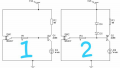
The second circuit is constant-current.
The first is not.
If you want to limit the current through the diode to a specific value than you would use the second circuit.
The second circuit is constant-current.
The first is not.
If you want to limit the current through the diode to a specific value than you would use the second circuit.
D4 and D5 are being used to more-or-less fix the voltage between the positive supply rail and the base of the transistor at two "diode drops." Because the base-emitter voltage of the transistor is also a "diode drop" (around 0.6 to 0.7 for a silicon PN junction operating at moderate current at room temperature), the voltage across R3 is one diode drop - let's say 0.7 volts. If the voltage across a resistor is fixed, the current through it must be fixed. Most of the current through the resistor is collector-emitter current though the transistor, and therefore through the LED. A small part of the current in the resistor is transistor base current. If the transistor had infinite current gain, the base current would be zero. With lots of common small transistors the ratio current gain will be in the range of 50 to a few hundred, so the error due to base current is quite small. With this circuit, if the supply voltage is varied, the voltage across R3 stays very nearly the same (small change due to change in diode voltage as the current through it changes, but not too significant for purpose). Almost 100% of the supply voltage change appears between the collector and emitter of the transistor, instead of across the resistor or the LED. It isn't a perfect constant-current driver, but it is plenty good enough to the visually apparent LED brightness very nearly constant over a pretty wide supply voltage range.
Sometimes a circuit like this is made using a LED instead of D4 and D5.
There is no particular difference between a constant-current and a current-limit function.
The terms basically refer to how they are used since they function similarly.

 Facebook
 Google
 GitHub
 Linkedin