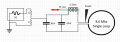
I have a radio engineering question: What works better in a tank circuit, a coil at its natural frequency that matches the incoming frequency or a coil within range of the incoming frequency?
Can you define what you mean by "works better"? The reason I ask is that the resonant frequency of a tank circuit depends on the capacitance of the capacitor in parallel as well as the parasitics. The Q of the tank circuit will depend on the series and parallel resistances. As you may begin to appreciate "works better" is not exactly a measurable quantity by any means.
For that you basically have to look at the magnitudes of the real and imaginary parts of the impedance. The real part is governed by the DC resistance of the wire and the ESR of the capacitor in parallel.
By your reference to "tank circuit" I am guessing that the coil is to be part of a transmitter circuit. The resistance of the coil as well as of the connections, has a big effect on the effective "Q" of a coil in a tuned circuit, especially at resonance. In transmitters and other power circuits with a resonant circuit, a very high "Q" factor will tend toward high currents flowing tn the tuned circuit. THAT can cause problems. The theoretical "Natural resonance" of a coil is from the assorted capacitance between the turns. Normally that is not an issue.
By your reference to "tank circuit" I am guessing that the coil is to be part of a transmitter circuit. The resistance of the coil as well as of the connections, has a big effect on the effective "Q" of a coil in a tuned circuit, especially at resonance. In transmitters and other power circuits with a resonant circuit, a very high "Q" factor will tend toward high currents flowing tn the tuned circuit. THAT can cause problems. The theoretical "Natural resonance" of a coil is from the assorted capacitance between the turns. Normally that is not an issue.
Transmitting on those frequencies for any distance requires a lot of power. They were used by the NAVY at one time to communicate with submarines underwater.
In general, resonant circuits tend to greater efficiency when the inductive and capacitive reactances are similar.
NO, I do not have the math to back that claim, it is what I heard from those more familiar with designing resonant circuits than I am.
Transmitting on those frequencies for any distance requires a lot of power. They were used by the NAVY at one time to communicate with submarines underwater.
In general, resonant circuits tend to greater efficiency when the inductive and capacitive reactances are similar.
NO, I do not have the math to back that claim, it is what I heard from those more familiar with designing resonant circuits than I am.

 Facebook
 Google
 GitHub
 Linkedin