What is the best way to wire a bunch of LED switches for a mock cockpit? Total amateur here

Thread Starter

BlairReeder

Joined Jan 25, 2018
5
I’m a handy guy in general and I totally out promised myself and need expert advice. I committed to build my 5 year old nephew a scaled down Star Wars X wing fighter toy for his birthday in August. It started out as a bed but has since morphed into a six foot mini x wing type of a project. My knowledge of woodworking will get me through the body of the fighter I feel confident. My idea for the cockpit is where I need help. I can wire basic a/c components around the house (lights, wall plugs, etc) but I have very limited experience with dc. I did some searching on the internet and was quickly overwhelmed with options I did not understand. So let me lay out a basic concept of my vision and any help/advice/links/products you can point me to would be immensely helpful.

I hope to fill the cockpit with led light switches, plain switches that turn on an led light, master power switch, possibly an led cockpit light at or two, etc. I only want the switches to light up, no motors or actuators needed (insert child imagination here). I would love to be able to plug it into 120v outlet rather than relying on battery power. I feel confident through small scale experimentation I can eventually figure out how to wire up the switches but the power source and exact switches I should buy are my biggest headache. Anything you can help with will be appreciated
 

dl324

Joined Mar 30, 2015
18,219
Welcome to AAC!

It will be safer for your nephew if you use a DC adapter so there won't be any high voltages to contend with.

Wiring up LEDs is fairly simple, but you'd be surprised by the number of posts on this site that make it seem otherwise.

LEDs need to have series resistors to limit LED current. Most LEDs are rated for 10-20mA with maximums for continuous current a bit higher. What matters more is the luminous intensity (brightness) you want.

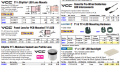
If you're going to mount the LEDs in an instrument panel, I've seen more hardware for 5mm diameter. This is from a current Jameco catalog:
upload_2018-1-25_12-3-56.png

Jameco has some red blinking LEDs on clearance.
https://www.jameco.com/z/MSB557DA-O...-with-39ohm-Resistor-80mcd-660nm_2186558.html

There are also some color changing LEDs.
 

BR-549

Joined Sep 22, 2013
4,928
BlairReeder.........It's not going to be easy for you. The internet makes it sound simple....but it's not........unless you have electronic background.

With a regular light bulb......you just connect/switch the correct voltage and the bulb works.

Not with a LED. You have to baby a LED. You have to contain the voltage AND the current.

When I first read your post.........I thought of the brightness of the LED. LEDs have a HARD brightness, especially on young eyes. And even brighter in the dark.

Take a few hours to learn how to contain these LEDs.....it won't take you long to figure out.

There is a textbook on this site. Or google something like LEDs for dummies.

Once you see how to control current and brightness......some wire, resistors, switches and a BATTERY is all you need. NO wall plugs.

To experiment the textbook(or internet) examples......you need a breadboard.....assorted resistors...a few pots.....batteries.....LEDs and data sheets. About 15 bucks. Oh...and the switches. Once you get the hang of it .......it's not too hard. It usually leads to other things.
 

Thread Starter

BlairReeder

Joined Jan 25, 2018
5
Welcome to AAC!

It will be safer for your nephew if you use a DC adapter so there won't be any high voltages to contend with.

Wiring up LEDs is fairly simple, but you'd be surprised by the number of posts on this site that make it seem otherwise.

LEDs need to have series resistors to limit LED current. Most LEDs are rated for 10-20mA with maximums for continuous current a bit higher. What matters more is the luminous intensity (brightness) you want.

If you're going to mount the LEDs in an instrument panel, I've seen more hardware for 5mm diameter. This is from a current Jameco catalog:
View attachment 144415

Jameco has some red blinking LEDs on clearance.
https://www.jameco.com/z/MSB557DA-O...-with-39ohm-Resistor-80mcd-660nm_2186558.html

There are also some color changing LEDs.

When I’ve seen what I believe to be a dc adapter for sale, all of them seem to have a proprietary adapter on the end for a plug on some type of device (a charger for something like an RC car for example). Do I just cut off the adapter and wire the dc adapter directly to say a main power switch, and then hook everything up to the main power switch? Or do they sell the adapters with bare wires and no proprietary plugs on the end?

Thanks for the light source of jameco. That’s very helpful
 

dl324

Joined Mar 30, 2015
18,219
When I’ve seen what I believe to be a dc adapter for sale, all of them seem to have a proprietary adapter on the end for a plug on some type of device (a charger for something like an RC car for example). Do I just cut off the adapter and wire the dc adapter directly to say a main power switch, and then hook everything up to the main power switch? Or do they sell the adapters with bare wires and no proprietary plugs on the end?
You don't give your location, but second hand stores should have them. A laptop adapter would give you around 18V at several amps to work with. If they have a proprietary connector, you can cut it off and replace it with a more standard connector. Leave the adapter as intact as possible. They've been UL approved (or equivalent in your locale) so meet standards for connecting to line voltage.

Going with a lower voltage, like 5V from a USB type adapter, will require you to have more current limiting resistors. With 18V, you could operate about a half dozen in series (depending on color).

Get some LEDs to see how much current you need for acceptable brightness. LEDs come in standard brightness with just a few mcd (millicandelas) of brightness, up to thousands of mcd.

If you're not handy at soldering, there are solderless connectors similar to the one shown shown on the Jameco catalog page (Jameco also has a large selection of adapters, but second hand will be more economical). With a 5 year old, you need to enclose all wiring and use switches that will take a lot of abuse.
 

ElectricSpidey

Joined Dec 2, 2017
3,312
Yes, you can just cut off the connector, but beware some supplies have a sense resistor placed there, and if you cut it off the thing might not work. A condition I learned the hard way.

And do your child’s eyes a favor and stick with diffused LEDs running at lower currents.
 

spinnaker

Joined Oct 29, 2009
7,830
When I’ve seen what I believe to be a dc adapter for sale, all of them seem to have a proprietary adapter on the end for a plug on some type of device (a charger for something like an RC car for example). Do I just cut off the adapter and wire the dc adapter directly to say a main power switch, and then hook everything up to the main power switch? Or do they sell the adapters with bare wires and no proprietary plugs on the end?

Thanks for the light source of jameco. That’s very helpful

Humm I have a few dozen of those power adapters and maybe 2 or 3 have proprietary connectors. Most use the 5.5mm plugs.

https://www.ebay.com/itm/5-x-DC-Pow...m=251152134807&_trksid=p2047675.c100005.m1851

You might want to look at a laptop adapter. They are typically 15V and fairly high current. The higher voltage will allow you to put more LEDs in series.
 

Thread Starter

BlairReeder

Joined Jan 25, 2018
5
Thanks to this site and it’s educational section I am learning a lot about wiring dc circuits, resistors, led lights, etc. Thanks to everyone who has contributed so far to my project. Your help and advice is awesome.
Couple of points as an update

I am going to spend some time in the educational section of this blog looking at DC circuits, led lights, resistors, various aspects of the circuit (ie. current, volts, amps, power) and associated calculations. I quickly discovered from a few basic LED YouTube videos that I didn’t know what I didn’t know. I see several DIY guides for 1-5 led lights but I had more light 30-50 lights/switches in mind. I need to understand the best way to wire that up (series, parallel) and the implications of each option. So I will study up on that

I appreciate the advice on dimming down the brightness of the bulbs. That seems very logical and was something I had not even considered. I saw a reference to a type of light sensitive resistor (?terminology) that seemed to decrease the brightness in low light and increase it in bright sunlight. I’m sure there are several ways to accomplish that and I will try and find out more.

Spinnaker, thanks for the power cord adapter/plug info. I think I misspoke by saying proprietary plug. I didn’t realize that 5.5mm was a standard. And the female end link you sent me from eBay is very useful. I forget that I’m talking to the people who design and build the systems I likely use everyday. I never thought to ask if I could by the other end to fit the power cords that are readily available. That actually would work well as a quick disconnect.

Again, thanks for all the tips. I want to educate myself and understand what I’m building and how it works and will put in some study time. If anyone thinks of anything else helpful or useful I’m all ears. And thank you all. When paper design begins to take form, I will certainly keep you all updated with photos.


Humm I have a few dozen of those power adapters and maybe 2 or 3 have proprietary connectors. Most use the 5.5mm plugs.

https://www.ebay.com/itm/5-x-DC-Power-Jack-2-1mm-Panel-Mount-Bulkhead-Free-Shipping/251152134807?_trkparms=aid=222007&algo=SIM.MBE&ao=2&asc=49924&meid=ffdb3517dabe4315b2281f504c509856&pid=100005&rk=4&rkt=6&sd=232288744026&itm=251152134807&_trksid=p2047675.c100005.m1851

You might want to look at a laptop adapter. They are typically 15V and fairly high current. The higher voltage will allow you to put more LEDs in series.
 

spinnaker

Joined Oct 29, 2009
7,830
To really do it right, consider a micro controller. You will easily be able to flash LEDs at different, rates, have sounds, sense different things. For example, you could have some LEDs that turn on with the wave of a hand, or maybe set off an alarm when a enemy fighter (you) approached the X wing fighter.

Or you can really go crazy and do something like this ;)


crutschow

Joined Mar 14, 2008
38,316
I need to understand the best way to wire that up (series, parallel) and the implications of each option.
Depending upon the supply voltages you can generally operate LEDs of the same type in series with one series resistor but they all will be on or off together.
If put in parallel, each LED should have its own series resistor.
 

DNA Robotics

Joined Jun 13, 2014
670
I say run everything on 12 volts. That way there are plenty of accessories that you can add to your project. Use a 1000 ohm resistor on each LED. You can get 100 of them for $1.62.
https://www.digikey.com/product-det...ronics-inc/CF14JT1K00/CF14JT1K00CT-ND/1830350
They will glow nicely with no strain and no math. A 1 amp power supply should run 83 of them.

LED Assortment, 3mm, 20each Red, Green, Yellow, Blue & White Sale: $2.95

Flashing RGB 5mm LED, Pack of 100 Sale: $4.95

30pc. Set 10mm LEDs 10ea. Red. Green. & Yellow Sale: $2.95

http://www.mpja.com/ usually has switches on sale cheap or try eBay.

Mini 3 Digit LED Battery meter, Input Powered, Blue Sale: $4.95

12 Volt Power Supply, 8.5A, 100W, Switching, Hengfu Sale: $21.69

Your imagination is the limit. Have fun!
 

Bernard

Joined Aug 7, 2008
5,784
Give a look at ALL ELECTRONICS- LED's for some suggestions on panel mount LEDs. 12V version- CAT # IND-160G or with resistor CAT # IND-13B. Or CLIPTITE / mounting clips in colors.
What will panel be made of ? Thick material is more difficult to mount LEDs on ?
Might consider some active displays like a circle or line of LED which advance with a push button switch.
I would use an AC adapter of 5 or 6 V @ 1 A give or take, ' found a mating panel mount socket at Radio Shack.
 

Thread Starter

BlairReeder

Joined Jan 25, 2018
5
I appreciate all the info. You guys are awesome. I’ve seen several responses for 5v power converter and several for 12v. As a novice who hasn’t yet grasped the full concept of dc power, and assuming an average of 4v per LED, there are A few wiring concepts to explore( please excuse the novice explanation).

Parallel, series wiring. I think one way adds the voltage of each light (3v + 3v+ 5v = 11 volts thus fewer lights per power source)and one way does not but “increases the power consumption/decreases the efficiency” (I’m sure that’s all screwed up). But am I on the right path. Whichever terminology is correct for the second option (I think series) is the best way to put 20 or 30 lights to one power source? If that’s true, what advantage would a 12v power source hold over say a 5 volt source if none of my bulbs pull more than 5v individually. Feel free to school me on my ignorance.

Also, the micro controller seems interesting. It also seems that I would need to learn c: programming language. I even saw a WiFi Alexa command which I could ask her to transfer to light speed. All sounds great but opens a huge box of stuff to learn. My initial focus will be on hard wiring the basics and getting a working prototype before introducing additional variables and potential complications. May be an upgrade at the end if I have time.

Thanks again for all the great input and links to products.
 

spinnaker

Joined Oct 29, 2009
7,830
Every LED has a voltage drop. If you wire LEDs in series and their total voltage drop exceeds the voltage applied then the LEDs won't light.

Likewise if you add them in parallel and your power supply cannot provide enough current.

It is always best to wire LEDs in series, if you can. If you wire in parallel and an LED gets damaged or burned out then the current consumed by that LED will flow through the remainders. Probbaly not a huge deal for the lower current LEDs bu the higher current will at the very least diminish their life.

There are ways around this by using something like an LED driver instead of resistors to limit the current. If you loss a "branch" of LEDs, the device will react anf adjust the current accordingly.
 

crutschow

Joined Mar 14, 2008
38,316
(I think series) is the best way to put 20 or 30 lights to one power source? If that’s true, what advantage would a 12v power source hold over say a 5 volt source if none of my bulbs pull more than 5v individually
You cannot put more bulbs in series then the sum of the voltages as compared to the power supply.
Thus for a 12V supply you could likely put about 3-4 LEDs in series depending on the voltage and allowing some drop for the current regulating resistor.
For a 5V supply you could only put 1-2 LEDs in series with the resistor.
Note that all LEDs in series on all on or off together.
If you mostly are just turning one or two LEDs on or off than a 5-6V supply would make more sense.
 

ebeowulf17

Joined Aug 12, 2014
3,307
If you mostly are just turning one or two LEDs on or off than a 5-6V supply would make more sense.
I think this is the key point. If I've understood the project plan correctly, most switches will probably only control one or two LEDs anyway. If you're not going to control a lot of lights per switch, the the serial/parallel question is strictly academic.

@DNA Robotics also made a good point about 12V accessories. Depending on what things you want to incorporate beyond just LEDs, 12V may make things easier. There are tons of automotive 12V components and accessories available.

Final thought - there have already been several veiled warnings about the dangers of parallel LEDs here. The warnings are true, but perhaps unclear. I'll try to explain:

It's perfectly fine to run as many LEDs as you want "in parallel" if they each have their own series resistor. In other words, if you imagine an LED "unit" consisting of a resistor and an LED, then you can safely run those "units" in parallel to your heart's content. It's less efficient than running series strings with a higher supply voltage, but it's perfectly fine.

What's not ok is running LEDs in parallel with each other and sharing one resistor (or other current limiting device) between them. In that situation, there's nothing to insure that they divide the current evenly between themselves, so one LED can effectively hog most of the current (think water taking the path of least resistance,) which will damage or even destroy that LED, leading to a cascading chain of failures.
 

ElectricSpidey

Joined Dec 2, 2017
3,312
What's not ok is running LEDs in parallel with each other and sharing one resistor (or other current limiting device) between them. In that situation, there's nothing to insure that they divide the current evenly between themselves, so one LED can effectively hog most of the current (think water taking the path of least resistance,) which will damage or even destroy that LED, leading to a cascading chain of failures.
Did you learn that from experience or theory?

I'm just curious...so don't take it the wrong way.
 

ebeowulf17

Joined Aug 12, 2014
3,307
Did you learn that from experience or theory?

I'm just curious...so don't take it the wrong way.
Strictly theory. Because enough people who's opinions I trust all agreed, I've never even tried the risky approach. I know there are examples of it working ok, but it seems an unnecessary risk. Resistors are cheap and I hate repairing stuff. I'd rather build it right the first time, even if there's a small risk that I'm overbuilding it.
 

ebeowulf17

Joined Aug 12, 2014
3,307
Thank you for that honest answer.

I want to ask another...

Do you place more credence on theory or actual experience in a given area?
That's a very tricky question. They both play an important role in any well thought out decision. Other factors shift the balance on a case by case basis.

I'm a big fan of understanding the theory as well as possible in order to understand the risks and make informed choices. If you don't understand the theory, you can try something a few times with success and assume that everything's fine... only to find that in the next production run, or the first time it's connected to a different international mains voltage, or the first time it's run in a hot and humid environment, etc. you'll get totally different results.

If you know the theory and understand the risks, but practical experience tells you that you can take a chance and still succeed most of the time, you can choose to take that risk for the sake of speed, cost, spatial restrictions, etc. However, if you don't understand the possibilities, and you make uninformed decisions, you risk being blind sided at every turn.

My work experience is much heavier in plumbing and metal work than in electronics, and in these realms we have a constant struggle with manufacturing tolerances. Far too many designs are based on the assumption that every laser cut part, every weld, every bend, and every bit of machining will be a perfect physical representation of the 3D model we designed.

We pay a lot of money for a few special prototype pieces, so they come in perfect, everything fits, and we order boat loads of them. Then, when a part comes in a little bit different than expected, nothing fits together. If we planned for acceptable tolerances, called them out on our drawings, got bids based on those tolerances, and then held our suppliers to those tolerances, we'd have far fewer problems... instead we design things based on perfect parts, have just enough success to make it seem like the design is valid, and then pay a big price in the long run struggling with difficult assemblies.

It's not exactly the same situation with electronics design, but I see many parallels. There are too many unpredictable edge cases. Just seeing something work a hundred times doesn't mean that you don't have a thousand failures in a row right around the corner. I don't take chances unless I'm pretty confident that I know the odds and that the risks when failure does occur are acceptable.

Sorry for the long rant. Lots of pent up work frustration in there, but hopefully some legitimate points too.

This has drifted pretty far off the original topic - I'd be ok with this splitting into a separate thread of there's more to discuss on this subject.
 
Top