Hi B,
I see !
I presume this applies to anything with a square wave, such as SPI signals.
I'm trying to figure out a PIC/TFT intermittent problem, where the TFT sometimes doesn't fire, but the PIC is still running.
Could it be cloned PIC or an error in the program/er or even a problem with the PCB?
C.
The slew rate SR defines how fast the output of an amplifier with feedback is able to follow the corresponding input signal.
However, we have clearly distinguish between (1) small signal rise time and (2) large signal behaviour.
(1) The small-signal rise time depends on the small-signal bandwidth of the amplifier only and is defined also for amplfier stages without feedback.
(2) In contrast, the slew rate SR is defined for feedback amplifiers like opamps only.
It can be measured with heavy feedback applied (usually for closed-loop unity gain) and a square wave input signal that is able to bring the 1st stage of the opamp into saturation (feedback is not active due to unavoidable delays within the amplifier) - until the feedback effect brings the whole amplifier back to linear amplification.
As a consequence, in the first short time period the opamps first stage acts as a current source which loads the compensation capacitor of the 2nd stage. This effect causes the characteristic linear slope of the output signal caused by a the slew rate which is too small to follow the input signal.
This linear slope of the output defines the slew rate given in V/µs.
Comment: Any other effects (caused by a capacitive load, for example) have nothing to do with the slew rate.
The slew rate SR defines how fast the output of an amplifier with feedback is able to follow the corresponding input signal.
However, we have clearly distinguish between (1) small signal rise time and (2) large signal behaviour.
(1) The small-signal rise time depends on the small-signal bandwidth of the amplifier only and is defined also for amplfier stages without feedback.
(2) In contrast, the slew rate SR is defined for feedback amplifiers like opamps only.
It can be measured with heavy feedback applied (usually for closed-loop unity gain) and a square wave input signal that is able to bring the 1st stage of the opamp into saturation - until (due to unavoidable delays within the amplifier) the feedback effect will bring the whole amplifier back to linear amplification.
As a consequence, in the first short time period the opamps first stage acts as a current source which loads the compensation capacitor of the 2nd stage. This effect causes the characteristic linear slope of the output signal caused by a the slew rate which is too small to follow the input signal.
This linear slope of the output defines the slew rate given in V/µs.
Hi camerart, I am only able to give you the definition (and its theoretical background) for the large-signal parameter SR (slew rate). I cannot know If this parameter has any relevance for your application.
Question: What is the form of the output signal for a (ideal) squarewave input?
Hi camerart, I am only able to give you the definition (and its theoretical background) for the large-signal parameter SR (slew rate). I cannot know If this parameter has any relevance for your application.
Question: What is the form of the output signal for a (ideal) squarewave input?
Sometimes imagery is useful in concepts for a visual thinker. I find it interesting that geometry
can help some to adapt a mathematic expression and gain confidence from past fear or math anxiety.
While some are struggling with algebra others are playing with numbers writing proofs not needing much geometry.
Others can visualize an animation of a gradual transformation in order to formulate a rate of change.
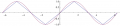
The picture below shows voltage over time. The formula shows voltage over time. As the numbers flow
through the Slew rate formula a change takes place as it approaches the Maximum slew rate.
With a periodic wave there is frequency. One of the Slew Rate characteristics is the frequency limit.
The expression for Slew Rate is
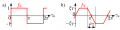
Have you ever wondered what electrical condition affects a sine wave to become more triangular?
Have you ever asked why a square wave starts to change shape to trapazoidal?
Good that is Slew Rate otherwise we chance opposition talking Geek to a Greek in figure b) ∀≠∃
Sometimes imagery is useful in concepts for a visual thinker. I find it interesting that geometry
can help some to adapt a mathematic expression and gain confidence from past fear or math anxiety.
While some are struggling with algebra others are playing with numbers writing proofs not needing much geometry.
Others can visualize an animation of a gradual transformation in order to formulate a rate of change.
The picture below shows voltage over time. The formula shows voltage over time. As the numbers flow
through the Slew rate formula a change takes place as it approaches the Maximum slew rate.
Have you ever wondered what electrical condition affects a sine wave to become more triangular?
Have you ever asked why a square wave starts to change shape to trapazoidal?
Actually the full problem is here: https://forum.allaboutcircuits.com/posts/1961000/
Someone posted that the problem could be 'slew rate' this is why I asked, but it may not solve the problem, and I'm trying to figure out the possibilities.
Cheers, C

 Facebook
 Google
 GitHub
 Linkedin