Depends on the meter. A higher end one will measure True RMS value of the waveform and a low priced one will measure the Average value and display an RMS value. So you can have average responding RMS indicating or RMS responding RMS indicating. Always check the meter's data sheet when buying so you get what you want. The lower priced will only effectively measure a nice clean sine wave accurately.
What kind of internal circuit they use for this? For example they need to measure the time difference like sample time t1 and sample time t2 etc. I feel it is very complicated. Do they use any internal micro controller to do the processing or normal discrete components?
What kind of internal circuit they use for this? For example they need to measure the time difference like sample time t1 and sample time t2 etc. I feel it is very complicated. Do they use any internal micro controller to do the processing or normal discrete components?
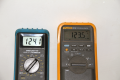
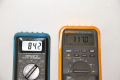
I suggest you give this a read as it addresses your question and points out Crest Factor as mentioned by danadak. Yes, some DMMs use micro controllers but as I mentioned, all of this depends on the meter and manufacturer. The better the meter, the more features, the higher the cost. This is also true of hand held as well as bench models. When choosing a meter you choose what you want based on your specific criteria. Here is an example using an inexpensive meter average responding RMS indicating and a True RMS responding RMS indicating meter.
Measuring a clean RMS sine wave, US mains power:
The same two meters measuring a MSW (Modified Sine Wave)
The meter on the left is an inexpensive about $12 USD meter, the meter on the right is about a $400 USD meter. The difference is pretty obvious.
I suggest you give this a read as it addresses your question and points out Crest Factor as mentioned by danadak. Yes, some DMMs use micro controllers but as I mentioned, all of this depends on the meter and manufacturer. The better the meter, the more features, the higher the cost. This is also true of hand held as well as bench models. When choosing a meter you choose what you want based on your specific criteria. Here is an example using an inexpensive meter average responding RMS indicating and a True RMS responding RMS indicating meter.
The reference to a "modified sine wave" implies that the output is likely from a UPS or inverter and is attempting to output a sine-like waveform at about 120 Vrms.
What kind of internal circuit they use for this? For example they need to measure the time difference like sample time t1 and sample time t2 etc. I feel it is very complicated. Do they use any internal micro controller to do the processing or normal discrete components?
Depends on the meter. Remember, AC measurements with handheld meters long predate digital multimeters.
Many of the old VOMs (volt-ohm-millameter) simply switched in a single diode to rectify the waveform and then let the physical meter movement's natural low-pass characteristic filter the result to give a meter deflection that was proportional to the average value. The scale on the meter face was then merely scaled to correspond to the rms values of the input when that input was a clean sinusoid.
The reference to a "modified sine wave" implies that the output is likely from a UPS or inverter and is attempting to output a sine-like waveform at about 120 Vrms.
That’s being very presumptuous – I would be interested to see what reading the Fluke meter gives when fed with a half wave rectified (mains) sine wave.
I’d be willing to bet it won’t read close to 85V (based on 120Vac mains).
That’s being very presumptuous – I would be interested to see what reading the Fluke meter gives when fed with a half wave rectified (mains) sine wave.
I’d be willing to bet it won’t read close to 85V (based on 120Vac mains).
There is an odd anomaly with Fluke meters that has been seen on more than one instance.
Before the low battery warning appears, the meter starts to give weird readings, seen on more than one meter.
I had a maintenance electrician come to me with a problem that he was measuring 240vac when it should be only 120vac, having seen this before on different ranges, I suggested he change the battery.
The correct reading appeared!
So now if a reading just doesn't make any sense I check the battery first.
Max.
The previous posts point out something very important: you must know how any instrument you are using works.
Note - every numeric value in the following is approximate.
A pure, undistorted sine wave of 120 volts RMS has a peak voltage of 168 volts. If you half-wave rectify the sine, you get something that has both an AC component and a DC component. The DC component is 53.5 volts. The AC RMS component is 64.8 volts.
Fluke believes that RMS meters should display only the AC component (may be exceptions! - read the manual), so they "AC-couple" the input to the meter - there is a capacitor that blocks any DC component. A Fluke meter set to AC will read zero volts for a pure DC input. To be sure of what the actual RMS value is, you must measure on the DC range, then on the AC range, and calculate the actual RMS value. You do this by squaring each component, adding the squares and taking the square root of the sum. The RMS value of DC is equal to the average of the DC.
Sometimes it is nice to have a blocking capacitor in the meter, sometimes it is an annoyance. It depends on what you are doing. But you must know how your meter works!
Max didn't report the peak or RMS for his unrectified voltage, but his meter is likely working just fine.
When I first started work back in the 1970s my employer purchased a well known brand of bench multimeters that were supposed to be true rms – I laughed then; I’m still laughing more than 40 years later at Fluke.
Those who want to measure the true rms voltage of a waveform – the best option is a digital scope, but even these use approximations when displaying the value on the fly.
With a waveform captured, most digital scopes allow limited manipulation including altering the cursor positions. Now with a static waveform (and data points), the scope has all the time in the world to calculate the correct true rms value of the waveform. But I bet they still use the same algorithm (as used on the fly), it being too much trouble to invoke an alternative calculation, which would highlight errors in the scope's measurements.
Fluke believes that RMS meters should display only the AC component (may be exceptions! - read the manual), so they "AC-couple" the input to the meter - there is a capacitor that blocks any DC component. A Fluke meter set to AC will read zero volts for a pure DC input. To be sure of what the actual RMS value is, you must measure on the DC range, then on the AC range, and calculate the actual RMS value. You do this by squaring each component, adding the squares and taking the square root of the sum. The RMS value of DC is equal to the average of the DC.
Measuring an everyday 9 V battery on the AC ranges the meter on the right reads Zero V and the meter on the left reads something like 19 V which is what we should expect.
The previous posts point out something very important: you must know how any instrument you are using works.
Note - every numeric value in the following is approximate.
A pure, undistorted sine wave of 120 volts RMS has a peak voltage of 168 volts. If you half-wave rectify the sine, you get something that has both an AC component and a DC component. The DC component is 53.5 volts. The AC RMS component is 64.8 volts.
Fluke believes that RMS meters should display only the AC component (may be exceptions! - read the manual), so they "AC-couple" the input to the meter - there is a capacitor that blocks any DC component. A Fluke meter set to AC will read zero volts for a pure DC input. To be sure of what the actual RMS value is, you must measure on the DC range, then on the AC range, and calculate the actual RMS value. You do this by squaring each component, adding the squares and taking the square root of the sum. The RMS value of DC is equal to the average of the DC.
Sometimes it is nice to have a blocking capacitor in the meter, sometimes it is an annoyance. It depends on what you are doing. But you must know how your meter works!
Max didn't report the peak or RMS for his unrectified voltage, but his meter is likely working just fine.
If what ebp says is correct (and I’ve no reason to doubt it), any ac waveform with a dc offset will result in a multimeter giving an erroneous Trms value.
At first I was shaking my head at this, but IIRC (and I had forgotten this since it has been so many years since I've used a Fluke for AC measurements of non-sinusoids and even that was for a very specific short-lived purpose) the Fluke meters report the RMS value of the AC component only. I don't know their rationale for doing so, but if you want the actual RMS value of the waveform you need to take the Pythagorean sum of the DC and AC measurements.
Using a simple spreadsheet with a 120 Vrms sinusoid and half-wave rectifying it with 0.7 Vf ideal diodes, I get the following:
Vrms = 84.38 V
Vdc = 53.64 V
Vacrms = 65.14 V
Note that √(Vdc² + Vacrms²) = 84.38 V
Personally, I would have had the AC ranges read the actual RMS voltage of the waveform since, if you needed the value for the non-DC component you could take that into account easily. But I imagine that had a typical use-case in mind for which it was more meaningful to just get the RMS value of the AC components. It would be interesting to know what that was.

 Facebook
 Google
 GitHub
 Linkedin