Well-known 555 desulfator : correct duty cycle

Thread Starter

Willen

Joined Nov 13, 2015
338
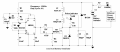
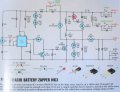
As an experiment, I made a lead acid battery desulfator. Frequency is around 1.2KHz and 6% duty cycle. When I connected the device in a battery, the circuit is working. I can see the LED is glowing little and I can hear its switching (magnetic flux developed around L1 and L2) in my AM receiver. But the IRFZ44 (60V, 0.028 ohms, 50A) is getting VERY hot within few second. Small heatsink is also not efficient to prevent the heating. (I had modified some of the thing so I am in doubt.) I think it's not normal so I didn't tried one of my 2kg heatsink. :)

Do I need to decrease duty cycle even more? Will it work for desulfation? Or any mistake around the circuitry?

IMPORTANT: the LTspice simulation file attached below is not totally same as the circuit posted below, but PRETTY close. But the circuit is totally same as the desulfator I made.
 

Attachments

Last edited:

Thread Starter

Willen

Joined Nov 13, 2015
338
Hi, When I was operating at 6% duty cycle 1.2KHz it was extremely hot eve in small heatsink. Also two of the parallel 100uF around output was getting hot gradually. So I decreased the dutycycle to 1% and changed these two parallel capacitors with BULKY one rated 220uF 400V. Now all seems fine.

But the 1% duty cycle brust can dissolve the sulfate back to the acid? Desulfator experienced needed.
 

Dodgydave

Joined Jun 22, 2012
11,395
Looking at other working circuit diagrams, your fet is not being turned off fast enough, by putting a pnp transistor to drive the gate, also the inductors have different values

Don't understand why you need an extra psu?
 
Last edited:

Alec_t

Joined Sep 17, 2013
15,126
With a 10V supply to the 555 the output voltage at pin 3 will be only about 8.8V. That may not be enough to switch your particular example of the IRFZ44 on fully.
 

Thread Starter

Willen

Joined Nov 13, 2015
338
...your fet is not being turned off fast enough
Hi,
-Why not enough? Due to the output voltage or current or impedance?
-Won't a pullup resistor to the 10V from the gate work? If need PNP then the schematic below work?
Curiosity from other post:
With a 10V supply to the 555 the output voltage at pin 3 will be only about 8.8V. That may not be enough to switch your particular example of the IRFZ44 on fully.
Does the partially turned on MOSFET dissipate more heat/power than the saturated?
 

Attachments

Last edited:

dendad

Joined Feb 20, 2016
4,641
If a FET is partially turned off (or on) it is really just a resistor and will dissipate like one.
An ideal switched FET is either short or open so no power is dissipated. Unfortunately, in the real world, the FET cannot turn on to be a short, but can get pretty close if the gate drive is sufficient. Most of the power dissipated is in the switching on and switching off times as that cannot be instantaneous. The slower the switching (not the frequency, but the "slope" of the transition) the more power is dissipated.
 

Thread Starter

Willen

Joined Nov 13, 2015
338
I learned two things:
The 555 supply should be around 12V so that the output is enough to turn on the mosfet. And need to use 'pulldown-transistor' (maybe) to turn off at the speed of transistor's top rated speed. Pretty nice idea!
Thank you for the sharing!
 
Last edited:

Thread Starter

Willen

Joined Nov 13, 2015
338
Thak you for all of the suggestion and correction. I prepared the circuit and set 1.2KHz 1% dutycycle. And I applied it to a badly sulfated battery of around 10Ah 12V lead acid. There was pretty thick layer of white things around battery plates (some said it's sulfate). After a week of use of the desulfator continuously, now I am seeing just 10% white layer has been remained and 90% sulfated dissolved back to the acid. Before battery voltage even with direct charging would not go more than 12V, but now it has more than 13V. Maybe I need to leave the desulfator till another week. So maybe it's working and the totally expired battery will be recovered little bit.

I realize that a fuse in series with the battery is VERY VERY important, which is not shown in the circuit mistakenly!!
 

Attachments

DC_Kid

Joined Feb 25, 2008
1,242
6% 1.2kHz is 0.05ms of on time per 0.833ms period. the gate charge of the FET is 67nC, so can the 555 move 67nC in 0.05ms?
try running at 50% duty cycle, do they cool down?
sounds like they are running most of their on time in the linear region.
i also suspect you have ringing in the gate due to some reactance coupled with Qg. scope it and see.

your FET has 110ns rise time which is way faster than 0.05ms, so maybe ringing in the gate is keeping that FET in linear too long, or the 555 is not moving the charge needed?
see https://www.vishay.com/docs/73217/an608a.pdf

and this gate ringing article
http://application-notes.digchip.com/009/9-12721.pdf
 
Last edited:

Dodgydave

Joined Jun 22, 2012
11,395
Thak you for all of the suggestion and correction. I prepared the circuit and set 1.2KHz 1% dutycycle. And I applied it to a badly sulfated battery of around 10Ah 12V lead acid. There was pretty thick layer of white things around battery plates (some said it's sulfate). After a week of use of the desulfator continuously, now I am seeing just 10% white layer has been remained and 90% sulfated dissolved back to the acid. Before battery voltage even with direct charging would not go more than 12V, but now it has more than 13V. Maybe I need to leave the desulfator till another week. So maybe it's working and the totally expired battery will be recovered little bit.

I realize that a fuse in series with the battery is VERY VERY important, which is not shown in the circuit mistakenly!!
Have you tried putting a 22K preset in series with the D1 to increase the fet on time, this will saturate the inductors more giving a larger back emf pulse, this will alter the pulse ratio too, ideally a scope would help to improve this design, anyhow i hope it's working well for you...
 

recklessrog

Joined May 23, 2013
985
Somewhere I have a design for a desulphator made from an ATX power supply. It revived an old tractor battery that I believe is still going strong ten years on!!
If I can locate it I will post details here. I've moved house twice since so may take me a while as I have about 3 tons of collected electronics and things I've made over the decades.
 
Last edited:

recklessrog

Joined May 23, 2013
985
From what I remember (back in about 1982), the modified atx psu I used, had the feed back voltage controlled from the 5 volt line and the output for the 12 volt was modified to be halfwave rectified with no smoothing, which was then connected to the battery. It was the high frequency that de-sulphated the battery but I can't remember if it was pulsed or not. It took over a couple of weeks to restore, but it was a big battery.
I just wish I could think where I put it.
 

Lumenosity

Joined Mar 1, 2017
614
It's the high voltage that forces the reverse reaction AFAIK.....I've always heard the "pulsing" was a gimmick used to sell fancy and expensive gadgets....but not necessary.
 

Thread Starter

Willen

Joined Nov 13, 2015
338
6% 1.2kHz is 0.05ms of on time per 0.833ms period. the gate charge of the FET is 67nC, so can the 555 move 67nC in 0.05ms?
try running at 50% duty cycle, do they cool down?
sounds like they are running most of their on time in the linear region.
i also suspect you have ringing in the gate due to some reactance coupled with Qg. scope it and see.

your FET has 110ns rise time which is way faster than 0.05ms, so maybe ringing in the gate is keeping that FET in linear too long, or the 555 is not moving the charge needed?
see https://www.vishay.com/docs/73217/an608a.pdf

and this gate ringing article
http://application-notes.digchip.com/009/9-12721.pdf
Hi,
Your technical advice seems advanced. Being a home made DIY engineer (hobbyist) I cannot do as you are saying. :) But it's a new thing to study. Thank you.

Have you tried putting a 22K preset in series with the D1 to increase the fet on time, this will saturate the inductors more giving a larger back emf pulse, this will alter the pulse ratio too, ideally a scope would help to improve this design, anyhow i hope it's working well for you...
Hi
I tried 6% dutycycle, the FET and the pump capacitor (across Gnd to Inductor) was VERY hot. Then I tried 2% and it still hot and then I tried 1%. And it was still hot so I used VERY BIG heatsink.
 
Top