Ways to measure audio noise level?

Thread Starter

MikeA

Joined Jan 20, 2013
446
I'd like to sample ambient noise once every 15 seconds. What about this idea: electret mic -> op-amp -> capacitor with a high value resistor to ground. Then an ADC will sample the voltage on the cap every 15 seconds. Is this a reasonable and straight forward way to accomplish this?
 

MrChips

Joined Oct 2, 2009
34,716
No. If you sample every 15 seconds, the highest frequency you can measure is 0.03Hz according to the sampling theorem.

What kind of noise do you want to measure? White, pink, brown, blue, violet, grey?

Colors of noise
 

#12

Joined Nov 30, 2010
18,224
It took me most of a minute to figure out what you said, MrChips.
I assumed MikeA wanted to find the general loudness level of the background noise. Kind of like taking a photo of a db meter every 15 seconds.

I guess we're about to find out.
 

MrChips

Joined Oct 2, 2009
34,716
Yes, I understood your idea even before you posted (amazing, isn't it?).

What you are proposing is to rectify the AC signal and measure the sound envelope. That will work also.
I wanted to put some theory up front on the table for the OP to understand.
 

#12

Joined Nov 30, 2010
18,224
Yes, I understood your idea even before you posted (amazing, isn't it?).
I know you think differently from me, and that is a major part of why this forum is good. It's just that sometimes I have to back up a step to get on your track.;)
 

Thread Starter

MikeA

Joined Jan 20, 2013
446
For now I'd like to measure just an average noise level. Bringing in a peak measurement might come in the future. :D
 

#12

Joined Nov 30, 2010
18,224
Average compared to peak is just a 2 resistor voltage divider, (and you're going to do that at the averaging capacitor anyway). You can add that circuit before or after the precision rectifier, but you can't easily build an, "average" rectifier that works properly across a wide range of amplitude.

It's just: Mic---precision rectifier---resistor--capacitor---resistor.

or you can do: Mic---resistor---resistor----precision rectifier---resistor---capacitor---resistor.

The second method rectifies the average instead of the peak, but it needs more parts to get to the same place.
 
Last edited:

joeyd999

Joined Jun 6, 2011
6,253
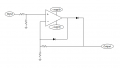
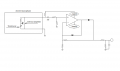
Here's a start. One of them shows the secret internals of an electret mic and the other is a peak detector with gain.
You have just stoked my curiosity, #12. Why do you suggest a differential amp for an electret? In what way is that better than single-ended?
 

#12

Joined Nov 30, 2010
18,224
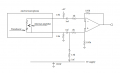
I did not mean to suggest a differential amplifier. That's just the drawing I had available in less than 3 minutes. It shows that an electret mic needs some power supply and can be connected to the input of an op-amp.

That one also has a switchable filter on it for some reason I can't remember.
That's what the OP needed that day...whatever day that was.
 
Last edited:

joeyd999

Joined Jun 6, 2011
6,253
I did not mean to suggest a differential amplifier. That's just the drawing I had available in less than 3 minutes. It shows that an electret mic needs some power supply and can be connected to the input of an op-amp.
Boy, you are just one big enigma today.

Ok...well, for the sake of the OP, a cursory (not rigorous!) analysis of the differential circuit tells me it might not work so well. Buyer beware....
 

#12

Joined Nov 30, 2010
18,224
You're right. There is a HUGE range of loudness levels and a log amplifier could make a much more useful output range.
 
Top