Facebook
 Google
 GitHub
 Linkedin
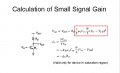
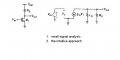
Please my attached files. For common-source stage with resistive load, there are two ways to drive a gain formula of small signal model.
The first way(as in attached file):
\(V_{out}=V_{DD}-R_{D} \c \dfrac {1} {2}\mu _{n} c_{ox}\dfrac {W} {L}\left( V_{GS}-V_{TH}\right) ^{2}\)
Then we derivative \(V_{out}\) with respect to \(V_{in}\)
The second way is draw small signal model and then using it to compute gain of the amplifier.
Could you explain to me why two methods are equivalent? I have computed it and they yield the same result.
The first way(as in attached file):
\(V_{out}=V_{DD}-R_{D} \c \dfrac {1} {2}\mu _{n} c_{ox}\dfrac {W} {L}\left( V_{GS}-V_{TH}\right) ^{2}\)
Then we derivative \(V_{out}\) with respect to \(V_{in}\)
The second way is draw small signal model and then using it to compute gain of the amplifier.
Could you explain to me why two methods are equivalent? I have computed it and they yield the same result.
Attachments
-
 40.4 KB Views: 39
 -
 25.8 KB Views: 42