Wallwart advice

Thread Starter

iONic

Joined Nov 16, 2007
1,662
I recently purchased an LED tent light which runs off of 4 1.5v AA batteries. I boasts 24 LED's...!! Aside from using one with batteries in a camping environment I am planing to retrofit one to my reading light, one by my recliner and another by bedside. The distribute the light so well for reading. I bought a couple of wall transformers with a output voltage of 6VDC and 700mA but when measuring them, open circuit, they read about 9.3VDC.

I took some measurements with the batteries installed and the 24 LED's on and got a series current of between 14mA - 15mA and a voltage drop on each LED of 1.2V.

My question is: What is the best way to efficiently drop the transformer voltage to 6V. I do not want to overdrive these LED's as I'm sure the design end of these devices did not take a whole lot of "What If" scenarios. They cost me a mere $7.

Thanks
 

Wendy

Joined Mar 24, 2008
23,798
Try loading them down with the current you plan on using, you will find the voltage drops dramatically. These are not regulated power supplies. One you have the voltage at the current rating you are planing on using, you may not need to regulate it. If you do, there are many options, such as 3 teminal regulators.
 

Thread Starter

iONic

Joined Nov 16, 2007
1,662
Once you have the voltage at the current rating you are planing on using, you may not need to regulate it.
So maybe I should just use a LM317, or the like, as a currebt regulator a 14mA?
Or would it be better to use the LM317 as a voltage regulator for 6VDC?
 

blocco a spirale

Joined Jun 18, 2008
1,546
At around 15mA the LEDs are being driven well within the usual current range of 20-30mA. Modern LEDs can work reliably even when overdriven as they often are in high-power flashlights. I've been running a pair of white LEDs in my car sidelights at nearly 40mA for over 6 months now. I think you should be able to connect directly to you nominal 6V supply with no problems.
 

Wendy

Joined Mar 24, 2008
23,798
Put a variable resistor in there, 1KΩ should do it, and adjust it until the voltage is right. This is a case where you don't need overkill.
 

Audioguru

Joined Dec 20, 2007
11,248
LEDs are 1.8V to 2.2V for red, and are about 3.4V each for white.
You measured only 1.2V so maybe your voltmeter reads low and the 9.3V you measured is actually much higher.

Your measurement of only 13.5mA is extremely low for a total of 24 LEDs. It is probably 10 times to 33 times higher.
 

Thread Starter

iONic

Joined Nov 16, 2007
1,662
LEDs are 1.8V to 2.2V for red, and are about 3.4V each for white.
Your numbers are old and historical. They do not apply for some of the new LED's on the market these days.
1.2V is very reasonable.

You measured only 1.2V so maybe your voltmeter reads low and the 9.3V you measured is actually much higher.
Voltmeter is fine: I have another wall transformer that reads almost exactly 6V as rated. It may very well have its own voltage regulator inside.

Your measurement of only 13.5mA is extremely low for a total of 24 LEDs. It is probably 10 times to 33 times higher.
Now here you ma have a point. I was using a cheep meter too measure the current as the fuse was blown for my good meter. A factor of 10 would make sense (10 time higher), but 33 times would not be possible with the scaling factor on the meter.

I believe the design is something like 4 series sets of 5 parallel LED's in series with a 5th set of 4 parallel LED's... = 24.

(1.2V x 4) + (1.2V x 1) = 6.0V

The current scenario with 135mA/5 = 27mA per LED which is way out of the norm.
 

Wendy

Joined Mar 24, 2008
23,798
Actually you have it backwards, the newer higher efficiency LEDs tend to drop a lot more voltage, not the other way around. I have never run into an LED that dropped less than 1.5V, ever, and the new ones are much higher.

27ma per LED is just about right, actually. Modern, extremely high efficiency LEDs (which these aren't) can pull an amp, but you pay in cash for the privilege, they aren't cheap. Had my nose rubbed in it a while back at this site, datasheets can be very handy. Personally I tend to focus on 10ma per LED, and can go 2ma if I'm concerving battery life and it is just an indicator.

Personally if I'd measured 1.2V across an LED I'd be doublechecking my meter too. Do these diode have dropping resistors? Most LED flashlights depend on the internal resistance of the battery, but hey, LEDs are cheap.
 

Thread Starter

iONic

Joined Nov 16, 2007
1,662
Actually you have it backwards, the newer higher efficiency LEDs tend to drop a lot more voltage, not the other way around. I have never run into an LED that dropped less than 1.5V, ever, and the new ones are much higher.
Just used two different multimeter's to measure the voltage on a single NiMH 1.2v AA. They both measures 1.134V.
 
Last edited:

Wendy

Joined Mar 24, 2008
23,798
The other question I would ask is what other circuitry is associated with these? It sounds like there may be some pulsing DC involved somewhere, it is an alternative to current regulation in some cases. Try the AC scale on the DVM. I doubt the batteries are feeding these LEDs directly from everything I've heard.
 

Audioguru

Joined Dec 20, 2007
11,248
You calculated that the LEDs need 6V but you did not mention the voltage across a current-limiting resistor. No current limiting?

Infrared LEDs are 1.2V to 1.5V. Red ones are from 1.8V to 2.2V.
Show the datasheet or the part number of your LEDs.

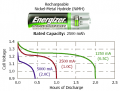
A Ni-MH cell fully charged and still on a charger is 1.5V. Its voltage averages 1.25V over a discharge. Yours is nearly dead at only 1.134V.
Here is the datasheet from an Energizer AA Ni-MH cell:
 

Attachments

Thread Starter

iONic

Joined Nov 16, 2007
1,662
First off, AudioGuru, don't know what I did but the voltage drop across was not 1.2V, it ends up to be 3.8V.

Bill,

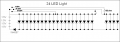
The circuit was not as I thought, below is the real circuit. Switching is used to turn on either 20 LED's, 4 LED's, or 24 LED's. The switching section contains the 3-way switch and a 100 ohm resistor.

The voltage drops on all LED's is 3.75V and .87V across the 1N4007 Diode. The battery voltage was 5.83V
The math is weird though... 5.83V - .87V - 3.75V = 1.21V. When the 24 LED's are on there is no voltage drop across the 100 resistor, but when only the 4 LED's are on there is a 1.2V voltage drop.

So there really is not any extravagant circuitry here but maybe you or someone can explain what the function of the diode is here.
 

Attachments

Last edited:

SgtWookie

Joined Jul 17, 2007
22,230
The 1N4007 protects the LEDs in case the batteries are put in backwards; LEDs have a low threshold for reverse voltage. When forward biased, it drops around 0.65-0.8v (roughly) across itself depending upon the current.
 

Audioguru

Joined Dec 20, 2007
11,248
You didn't say the colour of the LEDs but 3.8V is a bgight green, blue or white LED.

I don't see a 100 ohm resistor in your schematic. I see nothing to limit the current.
The diode reduces the voltage from the battery. If the LEDs have a max allowed current of 30mA then 24 of them draw 720mA or more which drags down the battery's voltage and increases the voltage drop across the diode and across the LEDs.

You show 24 LEDs directly in parallel. They have nothing to help them share the current so some will operate at 40mA and others will operate at 20mA. The ones at 40mA will quickly burn out then the battery voltage will rise and fry the remaining ones.
 

Thread Starter

iONic

Joined Nov 16, 2007
1,662
You didn't say the colour of the LEDs but 3.8V is a bgight green, blue or white LED.
They are white.

I don't see a 100 ohm resistor in your schematic. I see nothing to limit the current.
I was altering the schematic as I posted, it is in there now.


You show 24 LEDs directly in parallel. They have nothing to help them share the current so some will operate at 40mA and others will operate at 20mA. The ones at 40mA will quickly burn out then the battery voltage will rise and fry the remaining ones.
This is a scenario I would like to avoid if possible. How would I regulate current and keep them in parallel?
 

Audioguru

Joined Dec 20, 2007
11,248
You can connect LEDs directly in parallel only if you test hundreds and sort them into groups that have exactly the same current at a certain voltage. Then use a current-limiting circuit or resistor. Manufacturers sort LEDs to make flashlights and other LED things.

Since your supply voltage is low, each LED should have its own current-limiting resistor in series with it.
Or you can measure each one and sort them into groups then each group needs its own current-limiting resistor.
 

Wendy

Joined Mar 24, 2008
23,798
The fact you are measuring such low voltages still suggests some sort of electronic switching scheme to regulate current. Have you ever tried the AC range? Other than telling you if there is something there it won't give much in the way of technical information.
 

Thread Starter

iONic

Joined Nov 16, 2007
1,662
You can connect LEDs directly in parallel only if you test hundreds and sort them into groups that have exactly the same current at a certain voltage. Then use a current-limiting circuit or resistor. Manufacturers sort LEDs to make flashlights and other LED things.

Since your supply voltage is low, each LED should have its own current-limiting resistor in series with it.
Or you can measure each one and sort them into groups then each group needs its own current-limiting resistor.
These LED Lights are pretty darn cheap. It would be most difficult, if not very time consuming to re-wire them with their own cl resistor. And since these LED's are unique, I would not have the ability to match up LED's for a matching current.

I think my best bet is to limit the input voltage. If 4 new alkaline batteries measures. 1.6v x 4 = 6.4V and as low as 1.25 x 4 = 5.0V then by restricting the input voltage to 5.5V might keep them safe longer. Or am I all wet here?
How about a resistor in series with the lot of parallel LED's?
 

Thread Starter

iONic

Joined Nov 16, 2007
1,662
Didn't get any reply to my previous post. Was wondering if any ot the ideas were helpful?

Thanks
 
Top