VTVM doesn't show proper readings in AC mode?

Thread Starter

Rahulk70

Joined Dec 16, 2016
538
Hi,

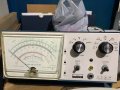
I've a Heathkit SM-21A VTVM(similar to the Heathkit IM-13 with same internals) that I'm trying to restore. Initially there was some issues with the static accumulation on the gauge, but used some Ant-static LCD cleaner and got that solved. Changed the battery and the electrolytic capacitor in the VTVM. The other caps are two 400V 0.05MF caps and a 1600V cap.

I checked the OHMS mode and the DC+ mode and they work fine and are calibrated. But the DC- is slightly off but that minor only.
On the AC mode it is a complete different story. I tested on my outlet that is 115V and it shows only like 22VAC on the 150V selector mode.

Could it be a tube issue like the 6AL5 from the symptoms? If that is dead I'll be in trouble cause I don't have a spare at the moment.
 

Attachments

crutschow

Joined Mar 14, 2008
38,532
Could it be a tube issue like the 6AL5 from the symptoms?
That's probably the most likely.
But it could also be a capacitor or resistor that has failed in the AC portion of the circuit.

You could try replacing the tube with a couple of 1n400x diodes (where x = 4 through 7) to see if it then works.
Connect one diode between pins 2 (cathode) and 5, and the other diode between pins 1 (cathode) and 7.
 

Thread Starter

Rahulk70

Joined Dec 16, 2016
538
That's probably the most likely.
But it could also be a capacitor or resistor that has failed in the AC portion of the circuit.

You could try replacing the tube with a couple of 1n400x diodes (where x = 4 through 7) to see if it then works.
Connect one diode between pins 2 (cathode) and 5, and the other diode between pins 1 (cathode) and 7.
Okay. I've got hands on a 6AL5 from a friend. Will try a replacement and see how it goes.

But as you have mentioned I'll try to check the wax caps and resistors also thoroughly.
 

Thread Starter

Rahulk70

Joined Dec 16, 2016
538
Check circuits through C1,C2, V1.
I tried swapping the V1 and V2 valves with new ones and there was no change. Next I changed the C2 & C3 caps. Unfortunately I don't have a C1 replacement at the moment. I'll thoroughly recheck the resistors again. My digital multimeter can measure only upto 20m ohms so the resistors from R6 to R11 wouldn't show anything if they are faulty. But the rest of the resistors I'll check them as you had asked and post the results.
 

MisterBill2

Joined Jan 23, 2018
27,600
I suggest trying a direct connection at the input, bypassing the probe with the switch. If the switch is not working the DC voltage would work but the AC readings will be lowered. Then next I suggest cleaning the function and range switch contacts with some control cleaner spray. Of course one other thing is to carefully check that the circuit is wired correctly. If you never saw it working right, it may have a wiring error. That can happen with kits. Also there may be a poor solder connection, possibly on the 6AL5 socket, or close to it.
 

Thread Starter

Rahulk70

Joined Dec 16, 2016
538
I suggest trying a direct connection at the input, bypassing the probe with the switch. If the switch is not working the DC voltage would work but the AC readings will be lowered. Then next I suggest cleaning the function and range switch contacts with some control cleaner spray. Of course one other thing is to carefully check that the circuit is wired correctly. If you never saw it working right, it may have a wiring error. That can happen with kits. Also there may be a poor solder connection, possibly on the 6AL5 socket, or close to it.
Sorry for the late reply. I was actually waiting for the 22ohm resistors to arrive from China. Took almost 3 weeks to get my hands on them. Actually after measuring the old 22ohm resistors they were in the 2.5 to 1.9 Mega ohm range only. Way off! So, I've change all with 22 again but still the problem persists. It's driving me nuts. I need to isolate the AC part only and check that portion thoroughly again.
 

MaxHeadRoom

Joined Jul 18, 2013
30,681
On the AC mode it is a complete different story. I tested on my outlet that is 115V and it shows only like 22VAC on the 150V selector mode.
.
Completely different equipment but same scenario.
I had a maintenance electrician call me about a 240vac reading he was getting on a Fluke VOM where the circuit should have read 120vac.
Turns out the meter had a low battery, evidently this is common with some Fluke meters that show errors before the low battery alarm comes on.:(
Max.
 

Thread Starter

Rahulk70

Joined Dec 16, 2016
538
Completely different equipment but same scenario.
I had a maintenance electrician call me about a 240vac reading he was getting on a Fluke VOM where the circuit should have read 120vac.
Turns out the meter had a low battery, evidently this is common with some Fluke meters that show errors before the low battery alarm comes on.:(
Max.
Hi Max,

The battery in the VTVM was replaced with a brand new 1.5V C cell. What amazed me was there was a vintage Energizer Union carbide cell that was till showing 1.47V. Pretty strange. But if I'm right the battery in these VTVMs are only for the ohm readings. The other functions are fully powered from the 115V AC outlet.
 

MisterBill2

Joined Jan 23, 2018
27,600
One more thought, which is, DO YOU KNOW if the AC voltage function ever worked correctly? I have found kits with wiring errors, such that part of it worked and part of it did not work. If you are not certain that the AC volts function was ever correct, tracing out the circuit or going through the wiring steps may help find the problem. Also, check to see if the problem is on all AC ranges or just on some of them. AND, go through the calibration process again, since an incorrect calibration can cause all kinds of problems.
 

Thread Starter

Rahulk70

Joined Dec 16, 2016
538
One more thought, which is, DO YOU KNOW if the AC voltage function ever worked correctly? I have found kits with wiring errors, such that part of it worked and part of it did not work. If you are not certain that the AC volts function was ever correct, tracing out the circuit or going through the wiring steps may help find the problem. Also, check to see if the problem is on all AC ranges or just on some of them. AND, go through the calibration process again, since an incorrect calibration can cause all kinds of problems.
I’ll thoroughly trace the AC circuit to see if there is any mistake or some component failure that’s causing this. I had purchased this off eBay. But the seller seems to have got it on some estate sale. She just informed me that she had tested with a probe and the meter showed movement and worked fine. I guess she never tested the AC function though.
 

MisterBill2

Joined Jan 23, 2018
27,600
I’ll thoroughly trace the AC circuit to see if there is any mistake or some component failure that’s causing this. I had purchased this off eBay. But the seller seems to have got it on some estate sale. She just informed me that she had tested with a probe and the meter showed movement and worked fine. I guess she never tested the AC function though.
There is certainly a big difference between getting the meter to move and getting it to move to show the correct reading. Just because it functions does not mean that it functions correctly. It may even be as simple as a connection that was not soldered correctly, or not soldered at all. I have seen both in repairing kits built by others.
 

Thread Starter

Rahulk70

Joined Dec 16, 2016
538
There is certainly a big difference between getting the meter to move and getting it to move to show the correct reading. Just because it functions does not mean that it functions correctly. It may even be as simple as a connection that was not soldered correctly, or not soldered at all. I have seen both in repairing kits built by others.
Hi Bill,

But the strange thing is this isn't the IM-13.Well yeah exactly the same circuit but this is the factory built and tested SM-21A Schlumberger model. This was built by Heath itself from factiry I think. Maybe somebody with experience in vintage electronics can confirm that.
 
Last edited:

MrChips

Joined Oct 2, 2009
34,831
Since there is uncertainty as to whether the unit was factory built or DIY kit-built, go over the construction and check that it matches the schematic.

What are the symptoms on AC mode?
 

MisterBill2

Joined Jan 23, 2018
27,600
Since there is uncertainty as to whether the unit was factory built or DIY kit-built, go over the construction and check that it matches the schematic.

What are the symptoms on AC mode?
The complaint is given in post #1, which is that "the DC readings were a bit low, but the AC reading was very much too low." Of course there is no statement that the thread starter has attempted to adjust the calibration. It would be funny if THAT wee the problem. Presently I am guessing either a bad solder connection or a dirty switch contact. It might possibly be a bad connection at a grounding lug.
 

Thread Starter

Rahulk70

Joined Dec 16, 2016
538
Hi

@MisterBill2 and @MrChips I've done the following so far now. Cleaned all the pots and switches with contact cleaner. Then I changed the 22 Ohm resistors and the 10 ohm resistor that were off. Removed the - copper spring contact of the battery terminal and then put a fresh battery. Also changed the 630V 0.05uF caps too.

Fired up the VTVM again and tried the Ohm function setting and after calibration works perfect. Next tried the DC+ and calibrated it and it seems to be working good too. But on DC- I get slightly off reading like 1.5V reads only 1.35V. Now on the AC mode my outlet supply is 119.1VAC and with the VTVM even when the calibration pot is at its max I get only the needle to move upto 100VAC. What might be causing this issue. I don't seem any broken soldering connections or anything.

Yes, this is a factory made kit version. The equivalent of the username kit is IM-13.
 

MisterBill2

Joined Jan 23, 2018
27,600
I studied the circuit again based on your report. The DC discrepancy seems like it should require adjusting the DC balance control again. For the AC readings being low, first, using a different ohm meter, verify that the switch in the probe is really bypassing the internal resistor. Then, I would suspect the 22 megohm resistor in the AC part of the voltage divider. Also, I suggest checking the AC on a lower range, using a transformer , possibly, to get down to a lower voltage.
Very high value carbon composition resistors are known for increasing their resistance.
and,I AM PRESUMING THAT A FULL CALIBRATION WAS DONE ACCORDING TO THOSE INSTRUCTIONS IN THE MANUAL. They do appear to be sequence sensitive.
 
Last edited:
Top