Facebook
 Google
 GitHub
 Linkedin
Hey guys, I have a question relating to integration which is puzzling me.
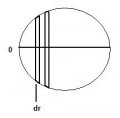
I figured that I would try and derive the volume of a sphere myself. Having never done this before I started out with a strategy that to me seems perfectly logical. If it can be seen from the 10 second scribble in paint, I imagine the circle i've drawn to be a 3-d sphere. If i cut the sphere up in cross-sectional slices with cross sectional area πr^2 and integrate from 0 to r, taking the zero point to be the left most point on the circle, I would have found the volume of a hemisphere. Therefore I would need to multiply this integral by two to get the total volume.
Like this: 2∫πr^2 dr (from 0 to r) = [2πr^3]/3
Obviously this is wrong so could someone point out the flaw in my approach as I am off by a factor of 2.
I figured that I would try and derive the volume of a sphere myself. Having never done this before I started out with a strategy that to me seems perfectly logical. If it can be seen from the 10 second scribble in paint, I imagine the circle i've drawn to be a 3-d sphere. If i cut the sphere up in cross-sectional slices with cross sectional area πr^2 and integrate from 0 to r, taking the zero point to be the left most point on the circle, I would have found the volume of a hemisphere. Therefore I would need to multiply this integral by two to get the total volume.
Like this: 2∫πr^2 dr (from 0 to r) = [2πr^3]/3
Obviously this is wrong so could someone point out the flaw in my approach as I am off by a factor of 2.
Attachments
-
 5.3 KB Views: 22
Last edited: