Facebook
 Google
 GitHub
 Linkedin
Hey everyone, I'm currently designing a Rx board for wireless power transfer (WPT) in university. I'm not sure if I'm allowed to post my KiCad files here so I'll post snippets of my schematic and PCB here.
Down below is the schematic for my PCB. Here's a simplified BOM as well:
J1 & J2: Würth Elektronik 691214110002
F1: Bel 0697H4000-01
BR1: Panjit GBU1008LV_T0_00601
VR1: ROHM Semiconductor BAJ5CC0T
C1 & C2: TDK CGA4J3X5R1H475M125AB
L1: Traco Power TCK-050
C3: KEMET C1808C102KHRAC7800
U1: MEAN WELL SKMW15F-05
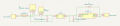
Essentially, a Rx coil used for WPT is installed at J1 which picks up on the AC waves sent from the transmitting circuit and coil. AC voltage is then induced onto the Rx coil which is rectified by BR1 before being passed onto VR1 to ensure that the input into the DC-DC converter/U1 is always 15V/1A. The DC-DC converter expects anywhere between 9-36V and 730mA to output 5V/3A but since I couldn't find any regulators that can output 730mA, I went with the BAJ5CC0T. Please let me know if this was a mistake. The reason for choosing this particular DC-DC converter is because of its power output which is suited for using a smartphone as a load. The other elements such as F1, C1, C2, L1, and L3 are part of the "EMC suggest circuit" from U1's data sheet.
I've fabricated the PCB and soldered on the components but when I connected my receiving coil onto the circuit board at J1, I don't get the desired output at the end of the DC-DC converter. J2 is connected to a male USB-C test board by the way.
At first, I thought that my receiving coil wasn't harvesting enough power from the transmitter so I decided to swap out the receiving coil for a 12V DC power supply to troubleshoot if it was my circuit that was the problem or the coil itself where I faced the same issue as before. The power supply's current was about 0.30A if that's any help.
I was then advised to have a common ground plane for the voltage regulator and the two negative input/output pins as shown in the schematic below. I did this by just soldering some jumper wires across J1, J2, and VR1.
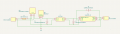
When I measured the voltage across the positive and negative pins of the bridge rectifier, I measured 10.91V. This was the same at the input pins (red on VCC, black on GND) of the voltage regulator. When I measured the output voltage (red on GND, black on VOUT) of the regulator, I measured -0.7V. According to the voltage regulator's data sheet, when I input a voltage of 4-25V, the output should be 15V/1A. I should also note that the voltage regulator becomes very hot the moment I turn on the 12V power supply.
I'm beginning to suspect that it could be my PCB's trace connections that could be the problem here but I'm unsure of what I'm doing wrong. Did I break some PCB tracing rules and am being ignorant about it or is there a bigger problem that I can't see? Here's a snippet of my PCB layout:

Any advice that could guide me in the right direction would be greatly appreciated. Cheers!
Down below is the schematic for my PCB. Here's a simplified BOM as well:
J1 & J2: Würth Elektronik 691214110002
F1: Bel 0697H4000-01
BR1: Panjit GBU1008LV_T0_00601
VR1: ROHM Semiconductor BAJ5CC0T
C1 & C2: TDK CGA4J3X5R1H475M125AB
L1: Traco Power TCK-050
C3: KEMET C1808C102KHRAC7800
U1: MEAN WELL SKMW15F-05
Essentially, a Rx coil used for WPT is installed at J1 which picks up on the AC waves sent from the transmitting circuit and coil. AC voltage is then induced onto the Rx coil which is rectified by BR1 before being passed onto VR1 to ensure that the input into the DC-DC converter/U1 is always 15V/1A. The DC-DC converter expects anywhere between 9-36V and 730mA to output 5V/3A but since I couldn't find any regulators that can output 730mA, I went with the BAJ5CC0T. Please let me know if this was a mistake. The reason for choosing this particular DC-DC converter is because of its power output which is suited for using a smartphone as a load. The other elements such as F1, C1, C2, L1, and L3 are part of the "EMC suggest circuit" from U1's data sheet.
I've fabricated the PCB and soldered on the components but when I connected my receiving coil onto the circuit board at J1, I don't get the desired output at the end of the DC-DC converter. J2 is connected to a male USB-C test board by the way.
At first, I thought that my receiving coil wasn't harvesting enough power from the transmitter so I decided to swap out the receiving coil for a 12V DC power supply to troubleshoot if it was my circuit that was the problem or the coil itself where I faced the same issue as before. The power supply's current was about 0.30A if that's any help.
I was then advised to have a common ground plane for the voltage regulator and the two negative input/output pins as shown in the schematic below. I did this by just soldering some jumper wires across J1, J2, and VR1.
When I measured the voltage across the positive and negative pins of the bridge rectifier, I measured 10.91V. This was the same at the input pins (red on VCC, black on GND) of the voltage regulator. When I measured the output voltage (red on GND, black on VOUT) of the regulator, I measured -0.7V. According to the voltage regulator's data sheet, when I input a voltage of 4-25V, the output should be 15V/1A. I should also note that the voltage regulator becomes very hot the moment I turn on the 12V power supply.
I'm beginning to suspect that it could be my PCB's trace connections that could be the problem here but I'm unsure of what I'm doing wrong. Did I break some PCB tracing rules and am being ignorant about it or is there a bigger problem that I can't see? Here's a snippet of my PCB layout:
Any advice that could guide me in the right direction would be greatly appreciated. Cheers!