Voltage Reference vs Power supply voltage help

Thread Starter

shakmana

Joined Feb 15, 2025
11
team,

Hope you all are well. I'm graduated as electrical engineer back 2013 and never worked as electrical engineer ever since due to lacking of opportunities at least where I live. So, now am trying to refresh my memory about my back ground so am watching you tube channels and stuff like that. And at the moment am reviewing all electronics components and stuff and I cam cross diodes.

So my question is that Zener diode can be used as a reference voltage does that mean it can serve as another power supply voltage for a circuit ? so more voltage in the circuit ? also i read that it can be used or function as a voltage regulator does that means that it will generate stable voltage irrespectively of other i.e resistors or load in circuit ? Thanks in advance team.
 

ericgibbs

Joined Jan 29, 2010
21,420
Hi shak,
Welcome to AAC.
A Zener diode can be used to create a voltage reference, what circuit design do you have in mind?
E
 

Papabravo

Joined Feb 24, 2006
22,066
team,

Hope you all are well. I'm graduated as electrical engineer back 2013 and never worked as electrical engineer ever since due to lacking of opportunities at least where I live. So, now am trying to refresh my memory about my back ground so am watching you tube channels and stuff like that. And at the moment am reviewing all electronics components and stuff and I cam cross diodes.

So my question is that Zener diode can be used as a reference voltage does that mean it can serve as another power supply voltage for a circuit ? so more voltage in the circuit ? also i read that it can be used or function as a voltage regulator does that means that it will generate stable voltage irrespectively of other i.e resistors or load in circuit ? Thanks in advance team.
The major characteristic of a "power supply" is that it provides whatever current a load requires at a fixed voltage subject to a limit on the maximum current it is capable of handling. The Zener diode as a reference is like a seesaw at the balance point where voltage and current are in a stable configuration. If you try to draw current away from the Zener diode you will upset the balance and loose the relationship between voltage and current.
 

kiroma

Joined Apr 30, 2014
80
Can you use as a voltage reference? Yes.
Is it stable? No, it depends on temperature and current.
There are ways of creating a stable voltage reference with for example TL431, op amps, and other things.
Depending on the application you can use a zener as the power supply of some circuit.
 

MrChips

Joined Oct 2, 2009
34,714
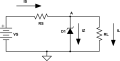
A zener diode can be used as a voltage regulator but it has limitations.

1739632228841.png

1) A zener diode has a power rating. It can handle only so much current.
The maximum current can be calculated from the power rating,

Imax = Power / Vz

Calculate Rs so that the max current is not exceeded.
Rs = (Vs - Vz) / Imax

Usually, we design the zener voltage regulator circuit based on how much current the load needs (i.e. Imax). Then we select the zener for proper power rating.

How does the zener diode voltage regulator work?

The total current in the circuit is Imax. This is split between the load and the zener diode.
If the load RL demands all the current, zero current flows through the zener diode, and vice-versa,
in other words, if the load takes zero current, the zener diode has to take all the current, Imax.

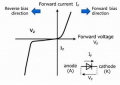
2) The zener diode does not have a sharp zener voltage. It has a "soft" knee voltage as well as internal resistance. The zener voltage Vz is not a constant. It depends on the current through the zener diode. Hence, don't expect the output voltage to be perfectly flat over all operating currents.


1739632798342.png

3) The zener voltage is temperature dependent.
 

ElectricSpidey

Joined Dec 2, 2017
3,317
You can make a simple shunt regulator with a zener and resistor, and you can also improve on the design by adding a transistor.

" so more voltage in the circuit ? " The answer to that one is "no".
 

crutschow

Joined Mar 14, 2008
38,423
A Zener can be used to generate a lower voltage from a supply, but it's not used for that purpose if good accuracy or stability is required for that voltage.
They are often used to clamp or limit a voltage to a desired value where low accuracy is acceptable.

For more precise voltage, a voltage reference IC (for high stability) or a voltage regulator IC (for typical circuit supply stability) is normally used.
 

Thread Starter

shakmana

Joined Feb 15, 2025
11
Hi shak,
Welcome to AAC.
A Zener diode can be used to create a voltage reference, what circuit design do you have in mind?
E
Hi no I don't have circuit design in mind. It's just that I want to understand the concept or how Zener diode can serve as a voltage reference? I would assume that there's for sure a power supply in the first place to power up the circuit and then the Zener diode would help to generate a stable DC output based on the Zener diode specs...I hope my understanding is correct. Also what confused me a bit is saying that the Zener diode will serve as voltage reference irrespective to load or resistor in the circuit....how does that possible to have zero impact on the Zener diode? Thanks ericgibbs
 

Thread Starter

shakmana

Joined Feb 15, 2025
11
The major characteristic of a "power supply" is that it provides whatever current a load requires at a fixed voltage subject to a limit on the maximum current it is capable of handling. The Zener diode as a reference is like a seesaw at the balance point where voltage and current are in a stable configuration. If you try to draw current away from the Zener diode you will upset the balance and loose the relationship between voltage and current.
So can I say Papabravo that zener diode can be like a balancer of voltage in the circuit somehow or serve as a stabilizer of the voltage throughout the circuit...!!
 

Thread Starter

shakmana

Joined Feb 15, 2025
11
Can you use as a voltage reference? Yes.
Is it stable? No, it depends on temperature and current.
There are ways of creating a stable voltage reference with for example TL431, op amps, and other things.
Depending on the application you can use a zener as the power supply of some circuit.
Hi Kiroma...what exactly you mean by voltage reference? could you explain further please? when you say that zener diode can be used as a power supply for some circuit does this mean it can work as a power supply itself without external power supply ?
 

MrChips

Joined Oct 2, 2009
34,714
A zener diode is not a power supply. It is a voltage clamp. It restricts the voltage from rising above the zener voltage.
If the voltage falls below the zener voltage, the zener diode has no effect.
 

Papabravo

Joined Feb 24, 2006
22,066
So can I say Papabravo that zener diode can be like a balancer of voltage in the circuit somehow or serve as a stabilizer of the voltage throughout the circuit...!!
No, it is too weak to be able to do that. The effect is limited to a narrow range voltage and currents. Any disturbance to a carefully balanced circuits destroys the effect. It is not stable.
 

BobaMosfet

Joined Jul 1, 2009
2,211
team,

Hope you all are well. I'm graduated as electrical engineer back 2013 and never worked as electrical engineer ever since due to lacking of opportunities at least where I live. So, now am trying to refresh my memory about my back ground so am watching you tube channels and stuff like that. And at the moment am reviewing all electronics components and stuff and I cam cross diodes.

So my question is that Zener diode can be used as a reference voltage does that mean it can serve as another power supply voltage for a circuit ? so more voltage in the circuit ? also i read that it can be used or function as a voltage regulator does that means that it will generate stable voltage irrespectively of other i.e resistors or load in circuit ? Thanks in advance team.
Yes, there is a common circuit for this, based on using a zener to control a transistor to regulate flow.

1739723270626.png

This will help for a quick Refresher:

The Art of Electronics 3rd Ed.
Author(s) Horowitz & Hill
ISBN-10: 9780521809269
 

Thread Starter

shakmana

Joined Feb 15, 2025
11
A zener diode can be used as a voltage regulator but it has limitations.

View attachment 342574

1) A zener diode has a power rating. It can handle only so much current.
The maximum current can be calculated from the power rating,

Imax = Power / Vz

Calculate Rs so that the max current is not exceeded.
Rs = (Vs - Vz) / Imax

Usually, we design the zener voltage regulator circuit based on how much current the load needs (i.e. Imax). Then we select the zener for proper power rating.

How does the zener diode voltage regulator work?

The total current in the circuit is Imax. This is split between the load and the zener diode.
If the load RL demands all the current, zero current flows through the zener diode, and vice-versa,
in other words, if the load takes zero current, the zener diode has to take all the current, Imax.

2) The zener diode does not have a sharp zener voltage. It has a "soft" knee voltage as well as internal resistance. The zener voltage Vz is not a constant. It depends on the current through the zener diode. Hence, don't expect the output voltage to be perfectly flat over all operating currents.


View attachment 342576

3) The zener voltage is temperature dependent.
Thanks Mr Chips for the detailed explanation but are you saying now that zener diode can work as a voltage regulator as well in your mentioned circuit ? how about voltage reference ? what is that supposed to mean exactly ? can I say that zener diode has different functions or applications depends on what application I want to use it in ?
 
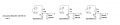
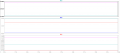
This simulation shows how a typical 5.1V Zener diode behaves under different conditions (ignoring temperature). The voltage regulation depends on both the load resistance (100, 500, 1k) as well as the source resistance (100, 1k, 10k).

To make things easier for display, I used the .step parameter to set three load resistances for each source resistance.

You can see pretty clearly that if the source resistance is 100, then each load is regulated quite close to 5.1V. Each horizontal line represents one of the three load resistances.

As the source resistance increases to 1k, regulation is only achieved for loads greater than 1k.

Then if the source further increases to 10k, there is no regulation for any of the loads.

So, the actual regulation achieved with this topology depends on how much current the load draws as well as how much current the source is able to provide. Any current that isn't consumed by the load must also pass through the Zener.

Regulation also depends on temperature but for demonstration purposes, I didn't plot the changes. You can use the .STEP temp -40 40 10 parameter to sweep from -40 to 40C in 10C increments to get a decent visualization.

I find simulations like this augment calculations nicely and give a much better understanding than calculations alone. I included the LTspice simulation file. I highly recommend you spend time changing settings to see what happens.

z21.png
z22.png
 

Attachments

Thread Starter

shakmana

Joined Feb 15, 2025
11
A Zener can be used to generate a lower voltage from a supply, but it's not used for that purpose if good accuracy or stability is required for that voltage.
They are often used to clamp or limit a voltage to a desired value where low accuracy is acceptable.

For more precise voltage, a voltage reference IC (for high stability) or a voltage regulator IC (for typical circuit supply stability) is normally used.
thanks crutschow...so is voltage regulator same as voltage reference ? are they the same thing ? if not what are the major differences between the two ?
 

MrChips

Joined Oct 2, 2009
34,714
Voltage Regulator vs Voltage Reference
What is the difference?
There is no difference. Any difference is in the application.

The purpose of a voltage regulator or voltage reference is to produce a constant voltage output.
If there is a difference, it is in how much current it can supply.
The function of a power supply is to provide a certain amount of current and voltage. A voltage regulator circuit is used to hold the output voltage constant over a range of output current, i.e. over a range of loads.

A voltage reference is not intended to supply any significant amount of current (and hence power). It is not intended to be a source of power. The function of a voltage reference is to provide a known constant voltage. Like any voltage source, current will be drawn from the source. A voltage reference can only supply so much current (usually very low) before it fails to provide a constant voltage. Hence it is called a voltage reference. Use it as a standard voltage, not as a source of power.

A zener diode circuit can be used both as a voltage reference and a voltage regulator.
 

crutschow

Joined Mar 14, 2008
38,423
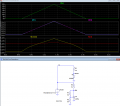
Below is the LTspice sim showing the difference in a 5V Zener voltage change (yellow trace) compared to the change for a TL431 2.5V adjustable voltage reference configured for 5V, for an input voltage change of 6V to 20V (green trace), which results in a current change through the devices of about 14mA (blue and purple traces):
Note the much larger change in voltage from the Zener.

So which to use depends upon the application accuracy requirements for the generated voltage.

1739730535352.png
 

Thread Starter

shakmana

Joined Feb 15, 2025
11
Voltage Regulator vs Voltage Reference
What is the difference?
There is no difference. Any difference is in the application.

The purpose of a voltage regulator or voltage reference is to produce a constant voltage output.
If there is a difference, it is in how much current it can supply.
The function of a power supply is to provide a certain amount of current and voltage. A voltage regulator circuit is used to hold the output voltage constant over a range of output current, i.e. over a range of loads.

A voltage reference is not intended to supply any significant amount of current (and hence power). It is not intended to be a source of power. The function of a voltage reference is to provide a known constant voltage. Like any voltage source, current will be drawn from the source. A voltage reference can only supply so much current (usually very low) before it fails to provide a constant voltage. Hence it is called a voltage reference. Use it as a standard voltage, not as a source of power.

A zener diode circuit can be used both as a voltage reference and a voltage regulator.
thanks a lot MrChips you explained it very well. Thank you sir !!
 
Top