voltage reduction

Thread Starter

LaurenceR

Joined Feb 7, 2013
107
I am looking for the best (simple and effective) way to drop mains voltage down to 24 vdc. My MCU board has circuitry to drop the 24 vdc down to 5 vdc to operate the logic circuits. I was originally using 24vdc as a supply voltage however I now have to use other voltages. My suspicion is a transformer and a zener or a voltage regulator. Any help would be appreciated.
Thanks,
 

crutschow

Joined Mar 14, 2008
38,503
You could use a transformer and an LM317 regulator. A shunt zener regulator can dissipate a lot of power.

Alternately, and more simply, you could use a wallwart with a 24Vdc output.
 

#12

Joined Nov 30, 2010
18,224
Your MCU board will probably drop UP TO 24 volts down to the correct range. Read the instructions and see if it will work on 8V to 10V. That would cause less heat waste.
 

Thread Starter

LaurenceR

Joined Feb 7, 2013
107
Thank you all. All good suggestions. For the sake of discussion using a transformer, rectifier, cap and or regulator sounds very effective. This begs me to ask the question I've been over many times. Do I need to use a center tapped transformer? As I have seen; without the center tap you can't really get full wave rectification of mains voltage. I don't know that the capacitor alone would be enough to smooth out the half wave voltage. I'm sure I opened a can of worms with this question.
Thanks in advance.
 

#12

Joined Nov 30, 2010
18,224
There are a dozen ways to make, "smooth" DC. Unfortunately, an on-board regulator doesn't need smooth DC. It needs mostly DC that never goes below the minimum feed voltage for the regulator.

You need to feed a 5V regulator? A "DC" wave that varies from 24 volts peak to about 10 volts in the valleys would work on the regulators I know about.
 

Attachments

Alec_t

Joined Sep 17, 2013
15,118
As I have seen; without the center tap you can't really get full wave rectification of mains voltage.
What you have seen is wrong. A rectifier bridge will provide full-wave rectification of a non-centre-tapped transformer output.
 

Thread Starter

LaurenceR

Joined Feb 7, 2013
107
There are a dozen ways to make, "smooth" DC. Unfortunately, an on-board regulator doesn't need smooth DC. It needs mostly DC that never goes below the minimum feed voltage for the regulator.

You need to feed a 5V regulator? A "DC" wave that varies from 24 volts peak to about 10 volts in the valleys would work on the regulators I know about.
You make a good point about the minimum feed voltage, I suppose a capacitor would keep it above that level easily especially at such low current draws.
Thanks.
 

Thread Starter

LaurenceR

Joined Feb 7, 2013
107
Is there a reason you want 24 volts? Are you running something else with the supply besides the MCU. If not just a little 9 volt wall wort would be cheapest and easiest.

http://www.ebay.com/itm/Replace-9-V...680?pt=Guitar_Accessories&hash=item51c3437bb8
I already have a voltage regulating circuit on the board that works very well for a 24 vdc supply. I can't remove it so I thought it best not to duplicate it and just bring the high voltage down to the 24 vdc level.
Thanks.
 

Thread Starter

LaurenceR

Joined Feb 7, 2013
107
What you have seen is wrong. A rectifier bridge will provide full-wave rectification of a non-centre-tapped transformer output.
This is the can of worms I was talking about. I have tried viewing 110vac passed through a full bridge rectifier with and without a capacitor and all you get is half wave dc. when I view a center tapped transformer I can get full wave on the scope. Am I missing something here?
Thanks
 

#12

Joined Nov 30, 2010
18,224
sqrt2 C Er(p-p) F = I

That says: For any current, and any frequency, you can use a capacitor to limit the variations. It is not a matter of, "if". It is a matter of, "how much".
 

#12

Joined Nov 30, 2010
18,224
I have tried viewing 110vac passed through a full bridge rectifier with and without a capacitor and all you get is half wave dc. when I view a center tapped transformer I can get full wave on the scope. Am I missing something here?
Thanks
Yes. You are missing the part about installing a capacitor.
 

MaxHeadRoom

Joined Jul 18, 2013
30,658
It sounds as though you do not need a regulated supply?
If you use a transformer you will need a 16v-17v AC secondary for 24vdc.
Max.
 

Thread Starter

LaurenceR

Joined Feb 7, 2013
107
sqrt2 C Er(p-p) F = I

That says: For any current, and any frequency, you can use a capacitor to limit the variations. It is not a matter of, "if". It is a matter of, "how much".
I understand what you are saying. Your equation points how the "how much" however it does take into account when calculating it the frequency "f". When you have full wave rectification the frequency doubles thus reducing the amount of capacitance needed. As you suggest the simplest way may be to rectify the ac, use a capacitor, and feed it to the present circuit.
Thanks.
 

Alec_t

Joined Sep 17, 2013
15,118
I have tried viewing 110vac passed through a full bridge rectifier with and without a capacitor and all you get is half wave dc. when I view a center tapped transformer I can get full wave on the scope. Am I missing something here?
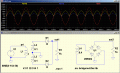
You must be. Even without a cap you should see something similar, like this:
Full-wave-rectifying.gif
 
Top