Voltage rating for cheap ceramic disc capacitors ?

Thread Starter

IcedFruits

Joined Jan 15, 2014
100
Hello.

What could be the voltage rating for these cheap brown colored ceramic disc capacitors ?
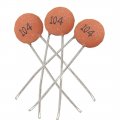
CERAMIC 104.jpg
I see these are (0.1uf / 104) often used for bypassing and stuff.And I am thinking about using a few, the same way across 22V rail.
So, will they be safe with that voltage, or they will burn up ?
 

dl324

Joined Mar 30, 2015
18,216
What could be the voltage rating for these cheap brown colored ceramic disc capacitors ?
It would appear to depend on the manufacturer and the specific part number. I searched Jameco and they had 6 0.1uF ceramic disc caps with operating voltages of 25, 50, or 1000V.

I have several boxes of MuRata 0.1uF ceramic disc caps and the voltage rating is marked under the capacitance. 12V in my case.
 

Thread Starter

IcedFruits

Joined Jan 15, 2014
100
Okay. So I guess 25V is the minimum i can expect for these unmarked ones. I just went and soldered them in those places. And they working without any problem.

Thanks.

(i have some 0.2uf ones that are marked 16V though)
 

MrChips

Joined Oct 2, 2009
34,626
You have not provided much information. For example, what is the unit and what is the supply voltage? What is the size and style of the capacitor package?
 

Thread Starter

IcedFruits

Joined Jan 15, 2014
100
You have not provided much information. For example, what is the unit and what is the supply voltage? What is the size and style of the capacitor package?
well, as i mentioned in the original post, they are at 22v line. and they look like the picture in the first post mentioned as well. don't really have any more on these, since they are purchased from local retail electronics parts shop.

That's not wise.
Doing this is not advisable. Working without problems so far...
it is being used for bypassing the input section of a discrete amplifier, and 22v is coming there through a 100ohm resistance (to a 100uf cap) for some minimalist regulation.

i guess, if this ceramic goes short, 220mA will flow through the resistor, and it will burn up.
 

MrChips

Joined Oct 2, 2009
34,626
If you have a number of these capacitors you can perform a destructive test on one.
Increase the applied voltage until it blows up. Then derate the safe operating voltage to 50%.
 

sparky 1

Joined Nov 3, 2018
1,218
If you compare the 104 xxx to a X5R or X7R 50V having the same 104 value for a power rail application.
The process should use high vacuum curing the ceramic and in glazing to prevent moisture. Dry and absorbent is bad.

If application used as a timing capacitor then more characteristics could be found. Measuing 990nF also has RC relationship.
The quality of the dielectric material could be estimated. It might be 10%, 20% or 30%, I guess it's mostly operating temperature and uF accuracy.
Unfortunately most of the orange ceramic only marked 104 are 20% but could be wrong. the size usually indicates the voltage. If the RC formula match a low percent error then you might have a better quality. They might be good as bypass, an average circuit might very well use a 20 or 30% without much noticeable difference otherwise 5% might be over kill. For issues requiring low noise or low ESR, some Tantalum or barium titanate
and other specific dielectric material are preferred. You might later end up with a variety of types. It is good practice to use labels.

I put together a 555 timer kit years ago and replaced the brown orange 104 cap for a green mylar 0.1uF 50V
On the power rail an X5R was fine for bypass. As voltage and power goes up the compliance also goes up.
In such an application I like the performance of the Mylar for timing, it follows the RC formula. In an RF HF application a silver mica have been popular.
Because I read so many do it yourself magazine articles, I have a bias toward what worked at the time.

Going to a website of a quality capacitor manufacturer reading application notes for a specific end use is better.
Most of the improvements I made resulted from the manufacturers engineering lab's recommendations.
Power Supply 22V going into something . Noise being a reasonable question otherwise..
Might need to step up a bit, the X7R 100V with reliable quality, personally I would over rate, but it's your call.
 
Last edited:
Top