Voltage Divider with variable load

Thread Starter

testing12

Joined Jan 30, 2011
80
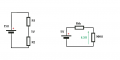
Hello, can someone please help me create the following curcuit? Id like to know the steps so i can to solve this. I dont seem to be getting the correct answer its very frustrating because it seems so simple. please advise.
Thank you!


Here is my attempt which is completly wrong.
 

Jony130

Joined Feb 17, 2009
5,599
For IL = 5mA we want Vout = 5V ±0.5V
So for RL = 4.5V/5mA = 900Ω
For IL = 0A we want Vout = 5V
And from thevenin Vth = 5V and Rth = 0.5V/5mA = 100Ω
Rth = R1||R2 = (R1*R2) / (R1+R2) = 100Ω
Vth = 15V * R2/(R1+R2) = 5V

R1/R2 = 2 and (R1*R2) / (R1+R2) = 100Ω

Is this enough?
 
Last edited:

Thread Starter

testing12

Joined Jan 30, 2011
80
Hello,
Im sorry im very new at this, i dont understand what your are doing from the 4th line on.

That is, from here:

"And from thevenin Vth = 5V and Rth = 0.5V/5mA = 100Ω
Rth = R1||R2 = (R1*R2) / (R1+R2) = 100Ω
Vth = 15V * R2/(R1+R2) = 5V
R1/R2 = 2 and (R1*R2) / (R1+R2) = 100Ω"

I dont know what Vth and Rth represent and where the 0.5 Volts comes from. I know the max allowables are 5.5 V and 4.5 V but dont understand why the 100 ohms is needed and what is being done with this value. Im verry sorry as i mentioned im very new at this.

Thank you for your reply.
 

Ron H

Joined Apr 14, 2005
7,063
For IL = 5mA we want Vout = 5V ±0.5V
So for RL = 4.5V/5mA = 900Ω
For IL = 0A we want Vout = 5V
And from thevenin Vth = 5V and Rth = 0.5V/5mA = 100Ω
Rth = R1||R2 = (R1*R2) / (R1+R2) = 100Ω
Vth = 15V * R2/(R1+R2) = 5V

R1/R2 = 2 and (R1*R2) / (R1+R2) = 100Ω

Is this enough?
For IL = 0A we want Vout = 5V
According to the specification, this could be 5.5V, which will allow less power to be wasted in the divider.
 

Jony130

Joined Feb 17, 2009
5,599
Do you familiar with thevenin's theorem?

Vth represent Vout voltages for IL = 0A

Vth = 15V * R2/(R1+R2)

And now if we connect a load 5mA and Vout drops to 4.5V
then internal resistance Rth is equal (5V - 4.5V) / 5mA = 100Ω
And Rth - represent R1 and R2

Rth = R1||R2= (R1*R1)/(R1+R2)
 

Attachments

Jony130

Joined Feb 17, 2009
5,599
Is that a good reason for wasting power?:rolleyes:
Hm, and I'm not so sure about this power wasting.
For 5V R1 = 300Ω ; R2 = 150Ω
For 5.5V; R1= 272.727Ω ; R2 = 157.895Ω
So R_total is equal to 450, and 430.622 . So I really don't understand.
 

Ron H

Joined Apr 14, 2005
7,063
Hm, and I'm not so sure about this power wasting.
For 5V R1 = 300Ω ; R2 = 150Ω
For 5.5V; R1= 272.727Ω ; R2 = 157.895Ω
So R_total is equal to 450, and 430.622 . So I really don't understand.
For 5.5V no load to 4.5V full load, I get Rth=200Ω
R1=545.45
R2=315.79

Exactly half the wasted current relative to your original values.
I think you forgot to recalculate Rth.
 

Thread Starter

testing12

Joined Jan 30, 2011
80
Hi guys thank you for all your replies, much appreciated. I will have to solve this with algebra i have not learned thevenin's theorem yet. I will work through the posts to see if i can come to some understand and post an answer if im able to. Once again thanks for all your time.
 

Jony130

Joined Feb 17, 2009
5,599
First
No load and Vout = 5V---> R1/R2 = 2
Now with load 5mA Vout = 4.5V
R1/(R2||900Ω) = 2.333
So you need to solve this
R1/R2 = 2 (1) --> R1=2*R2

2R2 / [(R2*900) / (R2+900)] = (15/4.5V -1)
(2)
Solve for R2
 

Ron H

Joined Apr 14, 2005
7,063
Hi guys thank you for all your replies, much appreciated. I will have to solve this with algebra i have not learned thevenin's theorem yet. I will work through the posts to see if i can come to some understand and post an answer if im able to. Once again thanks for all your time.
Yeah, you can easily do it without Thevenin's theorem.
It's just 2 equations and 2 unknowns.
 

Thread Starter

testing12

Joined Jan 30, 2011
80
First
No load and Vout = 5V---> R1/R2 = 2
Now with load 5mA Vout = 4.5V
R1/(R2||900Ω) = 2.333
So you need to solve this
R1/R2 = 2 (1) --> R1=2*R2

2R2 / [(R2*900) / (R2+900)] = (15/4.5V -1) (2)
Solve for R2

after following through and solving i got R2 = 1028.57 ohms or 1Kohm
and R2 = 2057.14 k ohm.

The probem comes when i try this in the electronics workbench simulator i have, it shows that the voltage drop accross the load is 3 volts when its not supposed to be less then 4.5 volts.

thanks again for your help guys...
 

Jony130

Joined Feb 17, 2009
5,599
Try again

2R2 / [(R2*900) / (R2+900)] = (15/4.5V -1)

2R2 / [(R2*900) / (R2+900)] = 2.33333333


2R2/1 * (R2+900)/(R2*900) = 2.33333333

( R2 + 900 )/450 = 2.33333333

R2 + 900 = 1050

R2 = 1050 - 900 = 150
 
Last edited:

Ron H

Joined Apr 14, 2005
7,063
Jony130 is pretty stubborn about using 5.0V instead 5.5V for the unloaded voltage. If I were your instructor, I would knock your grade down if you did that. The answer could be correct technically, but it is poor engineering practice. Why not just make R1=2 ohms and R2=1 ohm? It still meets spec, but I'll bet it is not what your instructor is asking for.
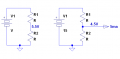
Have you studied Kirchoff's laws? Another way is to use KCL (Kirchoff's current law) to solve the problem.
See the attached schematic. You should be able to write one equation for the unloaded case on the left, and another for the loaded case on the right.
I'm not saying this is a better method than Jony130's. Just another approach.

I'm trying to leave a little of the work for you.
 

Attachments

Thread Starter

testing12

Joined Jan 30, 2011
80
Hi Ron,

yes i have studied KCL and KVL as well as ohms law, i just have never done anything dealing with a variable resistor. I will be studying this in greater detail in about half hour.
 

Ron H

Joined Apr 14, 2005
7,063
I forgot to label the voltage source on the left hand circuit. Obviously (I hope) it is the same 15 volts.
Think simultaneous equations.
 

Jony130

Joined Feb 17, 2009
5,599
But if you set Vout = 5.5V and then allow the voltage to drop from 5.5V to 4.5V then the error will be bigger then ±10 ?
(5.5-4.5/5.5) x 100 = 18%
But it seems that I'm wrong
 
Top