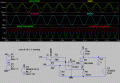
Voltage controlled current source Input +/- 10V output +/- 50mA

ci139

Joined Jul 11, 2016
1,993
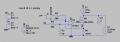
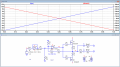
Succeeding in CC or CV is always a bit of luck how you manage to set it up for particular task ... so i took here quite a trivial top down design (that may be difficult to implement in practice due high prcision of resistors required ...) . . . anyway -- the current summing and load resistance independent draft ver. : cc_Draft_BP-1.gif
 

Attachments

I've built such an animal before. I used an LT1010 within the feedback loop of another OP-amp to boost the current. I used their applications note circuit to isolate a capacitive load.

You have to remember that the voltage across a capacitor can;t change instantaneously and the current through an inductor can;t change instantaneously. That mat result in some instability.

Vos and Ib are the most important parameters for OP-amps used in I-V converters. Vos does change with temperature.
 

ci139

Joined Jul 11, 2016
1,993
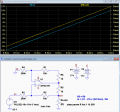
Yeah! - a quick fix was provided above (i'm quite not certain whether to use CC CV for neg. input reference there - i guess it's cc but it's "i guess" . . .)

. . . not - that it's temperature dependency got any better . . .

but it'll much likely won't work at all with that opamp coz it has p-Jfet input ... V.CM Common-mode voltage VCC– + 4 VCC+ – 4 V

however with opamps it always comes to that most precise responce is got from final output feedback = the line to R.LOAD had to be sensed and used for regulation although the near Zero goes messy . . .
_____________
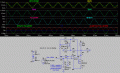
a bit modified : cc_Draft_VCCS-010b.gif
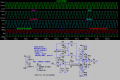
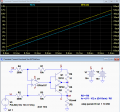
+ output feedback ver.: cc_Draft_VCCS-011a.png (+some extra models on .zip)
 

Attachments

Last edited:

Thread Starter

felix staehli

Joined Aug 14, 2019
18
Thanks a lot guys, I really enjoy that LTspice, there is a problem, in some of the models it cannot find symbol (s). Is there a way to add components into a library of LT spice.
 

crutschow

Joined Mar 14, 2008
38,529
Is there a way to add components into a library of LT spice.
Yes.
You can put the .sub or .lib model file in the lib\sub file, and put the symbol file in the appropriate lib\sym file.
If you don't have a sym file, you can pull up a similar symbol and modify it in LTspice so it's associated with the appropriate .lib/.sub file.

Here is more info on how to do that.

Below are the two files for the OPAx197 op amp I used in my Howland circuit simulation.
 

Attachments

Last edited:

Thread Starter

felix staehli

Joined Aug 14, 2019
18
thanks crutshow! one question to the howland. I am concerned about the temperature drift. is there a way to add maybe transistors?

one more thing, the load impedance can be 10 to 250 Ohms I just learned :( sorry for the late add on.
 

crutschow

Joined Mar 14, 2008
38,529
one question to the howland. I am concerned about the temperature drift. is there a way to add maybe transistors?
Why do you think adding transistors would reduce temperature drift?
Transistors have significant changes in their parameters with temperature.

How large a temperature change will the circuit experience?

The Howland circuit drift is mainly dependent upon any changes in the resistors with temperature, plus the OPAx197 op amp input offset drift of 2.5μV/°C, which will add about a 0.26μA/°C drift in the output current.
You should thus select resistors with a low temperature coefficient.
the load impedance can be 10 to 250 Ohms
I had to bump up the supply voltages to insure 50mA for the 250Ω load.

upload_2019-8-15_8-38-40.png
 
Last edited:

Thread Starter

felix staehli

Joined Aug 14, 2019
18
Hi Eric, i think i try that Howland circuit from crutshow.

@crutschow, your point is valid, voltage drift has a very small impact. but maybe there is a problem with overheating when runing at high currents. I think i will try.
 

crutschow

Joined Mar 14, 2008
38,529
maybe there is a problem with overheating when runing at high currents. I think i will try.
Good point. The op amp power can go to about 850mW@50mA with a 10Ω load.
That will require a heatsink or, perhaps better, the addition of some buffer power transistors.

Below is the circuit with BJT buffer transistors.
The transistors are inside the feedback loop, so will have no significant effect on the temperature drift.

upload_2019-8-15_19-41-24.png
 
Last edited:

crutschow

Joined Mar 14, 2008
38,529
Here're the BJT models:
Add them to the lib\cmp\standard.bjt file.

.MODEL TIP32 pnp
+IS=1e-09 BF=134.366 NF=1.29961 VAF=10
+IKF=0.742988 ISE=1e-16 NE=1.40014 BR=0.1
+NR=1.46599 VAR=100 IKR=3.21978 ISC=1e-16
+NC=2.71657 RB=7.44433 IRB=2.41268 RBM=0.218936
+RE=0.0152284 RC=0.0761421 XTB=0.1 XTI=1
+EG=1.05 CJE=3.26474e-10 VJE=0.446178 MJE=0.464223
+TF=1e-08 XTF=3.50642 VTF=8.2848 ITF=0.0305862
+CJC=3.07595e-10 VJC=0.77548 MJC=0.476497 XCJC=0.799334
+FC=0.8 CJS=0 VJS=0.75 MJS=0.5
+TR=9.57121e-06 PTF=0 KF=0 AF=1 Vceo=40 Icrating=3
**************************************
**************************************
.MODEL TIP31 npn
+IS=1e-09 BF=1200 NF=1.23899 VAF=10
+IKF=0.0333653 ISE=1e-08 NE=2.29374 BR=0.1
+NR=1.5 VAR=100 IKR=0.333653 ISC=1e-08
+NC=1.75728 RB=6.15083 IRB=100 RBM=0.00113049
+RE=0.0001 RC=0.0491489 XTB=50 XTI=1
+EG=1.05 CJE=3.26475e-10 VJE=0.446174 MJE=0.464221
+TF=2.06218e-09 XTF=15.0842 VTF=25.7317 ITF=0.001
+CJC=3.07593e-10 VJC=0.775484 MJC=0.476498 XCJC=0.750493
+FC=0.796407 CJS=0 VJS=0.75 MJS=0.5
+TR=9.57121e-06 PTF=0 KF=0 AF=1 Vceo=60 Icrating=3
 
Top