Vintage 6v Motorcycle Horn Repair

Ya’akov

Joined Jan 27, 2019
10,353
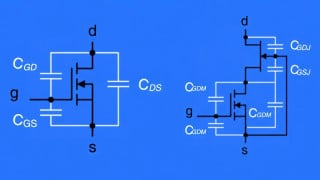
The very first thing, looking at the circuit, is that the horn has TWO CONNECTIONS! A Blue wire that get connected to fram ground (common) and a yellow wire that also is the power feed for some lights. So the horn is missing a connection! Next, others should examine the brake lights arrangement, which looks to me that the brake light switches are normally closed, which is reasonable because they are in series. PLUS, see the note: "Blue wire must be grounded to run."
This is an AC electrical system!!! So it is indeed an AC horn. And it is missing a terminal. Never would have noticed that if we had not seen the circuit diagram. Seeing the diagram told me a lot: First, there is no battery so probably no DC. Then, seeing that the horn has two connections, and case ground is not one of them , That tells me that the electrical system is quite different. IT IS AN AC SYSTEM!!!

And OF COURSE!!! That is why the six volt horns I put on a car many years ago had two isolated terminals that enabled me to put them in series. They had no horn relays! one side went to the battery positive, and the horn switch on the steering wheel grounded the other side. That is why the horn always stuck on when vehicles crashed in front.
Now it all makes perfect sense.
And the horn in question has the damaged terminal connection shorted to the case because the plastic melted when somebody tried to solder a wire to it.
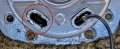
It’s not missing a terminal, it just has only one pigtail plugged in to one of the two recessed spade/faston terminals on the back.

1701179244446.jpeg​
 

MisterBill2

Joined Jan 23, 2018
28,490
OK, that was never apparent to me. And neither of those should be connected to the case.
And the ONLY part that may be six volt is the bulbs in the light. This is an AC magneto system exclusively. The starting must be either kick-pedal or "Run and Bump", which can work with small engines but is quite a challenge on a 74.
 

Tonyr1084

Joined Sep 24, 2015
9,744
OK, so I don't know if the disc in the centre of the diaphragm is magnetic but I will check. The coil inside the horn does produce a magnetic field and does pull the diaphragm on to it until the power is released.
AH! MOPED! I know I've heard a horn from such a bike before. As the motor slowed down the horn tone dropped.

OK, we know the diaphragm pulls in. That means the coil is good. If you're testing the horn using a 12V transformer then it's unlikely you're going to get it to do much more than suck in and stay there. Since the engine RPM which spins the generator can run from (guessing) 700 RPM to possibly 3500 RPM then with every rotation of the engine you'll produce a single positive going sine wave signal. Pulse that is. At 700 RPM that's almost 12 pulses per second (Hertz). 3500 RPM (divided by 60) equals 58Hz. A line transformer is producing 50 to 60Hz depending on where you are. So a transformer with sufficient current should work as far as testing goes.

Since you describe the diaphragm pulls in and stays in until power is removed then it's possible that either the core is becoming magnetized and remaining saturated even in the event of a negative going sine wave. It might just be the diaphragm doesn't drop out fast enough. Or maybe there's a loss of tension that pulls the diaphragm away from the coil. Of course this is all speculation.
 
Top