Hi, i am a beginner in electronics, i want to design a VHF/UHF tv antenna in the frequency range of 40 - 800 mhz. What are the most reliable tv antenna design pages ?
I assume you mean MHz.
Designing such an antenna is strictly for experts in antenna design.
If you want to build one, Ramussons reference looks good.
But why do you want to build one, when you can buy one?
And does anybody still have cable TV? (Oh, I see where you are).
I get streaming HDTV anywhere in my house over WiFi from my internet modem (and cheaper than cable TV).
Cable TV is so yesterday and rapidly disappearing due to declining customers, along with the decline in POTS service (do you also have a landline for your telephone?).
Cable companies here are eliminating cable TV as a separate service, and translating to being internet-only providers.
But there are still a few who get over-the-air free TV.
(I think there are a number of TV station OTA broadcast antennas still in operation, even in Canada).
My high-speed internet provider also provides my many-channels and world-wide cable TV, a many-channels recorder and an old fashioned telephone service with free long distance at a bundled low price. Now they are pushing adding security cameras and recorders.
A competing provider uses fiber-optics cables.
I assume you mean MHz.
Designing such an antenna is strictly for experts in antenna design.
If you want to build one, Ramussons reference looks good.
But why do you want to build one, when you can buy one?
I'm looking for a website with the necessary design equations. Which websites with antenna calculators are reliable? Anybody knows one please post a link
RE:"" in the frequency range of 40 - 800 mhz "" The Mission Impossible.
The classical antenna constructions have banwidth much narrower, e.g. 155-165 MHz, yet the LogoYagi is one of antenna types capable to cover much wider bandwidth eg 300-900 MHz, but not so wide as You wish. My councel - apply one LogoYagi for 40-200 and another from 200-1000.
RE:"" in the frequency range of 40 - 800 mhz "" The Mission Impossible.
The classical antenna constructions have banwidth much narrower, e.g. 155-165 MHz, yet the LogoYagi is one of antenna types capable to cover much wider bandwidth eg 300-900 MHz, but not so wide as You wish. My councel - apply one LogoYagi for 40-200 and another from 200-1000.
RE:"" in the frequency range of 40 - 800 mhz "" The Mission Impossible.
The classical antenna constructions have banwidth much narrower, e.g. 155-165 MHz, yet the LogoYagi is one of antenna types capable to cover much wider bandwidth eg 300-900 MHz, but not so wide as You wish. My councel - apply one LogoYagi for 40-200 and another from 200-1000.
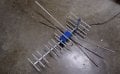
see picture, this is the antenna i want to build. It also uses a preamp. The antenna has a boomlength of 60 cm and is 80 cm wide. The materials they made the antenna of a are very cheap and weak. I want to try do make adjustments and use better, sturdier materials. I've looked at a lot of websites with information and antenna calculators, like this one https://www.steeman.org/Antenna/Yagi-Antenna-Calculator. If anyone knows a reliable source with info about how i can build this antenna please post it, many thanks in advance
And does anybody still have cable TV? (Oh, I see where you are).
I get streaming HDTV anywhere in my house over WiFi from my internet modem (and cheaper than cable TV).
Cable TV is so yesterday and rapidly disappearing due to declining customers, along with the decline in POTS service (do you also have a landline for your telephone?).
Cable companies here are eliminating cable TV as a separate service, and translating to being internet-only providers.
But there are still a few who get over-the-air free TV.
(I think there are a number of TV station OTA broadcast antennas still in operation, even in Canada).
Over-=the-air TV is about a thousand times more reliable than cable TV, which is a benefit indeed. And it is a lot less costly, and far more private, in that the cable company does not know what you are watching. Of course, I do not watch much because there is always something better to do, even if it is only solving problems for folks on some forum.
I pay about US $3 a month for cable TV but my girlfriend just told me that we don't get any signal so months ago she had a satellite antenna and converter installed. Where I live, there is not much over the air TV so for those who watch TV, options are limited.
Rather classical two range antenna with LW range adjusted to director, and SW range adjusted to vibrator line aka Yagi. And reflector adjusted to SW range. All formulas according the standard school books.
Back to the request in post #1, the closest to a wide bandwidth resonant antenna will probably be what is referenced as a "Log-Periodic" antenna. There are quite a few well done articles, including all of the formulas, available. And an effective antenna for that frequency range will be rather large, and quite directional.
And within that frequency range yo will find lots of rather high powered broadcast media in addition to narrow segments with many other types of signals at vastly lower power levels.
So i suggest considering a smaller segment to target, and also locating a spectrum allocation chart, which provides rather brief descriptions of what use has been assigned to different frequency ranges.
The challenge is that any receiver able to provide useful reception of that whole frequency range will be rather complex, and probably quite expensive as well.
I'm looking for a website with the necessary design equations. Which websites with antenna calculators are reliable? Anybody knows one please post a link
The challenge is that any receiver able to provide useful reception of that whole frequency range will be rather complex, and probably quite expensive as well.
Do not believe for a moment that that the complete USB dongle receiver system is not complex. Just because part of it resides in a small package does not mean that the IC devices inside are not complex. In addition, the attached computer that the dongle plugs into is fairly complex as well. Just because complexity is not easily visible does not mean it is not present.
Do not believe for a moment that that the complete USB dongle receiver system is not complex. Just because part of it resides in a small package does not mean that the IC devices inside are not complex. In addition, the attached computer that the dongle plugs into is fairly complex as well. Just because complexity is not easily visible does not mean it is not present.
Didn't say it wasn't complicated (it's not complex, as the math/programming is pretty simple and logical), only cheap and simple to use for 'normal' people. I used and repaired the Military (very expensive) equivalent of a HD SDR in the 70's so I do understand the technology and theory of IQ demodulation. It really is only complex to those that don't understand the techniques and technology. https://forum.allaboutcircuits.com/...in-electrical-engineering.176958/post-1603597

 Facebook
 Google
 GitHub
 Linkedin