Facebook
 Google
 GitHub
 Linkedin
I am currently designing a coplanar waveguide (CPW) structure for the attached circuit. In the past, I created a CPW structure for a passive antenna using FR4 material for the PCB, which has a dielectric constant of 3.48. The PCB thickness was 0.5 mm, which I used as the distance between layers, with the second layer serving as the reference ground plane. For that design, I calculated a 1 mm RF signal width and a 0.2 mm clearance from the ground using an online calculator. However, I am encountering difficulties applying the same approach for an active antenna due to differences in the design
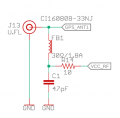
Attached is the schematic for the circuit I am designing on the PCB
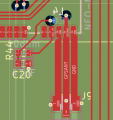
the coplanar waveguide (CPW) structure I attempted doesn’t seem to be designed correctly
I am seeking advice on the optimal component placement for this circuit to ensure the best performance, particularly for components such as the ferrite bead, capacitor, and resistor in the RF signal path. Additionally, I would appreciate guidance on how to properly route traces. I am a beginner in circuit designing and PCB design, so any help or suggestions would be greatly appreciated
Attached is the schematic for the circuit I am designing on the PCB
the coplanar waveguide (CPW) structure I attempted doesn’t seem to be designed correctly
I am seeking advice on the optimal component placement for this circuit to ensure the best performance, particularly for components such as the ferrite bead, capacitor, and resistor in the RF signal path. Additionally, I would appreciate guidance on how to properly route traces. I am a beginner in circuit designing and PCB design, so any help or suggestions would be greatly appreciated