VFD powering a motors AC elecromechanical brake, can it be done?

Thread Starter

Renesis

Joined Jul 14, 2009
14
Hello everyone.

I have an issue with the yaw system on some large 4MW wind turbines. The yaw system is made out of eight yaw drives engaging a massive toothed ring, each consisting of a high ratio gearbox and an electromechanically braked motor. The control circuitry is simple, the brake magnets are three phase ac powered and are connected directly to the motor supply on the connection board. Yaw left and right is controlled with a contactor for each direction, the motors are started directly on line.

The problem is excessive wear. The acceleration, and possibly moreso the deceleration on starting and stopping is so violent that the motor and brake components such as splines, keys and even shafts wear out and snap. Even the blades on the cooling fans start cracking and falls off over time, which is insane. The wind conditions here are so unstable and severe that the yaw system has far more starts per unit time than it was ever designed to handle, and wears to the point of failure atleast 5 times faster than it should.

The manufacturer is unwilling to rectify this, and with the end of the warranty period approaching, i've started looking at the feasibility of converting the entire system to be run by VFD's instead, so i can disengage and engage the brakes at low rpm, and softstart the motors. But there are many turbines, and cost will be a major determining factor here. To keep the cost down, i would like to avoid any rewiring other than that inside of the control cabinet, which means no separate powersupply for the motor brakes. And rewiring the brakes will be impractical for several reasons beyond just cost.

Is this even possible? Can a VFD power a three phase induction motor in such a way that it will reliably disengage an electromagnetic brake connected in parallel with the motor? I imagine the answer will generally be a resounding NOPE, but shurely this question must come up from time to time. Maybe some manufacturer carries a special model of VFD designed for this particular task? Does anyone want to share some insight or experiences?

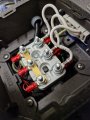
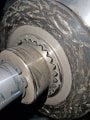
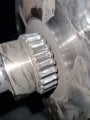
I've added some images showing the nameplate of the motors and how the brake supply wires are connected between each of the phases and the motors star point. I also added some images of a worn out brake disk and spline, that has been in operation for no more than four years.

Regards.
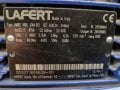
20241126_132939.jpg

20241126_133146.jpg

20230502_125609.jpg

20230502_125621.jpg
 

Alec_t

Joined Sep 17, 2013
15,103
I have absolutely no experience with handling 3-phase motors, but I note that the motors and brakes are rated for a 50Hz supply, so any winding energised at a lower frequency by a VFD will present a lower impedance than normal. Unless the winding can handle the resulting increased current I would expect it to have a correspondingly shorter life than normal. :(
 

schmitt trigger

Joined Jul 12, 2010
2,027
Since VFDs control the motor speed by SIMULTANEOUSLY reducing the frequency and voltage your idea might, just might work.
I would test the idea on a single turbine and see how this works.

(*) This is called a constant V/F ratio. As long as it remains constant, and the VFD precisely does that, the magnetic core won’t saturate.
 

MisterBill2

Joined Jan 23, 2018
27,181
I have a bit of experience, and the immediate analysis is that the control scheme is incorrect in more than one way.
First, the brake needs time to be fully released before any power to drive the motor is applied. This means that the brake must not be wired in parallel with the motor power.
Second, from the description, the variable speed capability does not appear to be utilized, as the statement of a violent sudden start. Most VF drives can be programmed for a gentle start, but that is not possible if enough power is provided to disengage the brake at the same time.
This means that the brake release power must be separate from the motor drive power, and also controlled separately.
IF the description of the current arrangement is correct, there is no simple way the operation can be improved. Adding a viscous drive coupling could work, but that is not a reasonable option.
As it stands, the design is certainly incorrect!!!
 

Thread Starter

Renesis

Joined Jul 14, 2009
14
Lots of good replies here, thank you all.

the motors and brakes are rated for a 50Hz supply, so any winding energised at a lower frequency by a VFD will present a lower impedance than normal.
Since VFDs control the motor speed by SIMULTANEOUSLY reducing the frequency and voltage your idea might, just might work.
I would test the idea on a single turbine and see how this works.
Im not worried about the brakes being overcurrented, because as Schmitt points out, the V/f ratio is kept relatively constant. What i am worried about is wether the current will be high enough in the initial stage of operation to fully release the brakes before the torque rises too much. I want to reduce the wear, not increase it, lol. I was imagining something like an operation mode where the voltage is increased way beyond the correct V/f ratio for a split second during startup, to properly magnetize the brake and physically move the brake components before the motor starts, well, motoring. But if this is even doable i have no idea. And the VFD might throw all sorts of fault codes too. That's why im wondering if any VFD manufacturers has a solution to this particular problem.

I would love to try this out on a single turbine, but that is far from realistic at this stage. Management is not onboard with my idea yet, and because of the simple fact that my employee card says technician and not engineer, they're not likely to listen to me anytime soon either. I'd need to make a pretty convincing pitch if im to get this project off the ground. Maybe i could get funds to try it out on a single spare motor? Hmm...

VFD's typically have a PLC stages, IOW I/O that can be programmed for various conditions.
Im aware of this, and it could be a great cost saver by avoiding a dedicated PLC. But that i a bit off the topic of this thread. Thank you for pointing it out though.

I have a bit of experience, and the immediate analysis is that the control scheme is incorrect in more than one way.
First, the brake needs time to be fully released before any power to drive the motor is applied. This means that the brake must not be wired in parallel with the motor power.
Second, from the description, the variable speed capability does not appear to be utilized, as the statement of a violent sudden start. Most VF drives can be programmed for a gentle start, but that is not possible if enough power is provided to disengage the brake at the same time.
This means that the brake release power must be separate from the motor drive power, and also controlled separately.
IF the description of the current arrangement is correct, there is no simple way the operation can be improved. Adding a viscous drive coupling could work, but that is not a reasonable option.
As it stands, the design is certainly incorrect!!!
I agree with your assessment, but let me clarify that the current yaw system does not have any VFD's.

The current control scheme is hardly a control scheme at all. All eight motors and all eight brake magnets are energized directly on line at the exact same time, with a single big contactor. You can hear the bang from a kilometer away. I cannot fathom why the OEM would choose this solution, especially since a proper VFD controlled yaw system would hardly increase the initial cost at all. There are two large operational contactors, for clockwise and counterclockwise, plus two equally big contactors for the E-stop circuitry. And each of the eight motor has one overcurrent relay and one short circuit protection relay. I doubt that eight small VFD's would be that much more expensive.

Indeed the brakes should have a separate power supply, this much is obvious. But retrofitting this would be a massive effort for several reasons, not least that we are talking about over a thousand motors in total.
 

MisterBill2

Joined Jan 23, 2018
27,181
The OEM selected the least expensive arrangement either because of incompetence or dishonesty! There is no reason to believe that a full voltage startup will be adequate in such a high inertia, high torque load application. Even an accountant should have seen that fact!
Given the size of the project, my thinking is that the motivation was dishonesty.
IT does not seem reasonable to think that a full voltage start of such a large, high inertia, load would work!
So how many systems are all ready on hand??
If a suitably rated VFD were able to provide a "full voltage zero speed" start, the DC could possibly release the brake before running the motor. BUT that is a W.A.Guess, not a studied engineering evaluation.
 

MaxHeadRoom

Joined Jul 18, 2013
30,559
A VFD has programming options for the internal PLC the will operate on the LV I/O when certain events occur, Detect when at zero speed, up to programmed speed etc.
etc
 

MisterBill2

Joined Jan 23, 2018
27,181
The problem in this specific case is that if the output POWER is high enough to adequately release the brake, the output torque is enough to do serious damage. Setting it for a gentle start will not release the brake. But there can not be a gentle start because it is across the line to start, and the brake is not yet released.
So just like I already stated, it is not correctly designed.The brake needs full voltage to release while the motor needs a gentle start because of all the inertia.
Thus, EVEN WITH a soft-start control, the brake release will need to be separate.. AND I can see that from almost 2000 miles away!!
 

MisterBill2

Joined Jan 23, 2018
27,181
Of…… Of……..
And the answer is……
{drumroll} Profits!
Really, though: Providing a seriously better product for a greater price would allow legitimate billing for more materials (with the markup) as well as additional labor charges. Instead, now the seller faces a certain legal judgement for providing an obviously poor design. (At least it is obvious to those who have ever created the motor controls for a high inertia load.)
 

MaxHeadRoom

Joined Jul 18, 2013
30,559
So just like I already stated, it is not correctly designed.The brake needs full voltage to release while the motor needs a gentle start because of all the inertia.
Thus, EVEN WITH a soft-start control, the brake release will need to be separate.. AND I can see that from almost 2000 miles away!!
It is essentially, as I mentioned, the brake can be full actuated from the VFD, even with a slow soft start. !
 

MisterBill2

Joined Jan 23, 2018
27,181
It is essentially, as I mentioned, the brake can be full actuated from the VFD, even with a slow soft start. !
OK, Max, please explain how one set of connections can provide enough power to release the brake but not to drive the motor that is connected to the same wires. Unless it uses red electrons.
 

MaxHeadRoom

Joined Jul 18, 2013
30,559
The PLC is separate internally to the motor control, they are generally 4- 6 outputs on just about all VFD's that can be set according to various conditions of the motor control itself.
They are either SS or relay contacts, usually both are available.
for e.g. a NO./NC relay contact that operates when the selected condition is met. power for the external device is provided separately to the VFD power for e.g.
 

MisterBill2

Joined Jan 23, 2018
27,181
Post #17 does not even pretend to hint as to how one set of 3 phase connections feeding both a motor and an electrically released brake can at the same time provide the power to release the brake and at the same instant power a gentle startup to the motor.
The reality is that first, enough power must be fed to the electrically released brake, and then a much reduced amount of power must be applied to the motor to provide enough torque to start it moving.
It is not clear to me as to how two different voltages can be present causing two different current levels to flow in the same wires at the same time.
So the initial error was to connect both the motor and the brake in parallel. They need to be separately controlled.
 

panic mode

Joined Oct 10, 2011
4,864
exactly... having worked with many servo and VFD drives i can confirm that they are always controlled separately. some products (SEW/Eurodrive) have separate brake control module but usually this is handled by the drive itself. so knowing the drive model and reading the relevant documentation (manual/datasheet/schematics) is absolutely essential...
 
Top