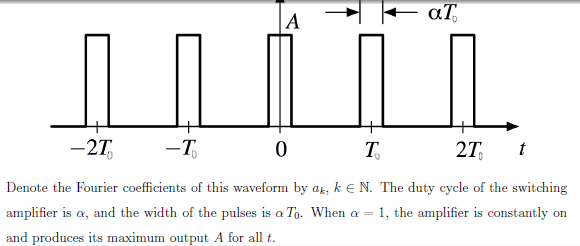
You might start by writing an expression which describes the time function [the pulse train] in a form which could be used to derive the Fourier series coefficients.
Remember the a0 term is simply the average value of the pulse train and it is written formally as
\(a_{0}=\frac{1}{T}\int^{T}_{0}f(t)dt\)
So how would you write the function f(t) over the interval t=0 to T
Looking at the waveform you will have to break it into several parts -
from t=0 to αT0/2,
from t=αT0/2 to (T0-αT0/2)
and from t=(T0-αT0/2) to T
The same will be true for finding the other Fourier coefficients.
If you think carefully about the average value case [a0] you don't need to do any integration ......
You might start by writing an expression which describes the time function [the pulse train] in a form which could be used to derive the Fourier series coefficients.
Remember the a0 term is simply the average value of the pulse train and it is written formally as
\(a_{0}=\frac{1}{T}\int^{T}_{0}f(t)dt\)
So how would you write the function f(t) over the interval t=0 to T
Looking at the waveform you will have to break it into several parts -
from t=0 to αT0/2,
from t=αT0/2 to (T0-αT0/2)
and from t=(T0-αT0/2) to T
The same will be true for finding the other Fourier coefficients.
If you think carefully about the average value case [a0] you don't need to do any integration ......

 Facebook
 Google
 GitHub
 Linkedin