Variable Rheostat question

Thread Starter

JStackz26

Joined Sep 20, 2023
12
Hello,
So I am not trolling. I haven't really studied electronics for basically like 6-7 years due to life circumstances. Got into another field and stuff.
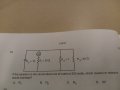
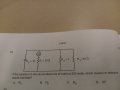
I have a quick matter about this image here.
I have been able to find research on rheostats. But I want to be sure to come to a correct conclusion on this.
The answer to question 7 is 100ohms but how is that answer derived.
There are also missing resistance values for R1, R2 and R3.
What I'd like to know is how to find them and also what the alphanumerical data means with the markings of
12SA7, 12AK7, 35L6

Apologies if it seems very basic information.

Also I'm not sure which is the correct thread for a post like this. Hopefully it gets moved to a correct thread. Feels like it should be education maybe.
1000011295.jpg
 

schmitt trigger

Joined Jul 12, 2010
2,027
It takes some knowledge of vacuum tubes to solve.
The first digits in the tube’s identifier are the filament voltage.
Thus 12+12+35=59 volts
The supply is 74, you must drop 15 volts in the rheostat.
Another piece of information, which is conveniently listed but could have been looked up in a tube manual, is the current 0.15 amp.
Then by ohms law, 15/0.15= 100 ohm
 

Thread Starter

JStackz26

Joined Sep 20, 2023
12
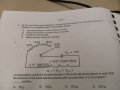
This is another one that is throwing me off, if anyone can help. Basically resistor value for R2 is missing. There are a few problems I see in this book like this and I am thrown off about how to determine the resistance. And stuff like this is really blocking my mind from being able to learn electronics further and really be good at the field.
It is definitely going to be an uphill battle with this here. I may have to ask a lot of what seems basic questions.
 

Attachments

Thread Starter

JStackz26

Joined Sep 20, 2023
12
It takes some knowledge of vacuum tubes to solve.
The first digits in the tube’s identifier are the filament voltage.
Thus 12+12+35=59 volts
The supply is 74, you must drop 15 volts in the rheostat.
Another piece of information, which is conveniently listed but could have been looked up in a tube manual, is the current 0.15 amp.
Then by ohms law, 15/0.15= 100 ohm
Thank you, I was really having a hard time determining what those meant. I thought they were values specifically about the resistance at first.
 

Thread Starter

JStackz26

Joined Sep 20, 2023
12
Now you know the voltage across each and the current through then. Hopefully, you can calculate the resistances.
My problem is that I tended to not be open about my deficiencies in electronics.

So now that you mention calculating the resistance, can you assist me in the problem that I just put up with the missing resistance value?

These are not homework assignments. This is independent study that I am doing on my own time. I'm working on doing 7-8 hours of study a day at least. To get myself very knowledgeable and capable in this field.
1000011320.jpg
 

boostbuck

Joined Oct 5, 2017
1,034
Determine the battery voltage: what voltage across 20 ohms (R1) will result in 4A?

R(total) = three resistors in parallel, one unknown.
What value of R2 in parallel with a 20ohm and 40ohm will result in a 10 ohm?

Having got the value of R2 and the voltage across all three, calculate the current through R2 and R3. Then calculate the power dissipated in each. It would seem that one of them is dissipating more than 250 watts.
 

boostbuck

Joined Oct 5, 2017
1,034
What value of R2 in parallel with a 20ohm and 40ohm will result in a 10 ohm?

Since 1/Rt = 1/R1 + 1/R2 + 1/R3,

1/R2 = 1/Rt - 1/R1 - 1/R3, therefore

R2 = 1/(1/Rt - 1/R1 - 1/R3)
 

MisterBill2

Joined Jan 23, 2018
27,179
For the problem in posts #4 and #6, if the current in R1 is 4 amps, and the resistor is 20 ohms, then V=I x R1=4amps x 20 ohms = 80 volts, and power is 4 amps x 80 volts= 320 watts (more than 250 watts)
The current in R3 (40 ohms)=I=V/R=80v/40ohms=2 amps. Power =40 V x 2A=80 watts.
Next R1\\R3= R1xR3 /(R1+R3)=/ 20x40/(20+40)=800/60=13.3ohms
If Rt=10 ohms, then 10 ohms=13.3R2/13.3+R2
10x(13.3+R2)=13.3R2
133+10R2=13.3R2
133=3.3R2
133/3.3=R2=40.303ohms
I think that is correct.
 

boostbuck

Joined Oct 5, 2017
1,034
The way I first looked at it:

if Rt = 10 ohms,
then if R1 = 20 ohms then
rest must = 20 ohms as well (20 in parallel with 20 is 10)
therefore since R3 = 40 ohms
R2 must be 40 ohms as well (40 in parallel with 40 is 20)
 

Thread Starter

JStackz26

Joined Sep 20, 2023
12
What value of R2 in parallel with a 20ohm and 40ohm will result in a 10 ohm?

Since 1/Rt = 1/R1 + 1/R2 + 1/R3,

1/R2 = 1/Rt - 1/R1 - 1/R3, therefore

R2 = 1/(1/Rt - 1/R1 - 1/R3)
Thank you looking at it this way is very useful in terms of equation forming
 
Top