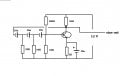
Why do you need a Sinewave oscillator, can you do this with a Square wave or Triangular instead, if so use a 555 timer chip.
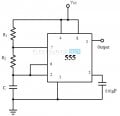
Here is a selection of 555 Astables, simply change C1 and make R1 variable with a 1K resistor in series to make ita Variable Oscillator.
http://ramon-electronica.blogspot.com/p/555.html?m=1
R1 make it a 22K pot and set it to 13K, make C1 100nF, this will give you 550Hz. your output will be at the supply voltage, so run it on a 6V supply.
I'm sorry, but I still don't understand the pin numbering system. Where does it start ?Which is #1, #6, etc ?R1 goes between pins 8-6, C1 goes between pins 2,6 and 1.
This is a top view of the '555:I'm sorry, but I still don't understand the pin numbering system. Where does it start ?Which is #1, #6, etc ?
Will do. Thanks. BTW, can I supply it with 12VDC from the car electrical, and still get the same results?On this diagram, make R1 1K, put your 22K variable resistor in R2, and make the capacitor C1 100nF on pin 6, set your preset to approx 13K, this will give you 550Hz .
View attachment 155446
Yes; the requirement for the car's computer is minimum 5.5 Volts and 550Hz. Since the signal comes from a permanent magnet 2 wire sensor inside the transmission, and generates AC, then I assume it mus be a sine wave. I am still a novice at electronics, and thought that AC only generates a sine wave.....???Be aware that the high level output (pin 3) is a rectangular wave and you can get a sawtooth of approximately 1/3 of the positive power supply across the timing capacitor, this would likely need to be buffered prior to use.
Does your 6VP-P signal have to be a sine wave?
Thanks Dave. However, I have not numbered my circuit's resistors and cap's. Which way are you numbering my circuit; from left to right, top to bottom, counter clockwise.....?R1 goes between pins 8-6, C1 goes between pins 2,6 and 1.
Your reasoning is sound. I suggest trying the NE555 (or more modern LMC555) pin 3 rectangular waves and if that solves your check engine light problem then you're done. If not, then I am sure one or more of us can recommend modifications to make the signal into a credible sine wave.Yes; the requirement for the car's computer is minimum 5.5 Volts and 550Hz. Since the signal comes from a permanent magnet 2 wire sensor inside the transmission, and generates AC, then I assume it mus be a sine wave. I am still a novice at electronics, and thought that AC only generates a sine wave.....???
Thanks Dick, much appreciated. Are you saying use the NE555 chip or LMC55 chip with the circuit in post #10 ? If so, I will get on it in the next few days.Your reasoning is sound. I suggest trying the NE555 (or more modern LMC555) pin 3 rectangular waves and if that solves your check engine light problem then you're done. If not, then I am sure one or more of us can recommend modifications to make the signal into a credible sine wave.
Thanks again Dick. I may simply use a 9V volt battery set. I will let you know if I change my plans. I may also attempt the Wein Bridge oscillator, since it appears very easy to build, and I have the components. I have lots of old radios, charges, motherboards, etc with tons of capacitors and resistors. Much appreciated all of you assistance. I know we can solve the issue. Anything I can do to simply send a signal to the ECM, in place of the faulty sensor, is what I need to do. I'm guessing the cars computer (ECM,PCM, ECA, etc) is more interested in the waveform, and not so much to voltage. Considering this is one of many two wire permanent magnet AC generators in use on the car (others are the vehicle speed sensor, cam/crank position sensor, anti-lock wheel sensor) it should not be so hard to do. I have even considered "piggybacking" off of one of those sensors to "steal" it's signal also. I'd rather just put in an oscillator and call it a day.In post #10 Dodgydave suggests the NE555. It might work better in your application than the more modern LMC555.
I guessing that you intend to operate this circuit from a 12 volt power supply. You will need something like a resistive devider to get down to 6 volts from the approx 10 volts that comes out of the NE555 or the 12 volts that comes out of the LMC555. Would you like some help with that? If can you tell us what the input to the transmission looks like electrically?
Edit: Does anybody know anything about that input other than 5.5V and 550 Hz?
That reminds me to recommend that you read the thread on protecting electronic comopnents in automotive applications.
https://forum.allaboutcircuits.com/...cuit-during-engine-start.150103/#post-1284439