Using zener diode for crowbar circuit

MisterBill2

Joined Jan 23, 2018
27,584
We were well aware that the camera would work as intended on 12 volts. My question was would it function correctly on a lower voltage. I was asking if it would work as needed and intended with a lower voltage of ten volts. There was never any question about operating correctly o twelve volts.
 

LowQCab

Joined Nov 6, 2012
5,101
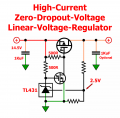
This Circuit can be "scaled" up or down depending on the Component-Specifications.
It does not require any Capacitors for stable operation.
.
Heavy Duty LDO Regulator .png.
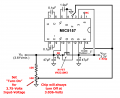
The below Circuit includes Current-Limiting and other desirable features ............
.
High Current LDO .PNG
.
 

PeteHL

Joined Dec 17, 2014
580
The article that I link to below is stating that a silicon controlled rectifier can be used as a crowbar. See about the fifth or sixth section of the article. Apparently if you apply a sufficient voltage across the anode and cathode of the SCR, and the gate of the SCR is unconnected, then the SCR is pushed into conduction. Not at all that familiar with the SCR, I don't know if a SCR that would conduct at a low enough voltage is available for the application that the thread starter has.

How about a manually triggered SCR in series with the load? That way, if there is a power failure, then no voltage can get to the camera when power is restored.

https://www.allaboutcircuits.com/textbook/semiconductors/chpt-7/silicon-controlled-rectifier-scr/
 

MisterBill2

Joined Jan 23, 2018
27,584
The article that I link to below is stating that a silicon controlled rectifier can be used as a crowbar. See about the fifth or sixth section of the article. Apparently if you apply a sufficient voltage across the anode and cathode of the SCR, and the gate of the SCR is unconnected, then the SCR is pushed into conduction. Not at all that familiar with the SCR, I don't know if a SCR that would conduct at a low enough voltage is available for the application that the thread starter has.

How about a manually triggered SCR in series with the load? That way, if there is a power failure, then no voltage can get to the camera when power is restored.

https://www.allaboutcircuits.com/textbook/semiconductors/chpt-7/silicon-controlled-rectifier-scr/
The goal is/was to protect the camera from voltage surges that evidently happen more often then voltage drop-outs. A shunt connected SCR is the classic approach to crowbar-mode over-voltage protection.
But in some areas it is the over-voltage that happens much more frequently. In one location where O lived it was caused by occasional "grounding" of one side of the split-phase power distribution grid,which would momentarily double our mains supply voltage. With an analog multimeter I measured one of those instances at 170 volts. The local utility folks denied it, what else could they do?? Admitting it would have opend them up to haVING TO PAY FOR THE DAMAGE IT DID.
 

schmitt trigger

Joined Jul 12, 2010
2,092
A circuit that I have used very successfully, and it was precisely to protect surveillance cameras, is a LTC4367 coupled with a Mosfet of adequate capacity.
It is an over voltage, under voltage and reverse voltage protector. Set points programmed with resistors. Instead of blowing a fuse, it quickly disconnects the load when the transient event occurs, and restores automatically.
Highly recommended. A little expensive though.
https://www.analog.com/en/products/ltc4367.html
 

PeteHL

Joined Dec 17, 2014
580
The goal is/was to protect the camera from voltage surges that evidently happen more often then voltage drop-outs. A shunt connected SCR is the classic approach to crowbar-mode over-voltage protection.
But in some areas it is the over-voltage that happens much more frequently. In one location where O lived it was caused by occasional "grounding" of one side of the split-phase power distribution grid,which would momentarily double our mains supply voltage. With an analog multimeter I measured one of those instances at 170 volts. The local utility folks denied it, what else could they do?? Admitting it would have opend them up to haVING TO PAY FOR THE DAMAGE IT DID.
Quoting from KevinHowJones' post #9,

"The power goes out frequently and when it comes back online that is when the problem occurs."
 

MisterBill2

Joined Jan 23, 2018
27,584
Quoting from KevinHowJones' post #9,

"The power goes out frequently and when it comes back online that is when the problem occurs."
OK, I stand corrected. But still, protection from the over voltage and returning to operation would seem to be the goal. Usually a security camera is most useful when operating.
 

PeteHL

Joined Dec 17, 2014
580
OK, I stand corrected. But still, protection from the over voltage and returning to operation would seem to be the goal. Usually a security camera is most useful when operating.
The question is whether or not he wants a simple less than optimum solution, or the ideal one that you propose which I assume would be more costly and maybe not so easily implemented by him.
 

MisterBill2

Joined Jan 23, 2018
27,584
A suitable voltage regulator costs less than a dollar and only demands two 0.1 mfd bypass capacitors. It is difficult to make a circuit simpler or cheaper than that.
 

PeteHL

Joined Dec 17, 2014
580
A suitable voltage regulator costs less than a dollar and only demands two 0.1 mfd bypass capacitors. It is difficult to make a circuit simpler or cheaper than that.
Okay I agree that the voltage regulator is the better solution. I suppose that LowQCab knows that the linear regulator can maintain a regulated output voltage even with a voltage spike at input.

EDIT: By the way, I didn't realize that in your post #28 you were referring to the use of a linear voltage regulator, I thought that you meant some circuit that would be more complicated. Using a voltage regulator is a great solution that I would have never thought of.
 
Last edited:
Top