Using two Ne555 to make 8 pulses at 40kHz

Thread Starter

yopy

Joined Apr 24, 2024
2
I made a monostable and astable NE555. I tried to connect them to output burst of 8 pulses at 40kHz, but the monostable is weird I can't seem to understand how it should work without a switch
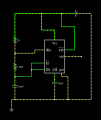
1713975266727.png

This is the monostable one. I added a switch so i can see how to connect it with the astable one.
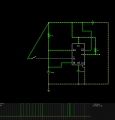
1714053334446.png

So my question is just, how should I make a the connection between them to make 8 pulses at 40kHz and if something is wrong.
Thanks
 

Thread Starter

yopy

Joined Apr 24, 2024
2
I was thinking of replacing the monostable with a astable that has 50% duty cycle and at 0.002Hz, but not sure if that work
 

Irving

Joined Jan 30, 2016
4,996
Connect the output of the monostable to the /RST of the astable. The astable will generate pulses for as long as the monostable output is high.

I can't seem to understand how it should work without a switch
I don't understand your comment. A monostable is triggered by an external event... ie your switch...

If you want to produce 8 pulses at a fixed interval then the second 555 must also be an astable with an 'on time' of 8 pulses of the other one, and an off-time of the required gap between pulses.

1714051261805.png
1714051335229.png

A pair of 555, or a single 556 (dual 555), works, but isn't the most accurate/reliable solution. For that I'd an ATtiny85 8-pin microcontroller. If you're interested, I'll describe how in another post.
 

MrAl

Joined Jun 17, 2014
13,667
I made a monostable and astable NE555. I tried to connect them to output burst of 8 pulses at 40kHz, but the monostable is weird I can't seem to understand how it should work without a switch
View attachment 320642

This is the monostable one. I added a switch so i can see how to connect it with the astable one.
View attachment 320705

So my question is just, how should I make a the connection between them to make 8 pulses at 40kHz and if something is wrong.
Thanks
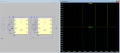
Hi,

There might be a problem trying to do this because the 555 in astable mode may not be able to start up fast enough to get all 8 pulses out that are of the same pulse timing.

My guess is that the astable would have to be running constantly, and you'd have to sync the monostable to that frequency in order to see 8 equal pulses come out of the astable. That's if you absolutely need all the pulses to be exactly the same. You might be able to use a trick though.

The problem with oscillators it they take a little time to start up. That's because it is hard to get them to be in the exact state that they need to be in order to start up correctly (fast enough) on the very first cycle.
One thing you can try, in addition to having the monostable trigger the astable, is to apply a voltage to the capacitor of the astable that is just under (or over) the threshold level, then when it is triggered, you remove that bias and let the oscillator start up normally. When the oscillator is halted again you then apply that bias to the capacitor again. It has to be just right though.
This would be to compensate for the astable capacitor voltage either dropping to near zero or near +Vcc when it is stopped, and you could check which it is and go from there.

This is sort of a guess for now though you could try it in simulation first and see if the startup behavior is acceptable without this kind of modification.

There could be other solutions also though. For example, set up to generate 9 pulses and block the first one out so it never gets to the output. That could be done with some logic and a simple delay circuit. The delay would have to be compensated by the trigger circuit which would then have to trigger the astable (and the delay) ahead of time by a little more than one pulse time.
 

WBahn

Joined Mar 31, 2012
32,703
You also need to consider adequate synchronization of the two, otherwise you may get nine pulses with the first and last one being short. Also, if the periods are adequately matched, you can get a pulse at either end that is cut short or a portion of an additional pulse that you didn't want. These are addressable issues, at least for a one-off, non-critical system. But you quickly get to a point of diminishing returns relative to just using a cheap MCU, even if it means some investment in tools and learning time (which will likely pay off handsomely down the road).
 

MrAl

Joined Jun 17, 2014
13,667
Hi,

Yes, the way it looks is that the 555 will always start up the same way if given the same 'off' times, so the startup time should be able to be predicted as well as the pulse width and period. That would mean setting up for the 9 pulses but adding a delay and AND gate so the first pulse does not get to the output. The last pulse out should be able to have its timing predicted too due to the first pulse period being predictable and the normal (eight) pulse periods being predictable.
Of course this has to be tested, but I think the crux of the matter is to time that first pulse startup time and create a delay circuit that accounts for that timing. This should not be too hard to calculate either.

That's if the trigger does not have to be in real time of course, like an oscilloscope. With this scheme once the trigger is triggered, there will be a delay that is longer than one normal pulse period. If that's not acceptable either then another way would have to be used such as the capacitor biasing/unbiasing scheme or something else altogether. It may be acceptable though if the delay could be incorporated into the trigger timing (trigger a little before the actual pulses have to start) but that still precludes real time triggering.

I would also prefer using a microcontroller as someone already mentioned, but we all know that brings in a host of other issues such as getting a programmer, learning to program, etc., etc. Some people are just not willing to do that especially for just one project.
 
Top