using higher voltage capacitor

Thread Starter

Daan Lageschaar

Joined Jul 8, 2019
45
Hi,

I just pulled two swollen 10uF 100v bipolar capacitors out of my Harman Kardon Sub-TS11 Subwoofer which I need a replacement for, however it's very hard to find the exact same ones so I was wondering if it's possible to use some capacitors that are rated for a higher voltage (and if this wouldn't affect audio quality).

Also, I don't know if they were DC or AC bipolar (that's a thing right?), so how do I find that out?

Thanks in advance :D

-Daan
 

SamR

Joined Mar 19, 2019
5,470
Yes, using a higher V is acceptable. You might also look at the temp rating and go higher there also. Electrolytic cans are obviously polar as well as tantalums. Tantalums are similar to multilayer ceramic but have polarity markings on them. A picture posted here would help us determine what the actual device is.
 

Thread Starter

Daan Lageschaar

Joined Jul 8, 2019
45
Yes, using a higher V is acceptable. You might also look at the temp rating and go higher there also. Electrolytic cans are obviously polar as well as tantalums. Tantalums are similar to multilayer ceramic but have polarity markings on them. A picture posted here would help us determine what the actual device is.
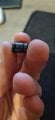
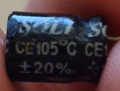
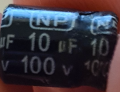
This is the cap:20200324_202431.jpg20200324_202440.jpg
 

PaulNewf

Joined Mar 24, 2020
17
Careful, try not to go too much higher on V. Some caps will have drastically different C at different V, see C's datasheet to be safe.
 

thedoc8

Joined Nov 28, 2012
162
Careful, try not to go too much higher on V. Some caps will have drastically different C at different V, see C's datasheet to be safe.
I don't get what you are saying. A rated 100V 50uf will have different C at different V, sorry don't get that.
 

Tonyr1084

Joined Sep 24, 2015
9,744
You want to stay with the same µF rating. Voltage ratings is just what the cap can handle. Higher voltage capabilities is safe. Lower ratings means the device may fail spectacularly. However, higher voltage caps are bigger. You might run into a space issue. Out in my garage I have a 47µF cap that is rated for 1000V. It's pretty darn big. Came out of a 480V 3Phase overhead crane. Using that in a stereo would be impractical due to its massive size. Large as a soda can (roughly).
 

dl324

Joined Mar 30, 2015
18,216
I just pulled two swollen 10uF 100v bipolar capacitors out of my Harman Kardon Sub-TS11 Subwoofer which I need a replacement for, however it's very hard to find the exact same ones so I was wondering if it's possible to use some capacitors that are rated for a higher voltage (and if this wouldn't affect audio quality).
The caps aren't bipolar. There's nothing special about them, so you should be able to find exact replacements.
EDIT: add cropped pictures:
1585087225114.png1585087253006.png

Newark has 18 varieties.
https://www.newark.com/w/c/passive-...or-terminals=radial-leaded&range=inc-in-stock

Using a cap with a higher voltage will usually mean a larger footprint. Other than that, knock yourself out.
 

PaulNewf

Joined Mar 24, 2020
17
I don't get what you are saying. A rated 100V 50uf will have different C at different V, sorry don't get that.
A 100uF 500V cap is 100uF at 500V, but may be different uF at 100V 200 300V etc. (Could be 10uF to 1000uF) Capacitor datasets typically have charts for uF change according to voltage and temperature. Try to match the specs or you might get strange performance.
 

SamR

Joined Mar 19, 2019
5,470
The caps aren't bipolar. There's nothing special about them, so you should be able to find exact replacements.
EDIT: add cropped pictures:
I think what he is asking is if they are polar. Yes, that is an electroylytic can type capacitor that has - & + polarity leads. Make sure to replace it with the same polarity as what you removed IE don't cross up + & - when you replace them. Some capacitors of the same uF specs will be different in size for various reasons. One that will fit the space with the uF rating and higher voltage rating is fine. But! Why did the capacitor fail or is it just puffed up from aging or leaking? Also look at the temp rating. Higher temp rating is fine but I would not go lower.
 
Last edited:

Thread Starter

Daan Lageschaar

Joined Jul 8, 2019
45
I think what he is asking is if they are polar. Yes, that is an electroylytic can type capacitor that has - & + polarity leads. Make sure to replace it with the same polarity as what you removed IE don't cross up + & - when you replace them. Some capacitors of the same uF specs will be different in size for various reasons. One that will fit the space with the uF rating and higher voltage rating is fine. But! Why did the capacitor fail or is it just puffed up from aging or leaking? Also look at the temp rating. Higher temp rating is fine but I would not go lower.
But on the cap it says NP, which means non polarized, right? So it shouldn't matter what way you put it in. And it doesn't say anything about polarity on the PCB it was attached to, so I guess it doesn't matter?

PS. Yeah it would have been a good idea to crop the pictures indeed
 

wayneh

Joined Sep 9, 2010
18,085
I haven’t looked those up but pay attention to one more spec, the ESR. It may be expressed in many ways and ripple current is related. If the originals have a ripple current spec, I wouldn’t go below that.

This is a concern for low ESR applications but may not be terribly important for a “generic” application. I mean, if the originals are not described as “low ESR” or such, then you can probably relax and not worry about it.
 

DickCappels

Joined Aug 21, 2008
10,661
The listing on Mouser's site says
Product:
Bi-Polar/Non-Polar Electrolytic Capacitors


The capacitor you found looks like a pretty good choice.

Ripple current is the current induced in the capacitor because of a fluctuating load or power source. The fact that the even mention it suggests that this capacitor was intended for the kind of use to which you will be putting it.

Nichicon is an excellent capacitor brand.
 
The caps aren't bipolar. There's nothing special about them, so you should be able to find exact replacements.
EDIT: add cropped pictures:
View attachment 202298View attachment 202299

Newark has 18 varieties.
https://www.newark.com/w/c/passive-...or-terminals=radial-leaded&range=inc-in-stock

Using a cap with a higher voltage will usually mean a larger footprint. Other than that, knock yourself out.
Those caps ARE bipolar though, as indicated by the “NP” on the caps themselves. NP= Non-polar.
Non-Polar=Bi-Polar. Same thing. So if you ever see a cap marked as NP it is in fact bipolar. The other indication is it doesn’t have a stripe down the side indicating the negative lead.
 
Top