Thanks, Bob. I've been waiting for my LEDs and other supplies to come in, the only thing that came in at this point is a bag of resistors Then, I bought various colors wire at one place, and after the order it shows up as not in stock, so now I don't know how long that is going to take. I don't understand how a US company selling these type things can't stock some wire or LEDs if they're selling it, but I hope it won't take 3 weeks to come out of China or something.
Thanks, Bob. I've been waiting for my LEDs and other supplies to come in, the only thing that came in at this point is a bag of resistors Then, I bought various colors wire at one place, and after the order it shows up as not in stock, so now I don't know how long that is going to take. I don't understand how a US company selling these type things can't stock some wire or LEDs if they're selling it, but I hope it won't take 3 weeks to come out of China or something.
The LEDs that showed up as not in stock, one of them (3mm from Chanzon) did arrive today, so it was in the US already even though it said it would be sent from China (this was an Amazon order). The wire I ordered along with the soldering station from Circuit Specialist, and that order is set to arrive today but on the confirmation I got via email it only listed the black wire as sent, none of the other wire was sent yet. But they didn't give me any information in the email whether or not they were sending it later or anything, so after I check what arrives today I may have to contact them about the wire.
The LEDs that showed up as not in stock, one of them (3mm from Chanzon) did arrive today, so it was in the US already even though it said it would be sent from China (this was an Amazon order). The wire I ordered along with the soldering station from Circuit Specialist, and that order is set to arrive today but on the confirmation I got via email it only listed the black wire as sent, none of the other wire was sent yet. But they didn't give me any information in the email whether or not they were sending it later or anything, so after I check what arrives today I may have to contact them about the wire.
Last night I tested some of the Chanzon brand LEDs I got in from Amazon on a breadboard. These are a 3mm, clear lens, round, warm white LED, and appear to be of good quality and came in an anti-static bag (which is a good sign). It looks like this brand LED is not overly bright to begin with (probably in part because this particular one is warm white) making them quite suitable for atmospheric lighting. On Amazon it shows a schematic of the LED design, and a table with wavelength, luminous intensity, forward voltage, viewing angle, etc., for the various LEDs Chanzon produces. So it seems this brand is a step up from the LEDs arriving in clear plastic bags with hardly any info about them, which makes me feel better about their overall quality.
I have one phone charger that came with a Lumia phone that has its wire integrated with the charger base (no removable USB cable) and has flat wire, leading me to think it only had red and black wires inside and no additional data wires. So I cut off the Micro USB plug and sure enough, the wire only has black and red inside. So I'm using that one to power the breadboard on my desk.
I want to say I put a 1k resistor in the circuit with the LED and left it on over night. I can't detect any heat from either the LED or from the resistor. I even tested temps with the new multimeter I got from Circuit Specialists (here) which comes with a heat sensor, and the temp would not even come up a degree from ambient. So this puts to rest some of my concerns about putting these parts in close quarters and them heating up too much.That multimeter is pretty impressive for the price.
Yesterday it was kind of like Christmas as almost all the stuff I ordered from various places came in. So I got the solder station from Circuit Specialists (here) and it's very nice. I read it's almost identical to some other stations like the Yihua 939D, but the CS one has a nicer front panel and has the multi-function turning knob and the 3 temp buttons and some other things. Circuit Specialist have this deal when you spend over $50 you get a free gift, so I selected a little butane torch worth $17. They also offered a multimeter but since I ordered a better one from them I had no need of it. To my surprise they upgraded the butane torch to a $30 one that also has an attachment for heat shrinking tubing, which I had been wanting to get. I'm not sure if this was because they were out of the wire I ordered, or if they ran out of the smaller torch, or if it was because of the size of my order but whatever the reason I appreciated it very much.
Last night I tested some of the Chanzon brand LEDs I got in from Amazon on a breadboard. These are a 3mm, clear lens, round, warm white LED, and appear to be of good quality and came in an anti-static bag (which is a good sign). It looks like this brand LED is not overly bright to begin with (probably in part because this particular one is warm white) making them quite suitable for atmospheric lighting. On Amazon it shows a schematic of the LED design, and a table with wavelength, luminous intensity, forward voltage, viewing angle, etc., for the various LEDs Chanzon produces. So it seems this brand is a step up from the LEDs arriving in clear plastic bags with hardly any info about them, which makes me feel better about their overall quality.
I have one phone charger that came with a Lumia phone that has its wire integrated with the charger base (no removable USB cable) and has flat wire, leading me to think it only had red and black wires inside and no additional data wires. So I cut off the Micro USB plug and sure enough, the wire only has black and red inside. So I'm using that one to power the breadboard on my desk.
I want to say I put a 1k resistor in the circuit with the LED and left it on over night. I can't detect any heat from either the LED or from the resistor. I even tested temps with the new multimeter I got from Circuit Specialists (here) which comes with a heat sensor, and the temp would not even come up a degree from ambient. So this puts to rest some of my concerns about putting these parts in close quarters and them heating up too much.That multimeter is pretty impressive for the price.
Yesterday it was kind of like Christmas as almost all the stuff I ordered from various places came in. So I got the solder station from Circuit Specialists (here) and it's very nice. I read it's almost identical to some other stations like the Yihua 939D, but the CS one has a nicer front panel and has the multi-function turning knob and the 3 temp buttons and some other things. Circuit Specialist have this deal when you spend over $50 you get a free gift, so I selected a little butane torch worth $17. They also offered a multimeter but since I ordered a better one from them I had no need of it. To my surprise they upgraded the butane torch to a $30 one that also has an attachment for heat shrinking tubing, which I had been wanting to get. I'm not sure if this was because they were out of the wire I ordered, or if they ran out of the smaller torch, or if it was because of the size of my order but whatever the reason I appreciated it very much.
Super! What is the forward voltage on the LEDs? "Not very bright" with a 1K resistor makes sense. That gives about1.5 mA to 2 mA of current. Very fitting for your application.
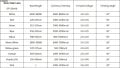
These Chanzon LEDs (3mm round, clear, warm white) are VF: 3.0-3.2v it says on the package.
With the little breadboard kit I ordered from Amazon (here) came a bag of LEDs in colors blue, red, green, yellow, and white. There were no specs for these LEDs, but I read that some colors draw more current (not sure if that is the right word, haha) than other colors. So interestingly enough when I hooked up each of these colors individually on the breadboard along with the warm white Chanzon LED, the Chanzon LED would turn off when I connected the generic red, yellow, and green LEDs (separately). But when I hooked up the white and the blue LED's, the Chanzon warm white would remain on, it just got a bit dimmer. So I guess that means that the red, yellow, and green LEDs took more current than the white and blue ones, if that makes sense.
I ordered some other Chanzon LEDs (like flat top and straw hat type) but those won't be in until early September, I think. I was trying to find some good warm white diffused LEDs but I haven't found any yet.
Here's the Chanzon chart for their 3mm clear lens LEDs:
EDIT: by the way, I read that normally yellow, green, red, require less voltage than blue and white... yet when I hook the blue and white up along with that Chanzon LED, the latter will stay lit. But when I hook up the (supposedly lower voltage) red, yellow, and green, the Chanzon LED turns off. Strange?
This is a quote from a website about this:
Typical VLED values are 1.7V for non-high-brightness red, 1.9V for high-brightness high-efficiency low-current red, 2V for orange and yellow, 2.1V for green, and 3.4 to 3.6V for bright white and most blue types.

 Facebook
 Google
 GitHub
 Linkedin


 Then, I bought various colors wire at one place, and after the order it shows up as not in stock, so now I don't know how long that is going to take. I don't understand how a US company selling these type things can't stock some wire or LEDs if they're selling it, but I hope it won't take 3 weeks to come out of China or something.