Using a bi-colour LED with separate Cathode

geekoftheweek

Joined Oct 6, 2013
1,429
I was more or less shooting in the dark. I have to say personally there's something else you're missing... the freaky led is just letting you know that. I once found when leds are in series and you put one in backwards although the string would not light up... there would still be enough current getting through the leds that my meter would pick up the proper voltage drop across the leds. Is your cathode of the led to ground? Is your ground for some reason being interrupted which would allow a minute backwards current through the green led and possibly mangle things up?

You might consider drawing some good schematics showing the entire circuit so others can see actually how you have it connected.
 

Thread Starter

1CM69

Joined Jun 12, 2017
56
I was more or less shooting in the dark. I have to say personally there's something else you're missing... the freaky led is just letting you know that. I once found when leds are in series and you put one in backwards although the string would not light up... there would still be enough current getting through the leds that my meter would pick up the proper voltage drop across the leds. Is your cathode of the led to ground? Is your ground for some reason being interrupted which would allow a minute backwards current through the green led and possibly mangle things up?

You might consider drawing some good schematics showing the entire circuit so others can see actually how you have it connected.
I think you're right, I'll draw up some schematics and post them ip
 

Thread Starter

1CM69

Joined Jun 12, 2017
56
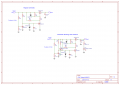
OK, here's two schematics, one shows the plain circuit & the other shows the circuit with working LED connections.

OVP-Using-LMV431.png
 

geekoftheweek

Joined Oct 6, 2013
1,429
How about a two channel op amp with one channel set up as an open feedback comparator (not sure if that's the best term, but it makes sense in my head) that runs the green led, and also feeds the second channel which would be an inverting comparator. One op amp and two resistors would do the trick if I'm thinking right. Connect the first channel to Vout so that when Vout is present it turns on the green led which in turn is invereted in the second channel turing off the red led.

I finally took the time to look at the application note you mentioned towards the beginning... thanks for the info. I'm kind of actually slowly working my way through this type stuff myself.
 

Thread Starter

1CM69

Joined Jun 12, 2017
56
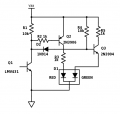
Try this - circuit not tested.

View attachment 131258
Right, looking at this circuit again, am I correct in thinking that it is a whole new section of circuit added in to my current circuit with the only common point being the LMV431?

And are R3 & R5 the resistors for the LED, so I can alter them to actual spec required?

Thanks in advance
 
You can use them in conjunction with Light Pipes too.

I built this weird overload indicator at one time. Peaks greater than +10 V flashed the light red for 1 sec.;
Less than -10 V flashed it green for 1 sec.
 

geekoftheweek

Joined Oct 6, 2013
1,429
How about a two channel op amp with one channel set up as an open feedback comparator (not sure if that's the best term, but it makes sense in my head) that runs the green led, and also feeds the second channel which would be an inverting comparator. One op amp and two resistors would do the trick if I'm thinking right. Connect the first channel to Vout so that when Vout is present it turns on the green led which in turn is invereted in the second channel turing off the red led.
I put some more thought into this while doing dishes... in an automotive environment you would also have to provide some sort of over voltage protection and what not to the op amp that this particular circuit is supposed to be providing to what it feeds in the first place or else you'll risk burning your op amp. Since it will be a fairly low current circuit it shouldn't be too hard to come up with something that would work.
 

geekoftheweek

Joined Oct 6, 2013
1,429
I would like to add if you're planning on this for an automotive use (the 13.8 and the app note lead me down this path of thinking) you may want to raise your trigger point to around 14.5 - 15 volts if possible. 13.8 volts is more or less what you want to see, but don't be surprised to see it higher under some conditions. The Delco alternators I replace at work are designed to default to 14.5 volts if the voltage sense signal from the batteries is lost... just a little thought. Depending on what you're powering that might be enough to ruin your day.
 
Last edited:

Thread Starter

1CM69

Joined Jun 12, 2017
56
Try this - circuit not tested.

View attachment 131258
Just to report back that I have now tried my circuit with this new section added and it works perfectly. I did leave the R3 & R5 resistors as 1K per the drawing.

I would like to add if you're planning on this for an automotive use (the 13.8 and the app note lead me down this path of thinking) you may want to raise your trigger point to around 14.5 - 15 volts if possible. 13.8 volts is more or less what you want to see, but don't be surprised to see it higher under some conditions. The Delco alternators I replace at work are designed to default to 14.5 volts if the voltage sense signal from the batteries is lost... just a little thought. Depending on what you're powering that might be enough to ruin your day.
I am using this OVP in the automotive environment but it is placed between a Buck/Boost convertor which is set at 13.8V output and attached equipment as an belt & braces safety device in case something fails in the Buck/Boost.
 

geekoftheweek

Joined Oct 6, 2013
1,429
I am using this OVP in the automotive environment but it is placed between a Buck/Boost convertor which is set at 13.8V output and attached equipment as an belt & braces safety device in case something fails in the Buck/Boost.
You're kind of right in the same area I'm trying to sort out myself. May I pick your brain for any ideas on general filtering of the incoming power before the converter? I'm using a commercially available converter myself to convert the auto's power to 5V. So far I have a simple diode, tvs, and capacitor on the incoming power connection.

Glad to know you got it working!
 

Thread Starter

1CM69

Joined Jun 12, 2017
56
You're kind of right in the same area I'm trying to sort out myself. May I pick your brain for any ideas on general filtering of the incoming power before the converter? I'm using a commercially available converter myself to convert the auto's power to 5V. So far I have a simple diode, tvs, and capacitor on the incoming power connection.

Glad to know you got it working!
Wish I could help but I have not gone that far to filter the supply & my electronics knowledge is extremely limited.
Regards..,
 
Top