USB to Current Loop Converter

panic mode

Joined Oct 10, 2011
4,864
of course:
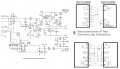
1. "I have taken Circuit Diagrams from a Serial to Current loop design and added in the USB".. so where is that circuit?
2. "But i am struggling to get any signal, " how are you testing? USB to serial part should work independently. does it?
3. the schematic is almost unreadable. parts of circuit are spread way too far and hard to follow (zoom to fit screen and text is too small, zoom in to see text and circuit overview is lost). why not try to organize it better and print on a smaller sheet such as letter? and what is up with showing things like optocouplers as packages instead of electronic symbols?
4. where is the power source for the current loop? this should be 12-24VDC. you seem to power everything of 5V from the USB port. the whole point of using current loop is to make long distance connection possible without sensitivity to noise, wire resistance etc.
 
Last edited:

Thread Starter

michaeldalton

Joined Oct 17, 2022
9
Hello
Thank you for your reply, i have compressed the diagram and uploaded it again, also attached the document i got the circuit from.
I have not included the 12-24V into this circuit, but this is connected to another circuit which provides constant 15V to the T+ and R-
I am getting USB connection to PC, but cannot read the Serial Information
 

Attachments

panic mode

Joined Oct 10, 2011
4,864
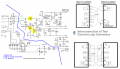
so you are trying to do something like this.

personally i am not fan of this as the circuit uses power tief (D4 D5 D6) and anyone who tried that more than once probably knows the lack of reliability (JDM programmer is one of infamous examples). but that is the part you are replacing and the loops are powered by 12V PSU and resistors R8,R9,R12, R14 which you do not have.
also do not see R17, or C9 in your version. also R11 is meant to be 200k but your R6 is only 1k. your FTD chip lacks any bypass capacitors and Vbus sense resistors...
1743004131729.png
1743004490508.png
 

panic mode

Joined Oct 10, 2011
4,864
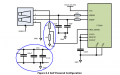
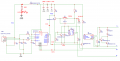
something like this would be better...
1743005511199.png

as for testing... apply steady signal to R+/R- and measure all voltages along the way to TP1.

same goes in another direction...
connect T+/T- into a circuit (with loop power) and measure voltage at TP2 and all the way to T+/T-

for circuits parts that are on the right side of the optocouplers, use negative side of the signal line as reference (R- for input and T- for output).

that will test things beyond FTDI chip.
to test the chip, you can connect TP1 and TP2 as a loopback adapter. then what ever you send out will be echoed back,,,

you did have the test points in your design did you not?
 

MisterBill2

Joined Jan 23, 2018
27,159
I see a USB to serial converter. AND I see U4, a 6N135L that appears to be some sort of opto-isolator. But in between Isee nothing to convert serial data to a current command.
 

panic mode

Joined Oct 10, 2011
4,864
this is not an analog circuit. it is a variant of RS232 interface for long distance. this is digital signal and current is either on (10-30mA) or off.

btw. when it comes to analog devices such as transmitters, 4-20mA is pretty common since wiring is simple but this means reduced signal range and can only be used on 2-wire transducers. 3 or 4 wire transducers can have 0-20mA output range.
 

MisterBill2

Joined Jan 23, 2018
27,159
OK, and certainly the serial 20 mA current loop was, as I recall, around before RS232 became common. No wonder that it was not immediately recalled from my memory heap.
 
Top