UNITS?? Are those volts or ohms??
For production transformers the wire sizes for different windings is very common. Even in the cheap junk doorbell transformers, the primary and secondary are different wire sizes.
Twp reasons for using voltage readings instead of resistance measurements: First, the no-load voltage reading is an absolute indication of turns ratio,at least in a transformer with no short-circuited turns, and also, because most multi-meters have rather poor resolution for very low resistance measurements. That is verified by the one-digit resistance readings in the supplied table.
For accurate low resistance measurements a four-terminal ohm-meter is usually required.
UNITS?? Are those volts or ohms??
For production transformers the wire sizes for different windings is very common. Even in the cheap junk doorbell transformers, the primary and secondary are different wire sizes.
I understood that we are trying to figure out the taps on a single primary winding, which should be all the same gauge wire. Mentioning the effect of different gauge wire on different windings is just confusing the issue.
I don't think I understand.. those VAC values were from a 21.45vac on each of the mentioned primary pairs.
The issues I had was which primary pairs were used for what, and why the blue and yellow leads (in combination with black) cannot accept 120vac without threatening to blow a breaker.
Like this latest set, I can send almost 22 volts to black/yellow but if I try 120 it wants to melt down. Is that perhaps because of that winding having a lower amount of resistance than black/white does?
I feel like I'm not able to verbalize a lot of this to the degree that you guys are used to.
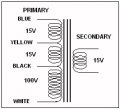
The secondary winding will be for charging the batteries, so it will take more than 6V. Connect your 21VAC source across the secondary and then measure the voltages between each pair in the primary. Be careful though, some of the voltages will probably be quite high. Shorting them together could cause damage and touching them could be painful!
Procedure:
1. Connect the AC voltmeter to a pair of wires on the primary.
2. Connect the AC voltage source to the secondary.
3. Record the voltage.
4. Disconnect the AC voltage source from the secondary.
5. Repeat 1 through 4 for every possible pair of wires on the primary..
That will give us the position of the taps on the primary and the voltage ratios between them..
The secondary winding will be for charging the batteries, so it will take more than 6V. Connect your 21VAC source across the secondary and then measure the voltages between each pair in the primary. Be careful though, some of the voltages will probably be quite high. Shorting them together could cause damage and touching them could be painful!
Procedure:
1. Connect the AC voltmeter to a pair of wires on the primary.
2. Connect the AC voltage source to the secondary.
3. Record the voltage.
4. Disconnect the AC voltage source from the secondary.
5. Repeat 1 through 4 for every possible pair of wires on the primary..
That will give us the position of the taps on the primary and the voltage ratios between them..
Ok here it is, 21.45vac applied to secondary leads:
black
blue
white
yellow
black
40.52
134.0
20.30
blue
40.52
175.3
20.29/30
white
134.0
175.3
155.0
yellow
20.30
20.29/30
155.0
The .29/30 signifies a constant fluctuation between the two, and of course all values are in VAC. Back in the day I caught a full T1's 130vdc twice back to back. After the second time my thumb quit working for a while, lol. So I try to be careful after that.
This time the numbers add correctly. I have rounded the numbers in order to keep it simple.
If you treat the input on the secondary as being 20VAC, then divide the numbers shown in the table below by 20 to give the turns ratio with respect to the secondary winding.
For example, blue-yellow is 20:20, blue-black is 40:20, blue-white is 175:20.
White-black is 135:20.

 Facebook
 Google
 GitHub
 Linkedin