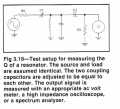
unloaded Q of parallel LC filter

Thread Starter

Zeeus

Joined Apr 17, 2019
616
Please assist..Don't really understand this

Used about 0 - 40pf variable cap for c1 and c2 (guessing low values prevent signal from coming up until high frequency inputs - about 10MHZ- using breadboard for this which is bad yeah?)

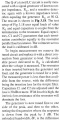
Read 2nd paragraph "To begin measurement we ..."...Why are we calculating power from voltage when we haven't gotten the resonant frequency? voltage from what frequency?

Don't really understand but think can find loaded Q value but not this.. Please assist

Thanks
 

Attachments

danadak

Joined Mar 10, 2018
4,057
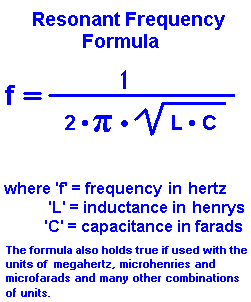
The resonant freq can be calculated for the tank L and C. But its complicated
by C1 and C2 which reflect (along with their series R's of 50 ohms) onto the
tank C and have to be included in the calculation of -


C! and C2 reflect, due to their series R component, a lower C than their value.
If the 50 ohms go to infinity then of course there is no reflected C. If the 50 ohms
go to 0 ohms then their full capacitance is reflected onto the tank. So thats the
reason for using the transform in the URL above.

http://aaronscher.com/Circuit_a_Day/Impedance_matching/series_parallel/series_parallel.html


Regards, Dana.
 
Last edited:

BR-549

Joined Sep 22, 2013
4,928
"Read 2nd paragraph "To begin measurement we ..."...Why are we calculating power from voltage when we haven't gotten the resonant frequency? voltage from what frequency?"

It's to set a base line. And it requires some assumptions with it. First we assume the signal generator VOLTAGE output is constant, with a change in frequency. If you don't want to assume that, you can sweep your test tank, and find the resonant frequency before hand. If you have a good generator, this is not necessary.

By connecting the generator directly to the load(resistor), we can measure the voltage, and knowing the resistance, we know the current, and by knowing the current, we now know the power. So, for a base line we measure and record the power output into a resistive load. The voltage across the resistor will indicate the power burned thru it.

This is the power delivered to the load, before any coupling caps and resonant tank are added.

In the following part of the exercise, you are going the measure the changes to the load with the addition of reactance. Anti resonant reactance separates voltage and current in time. Resonant reactance brings them(voltage and current) back together in time.
 

MrAl

Joined Jun 17, 2014
13,722
Please assist..Don't really understand this

Used about 0 - 40pf variable cap for c1 and c2 (guessing low values prevent signal from coming up until high frequency inputs - about 10MHZ- using breadboard for this which is bad yeah?)

Read 2nd paragraph "To begin measurement we ..."...Why are we calculating power from voltage when we haven't gotten the resonant frequency? voltage from what frequency?

Don't really understand but think can find loaded Q value but not this.. Please assist

Thanks
The loss with the LC included comes from knowing the non LC loss ... that is the only way you will know you have 30db loss WITH the LC.
 
Top