Understanding LED Forward Voltages

crutschow

Joined Mar 14, 2008
38,526
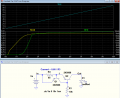
Below is the simulation of a two-transistor constant-current circuit for an LED.
It only requires an input voltage about 0.8V above the LED forward voltage to start controlling the current.
Above that point it the small current variation with input voltage is likely not noticeable in the LED output luminance.
1671665823502.png
 
Last edited:

Tonyr1084

Joined Sep 24, 2015
9,744
My point is, the supply voltage should be at minimum twice Vf, the higher the better.
I take issue with that statement. I have a series of 12V LED's manufactured for use in automotive applications running on a 12V source. Each unit consists of three LED's who's Vf is probably (not specifically) 3Vf in series, making a total of 9Vf. The units also have their own current limiting scheme built in. Whether it's a resistor or a CC control source.

Basically I have nothing to add to all the comments going before me. With the exception above. Let it be known that I highly respect MrChips and his advice. The fact that I take issue with his statement is just an expression of free speech, where we are allowed to disagree with one and other. In the case of 9Vf I wouldn't necessarily look for an 18 volt source. 12V is fine. But basically, yes, you want sufficient voltage to be able to control the current feeding the LED. For a 3Vf LED I would be happy with a 5V source. At 20mA a 250Ω resistor would be fine. The wattage would be a mere 100mA. a quarter watt resistor would be happy.

The one thing I've NOT seen mentioned here is reverse voltage. Since the discussion has centered mostly on a single LED, typical 5mm 3Vf 20mA type, nobody has said anything about reverse voltage. While yes, you can power it from 120V you need to understand that the 120V must be DC. If it's AC then you need another series diode that can withstand blocking reverse voltages that high. A typical LED doesn't like reverse voltages of more than 5V (from what I understand - and that may be adjusted by others comments). A second way of protecting an LED from reverse voltage is to put a parallel diode (LED or regular diode) in OPPOSITE POLARITY. That way the LED never sees that reverse voltage or current.
 

Tonyr1084

Joined Sep 24, 2015
9,744
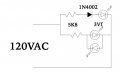
These are the two methods for powering a 20mA LED ( or LED's ) from a 120VAC source: In the upper case the 4002 blocks reverse voltage without damage, thus protecting the LED. In the lower case one LED is lit when voltage is forward and the other lights when the voltage is reversed. Each LED protects the other. If you DON'T protect the LED from reverse voltage (or current) it will blow. Learned that the hard way. And it took many lessons before I figured it out.
1671723536786.png
[edit] I made a calculation mistake. I took the 117 volt and divided that by 20mA and came up with 5850Ω (5K8). Correct resistance would be 6KΩ and the resulting calculated current would be 20mA. With the 5850Ω resistor the current would be 20.7mA.
[end edit]
 
Last edited:

MrChips

Joined Oct 2, 2009
34,824
I am certainly not proposing powering a 2V LED with 120VAC, or any AC voltage.
Nor am I proposing powering any LED with ten times Vf. What I am saying is powering a single LED at two times Vf is a good starting point (or n LEDS in series at 2n Vf).

If the LED assembly already has built-in current limiting circuitry then all bets are off.
 

Tonyr1084

Joined Sep 24, 2015
9,744
I take issue with that statement. I have a series of 12V LED's manufactured for use in automotive applications running on a 12V source. Each unit consists of three LED's who's Vf is probably (not specifically) 3Vf in series, making a total of 9Vf. The units also have their own current limiting scheme built in. Whether it's a resistor or a CC control source.
I am certainly not proposing powering a 2V LED with 120VAC, or any AC voltage.
Nor am I proposing powering any LED with ten times Vf. What I am saying is powering a single LED at two times Vf is a good starting point (or n LEDS in series at 2n Vf).
The comments I made about 120VAC was not directed at anyone. The only thing I was saying was that I don't always agree with double voltage for an LED. OK, yes, a 2Vf LED can easily be powered from a 5V source. But in the case where someone builds a string of LED's, say 5 LED's at 2Vf in series would be a total of 10Vf. I would be happy to run that at 12 volts with the appropriate resistance to achieve 20mA. I wouldn't see a need for 20 volts in such a scenario. But again, I respect you and am not looking for an argument. Just stating a difference of opinion. You COULD power 5 LED's with 20V, but now your resistor needs to dissipate that much more energy.
 

dl324

Joined Mar 30, 2015
18,333
Cheap LED 3AAA flashlights put a bunch of white LEDs in parallel without ballast or current limiting resistors. I sometimes replace the AAA batteries with a Li-ion battery.
 

Tonyr1084

Joined Sep 24, 2015
9,744
hi tony,
You don't require double the quoted LED forward voltage for any LED.
A ~20% above the rated forward voltage is all that is needed.
E
I agree. I was responding to:
My point is, the supply voltage should be at minimum twice Vf, the higher the better.
Then you can adjust for LED brightness by varying either the series resistance or the supply voltage. And you can ignore both If and Vf.
 

Tonyr1084

Joined Sep 24, 2015
9,744
I mentioned AC because no one else had said anything about it. For the edification of the TS I thought it wise to mention AC before they found out about high voltage AC destroying an LED. I've made that mistake before. To date I've probably tossed at least half as many LED's in the trash as I have successfully used. And I've been messing with LED's since 1973 when I first learned about them in high school. Today I rarely lose an LED.
 

MrChips

Joined Oct 2, 2009
34,824
If you want 2V overhead on any LED configuration that's fine with me.
What I am saying is the more voltage overhead you provide along with the proper series resistor the closer you get to achieving a constant current source.
 

ronsimpson

Joined Oct 7, 2019
4,699
Cheap LED 3AAA flashlights put a bunch of white LEDs in parallel without ballast or current limiting resistors. I sometimes replace the AAA batteries with a Li-ion battery.
The "cheap white LEDs in parallel" are sorted so they have the same forward voltage. LED-a, LED-b, LED-c, LED-d and LED-e are separated out and binned together. When you get LEDs that are not sorted you might get a "a" and a "d" in the same batch. We buy millions at a time; we can get all the "c" there are and many of the b and d versions. This leaves the a and e for the hobby market.
without ballast or current limiting resistors
There is no need for limiting resistors because they use a constant current power supply. PWM
 

dl324

Joined Mar 30, 2015
18,333
The "cheap white LEDs in parallel" are sorted so they have the same forward voltage. LED-a, LED-b, LED-c, LED-d and LED-e are separated out and binned together. When you get LEDs that are not sorted you might get a "a" and a "d" in the same batch. We buy millions at a time; we can get all the "c" there are and many of the b and d versions. This leaves the a and e for the hobby market.
Then why do LEDs in many of those flashlights start burning out? I have some that have half of the LEDs out.
There is no need for limiting resistors because they use a constant current power supply. PWM
The cheap ones don't use constant current supplies or PWM. They just use batteries across the LEDs.
 

wayneh

Joined Sep 9, 2010
18,108
But I see no practical reason to do so (and am interested in hearing of ones that you know of)...
The only time I've been compelled to mess around with voltage control was when using a data acquisition device that also has analog, voltage-controlled outputs. To experiment with that I wrote a routine to throb an LED with a slow voltage sine wave. I had to map the voltage range that took the LED from dim to bright. To get a nice effect, you want the LED to stay lit at all times and that means the bottom voltage of the sine wave has to stay above Vf. And of course you don't want to damage the LED, so that sets the peak voltage. The net result was a sine wave in an envelope of about 0.5V, from maybe 2.4 to 2.9V. (I forget the details except that it was a red LED. Don't hold me to those values. I could look them up if anyone cares.)
 

ronsimpson

Joined Oct 7, 2019
4,699
Then why do LEDs in many of those flashlights start burning out? I have some that have half of the LEDs out.
Because many of the Chinese "Engineers" have not had 2 years of technical school. They found a "working" light and made a copy, then removed any part that cost money. The engineers that I work with do not understand sorting LEDs and don't want to pay 10% more for sorted parts. People in your country only buy the lowest cost lights and China knows that, so they make junk. If you demanded a light that lasts 2 years then they would make a better product and it would cost 30% more. I am putting the blame on the consumer that will try to save and clearly don't care about quality.

LEDs across the battery, yes, I have made them that way. I was told to save the $0.01 for a resistor. We used low cost batteries with high internal resistance to limit the current. The LEDs ran at the absolute max current with a hot battery and quickly went dim. They sold under different names in Walmart for less than the cost of the included batteries. It was a through away light because replacing the batteries cost more than the light + batteries. When people used high quality batteries the current way too high and some burned out the LEDs. We sold millions. Then under different names we also sold quality lights that lasted much longer and did not dim with old batteries.

We make what people want and people don't want to pay for quality, in this disposable world.
 

WBahn

Joined Mar 31, 2012
32,874
My point is, the supply voltage should be at minimum twice Vf, the higher the better.
Then you can adjust for LED brightness by varying either the series resistance or the supply voltage. And you can ignore both If and Vf.
If that was your point, I have to say that the lead wasn't just buried, it was downright incinerated. Even knowing that that was your point, I can't fathom how that is a reasonable takeaway from your post without invoking mind reading.

But now that I know that that's your point, let's go from there.

Nor am I proposing powering any LED with ten times Vf. What I am saying is powering a single LED at two times Vf is a good starting point (or n LEDS in series at 2n Vf).
You are saying that the MINIMUM voltage that should be used for n LEDs in series, each having a nominal forward voltage of Vf, is 2⋅n⋅Vf. So if we have a string of 20 LEDs with a Vf of 3 V, you are saying that we need a minimum supply voltage of 120 V.

Why?

The underlying issue has nothing to do with Vf, but rather the uncertainty in Vf.

Let's assume, for the moment, that LEDs had a Vf that was extremely accurate and precise. In that situation, the current would be established just fine by adding a current-limiting resistor and providing enough overhead voltage to set the current through it. It wouldn't matter if you had 1 LED or 100 LEDs in series, the same overhead voltage would provide the same results.

If you are buying random LEDs, the fractional uncertainty in the total Vf drops as the sqrt of the number of LEDs. If you are buying binned LEDs, the uncertainty starts off at a much smaller value (and the fractional uncertainty from that bin's nominal Vf also drops as more LEDs are added to the string). The case that has the most potential to bite you is if you think you are buying random LEDs but, in fact, they happen to be binned.
 

MrChips

Joined Oct 2, 2009
34,824
If you had a single 2V LED what voltage overhead would you consider to be reasonable with a series resistor?

If you had a hundred 2V LEDs in series what voltage overhead would you consider to be reasonable with a single series resistor?
 
Top