Facebook
 Google
 GitHub
 Linkedin
Hi all,
In order to better understand how electric fence energisers roughly work, I've been trying to model one in Falstad. I tried a simple setup of taking a 5VDC input which is stepped up to around 30V with a buck-boost converter. The 30 VDC is charged in a capacitor, which is then discharged over a 1:100 transformer to create a voltage spike. I've done the discharging with a manual switch in the model, but normally I suppose this is done with a timer or microcontroller of some kind. I've attached the model as an image below, just after starting the discharge of the capacitor over the transformer.
Now I suppose the negative voltage at the transformer side is negative because the coil of the primary side is trying to resist the rise in current due to closing the switch, but I didn't really expect electric fences to work like that. Do they actually operate on a negative voltage at the fence or am I doing something wrong with this model?
I also noticed that the resistance between the two terminals on the secondary side has to be rather large, otherwise no voltage spike will occur. I don't think 1M Ohm is realistic when an animal touches the fence though. Curious to hear what I'm missing here.
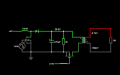
In order to better understand how electric fence energisers roughly work, I've been trying to model one in Falstad. I tried a simple setup of taking a 5VDC input which is stepped up to around 30V with a buck-boost converter. The 30 VDC is charged in a capacitor, which is then discharged over a 1:100 transformer to create a voltage spike. I've done the discharging with a manual switch in the model, but normally I suppose this is done with a timer or microcontroller of some kind. I've attached the model as an image below, just after starting the discharge of the capacitor over the transformer.
Now I suppose the negative voltage at the transformer side is negative because the coil of the primary side is trying to resist the rise in current due to closing the switch, but I didn't really expect electric fences to work like that. Do they actually operate on a negative voltage at the fence or am I doing something wrong with this model?
I also noticed that the resistance between the two terminals on the secondary side has to be rather large, otherwise no voltage spike will occur. I don't think 1M Ohm is realistic when an animal touches the fence though. Curious to hear what I'm missing here.