Facebook
 Google
 GitHub
 Linkedin
Hello everyone! First of all sorry for my english, I'm not native speaker) I have a question about bridge-tied load (BTL) mode in IC audio power amplifiers (for example TDA2822M, NJM2073, etc.). I spent some time trying to understand how it works but I'm confused about its schematics and operation as a result. As it can be seen from datasheets such mode is obtained by simply connecting both inverting inputs with a capacitor of 10uF and connecting the load between the 2 outputs of the IC.
My questions are:
1. How can this even work if negative feedback resistor dividers of both amps dont have a connection to the common (ground) wire? They are connected with each other at the point each one is connected to ground in single-end (stereo) mode. So how do such dividers divide output voltage to get feedback signal? They don't have zero-potential reference point in my understanding.
2. What's the use of 0.01uF cap from inverting input of 2nd amp to ground? Is it an accident that its value is equal to 1/1000 of the coupling capacitor (10uF)? Why this cap doesn't form an almost 100% negative feedback to inverting input of 1st amp thus making it almost unity gain? 0.01uF has impedance of tens kiloohms on signal frequencies making inverting input being connected to ground via this impedance.
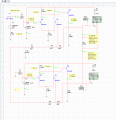
3. Does BTL-mode provide gain equal to single-end stereo mode? I thought it's gain is doubled but having built a test circuit in multisim I see that it isn't. I got 700mV RMS output with 70mV RMS input both in BTL and single-end mode with equal feedback resistors. Then what's the use of such mode? Does it simply give an opportunity to get a larger output swing but due to increase of input voltage, not but by doubling gain? Or have I built my circuit wrong and the gain must be doubled?
My questions are:
1. How can this even work if negative feedback resistor dividers of both amps dont have a connection to the common (ground) wire? They are connected with each other at the point each one is connected to ground in single-end (stereo) mode. So how do such dividers divide output voltage to get feedback signal? They don't have zero-potential reference point in my understanding.
2. What's the use of 0.01uF cap from inverting input of 2nd amp to ground? Is it an accident that its value is equal to 1/1000 of the coupling capacitor (10uF)? Why this cap doesn't form an almost 100% negative feedback to inverting input of 1st amp thus making it almost unity gain? 0.01uF has impedance of tens kiloohms on signal frequencies making inverting input being connected to ground via this impedance.
3. Does BTL-mode provide gain equal to single-end stereo mode? I thought it's gain is doubled but having built a test circuit in multisim I see that it isn't. I got 700mV RMS output with 70mV RMS input both in BTL and single-end mode with equal feedback resistors. Then what's the use of such mode? Does it simply give an opportunity to get a larger output swing but due to increase of input voltage, not but by doubling gain? Or have I built my circuit wrong and the gain must be doubled?
Attachments
-
642.1 KB Views: 7
-
 55.4 KB Views: 17