understanding an LED's Vf

Thread Starter

opeets

Joined Mar 16, 2015
103
I had a chance to run a quick test on my lunch break a short while ago. Basically a sanity check for me.

I used the 12V setting on my power supply, a 470Ω resistor and a red 3mm LED.

Observations:

1) The 12V power supply setting is actually putting out 11.91V. I measured it directly with a DMM1, then I verified it to be identical (connecting it to the appropriate breadboard jumper wires) while the LED was lit up.

2) My 470Ω resistor actually measured 460Ω (measured directly with DMM2 prior to placing it in the circuit).

3) Once the LED lit up I measured the current with DMM2 to be 21.03 mA

4) I measured the voltage drop across the resistor to be 9.68V. This checks out: V = .(02103)(460) = 9.67V

5) I measured the voltage drop across the LED to be 2.005V. I assume this is my Vf value (at 21.03mA)

6) The combined voltage drops do not equal 11.91V. The sum of the R and LED voltage drops is 11.69V. I am off by 220 mV.

7) I would have expected the current to be 21.53 mA instead of 21.03 mA because (11.91-2.005)/460 = 21.53mA. I am off by half a milliamp.

Am I just being pedantic or is this "close enough"?

Did I not account for a voltage drop somewhere?

Is the 1/2 mA dissipated in the DMM leads and jumper wires of various lengths connected to my breadboard? Is it due to the internal resistance of the ammeter? Is it both? It must be somewhere because I measured exactly 11.91V as my power source (connected to the circuit and independently).
 

djsfantasi

Joined Apr 11, 2010
9,237
Instead of LEDs, consider using a low wattage, low resistance resistor as your load. A 1 ohm 1/8 Watt resistor connected without a resistance in series will draw 6W, considerably more than the rated capacity of 1/8 W. A POP will result as the resistor burns up. A large resistor in series and nothing will happen. A medium to small resistor will pass enough current to cause the resistor to smoke.
Place an ammeter in the circuit and you have two visual sources demonstrating your circuit. The burning resistor and the meter.
 

dl324

Joined Mar 30, 2015
18,357
No working title yet, but the hypothesis is basically two things:

1) That we studied Ohm's Law and used a variant of it, R = (V-Vf)/I, to operate an LED with correct resistor values. Failure to use a resistor, or randomly choosing (an incorrect one for the supplied voltage) results in improper LED function.
Ohm's Law is easily demonstrated with a power supply with a built-in ammeter and voltmeter. You change resistors and observe the voltage and current readings from the power supply; taking into consideration that the resistors you use have a specified tolerance. Adding an LED makes it more interesting, but it's response is non-linear.
2) That he worked hard and learned something he previously had no exposure to.
Should be no problem here.
Am I dreaming or does everyone seem to disagree with me that this is a reasonable experiment to verify Ohm's law?
The resistor has a voltage drop (based on the current passing through it) and so does the LED (only slightly different based on the current passing through it). Those when added should equal the supplied voltage.
The dynamic resistance of the LED is an unnecessary complication for proving Ohm's Law.

If you wish to discover/prove something about LEDs, then they're a requirement.

I did a science project with my Daughter regarding "Which LED Is Brighter?". I intentionally threw in many colors, diffused/undiffused lenses, standard/ultra-bright, and an infrared LED to make it interesting. We used a TAOS light-to-voltage converter which had a response similar to the human eye, except it wasn't subjective. All family members participated in the brightness determination and only one person got it right. My Daughter correctly came to the conclusion that brightness is subjective and that different people see colors differently (e.g. some can't see red).

When I was teaching my Son about LEDs (using a curve tracer), I was surprised to observe that they emitted photons when reverse biased. I had always known they had reverse leakage that affected strobed displays, but I had never internalized that they would light when reverse biased.
 

Papabravo

Joined Feb 24, 2006
22,084
As you have no doubt discovered a diode or LED is a non-linear device. Non-linear devices can be "linearized" in a small neighborhood of a particular point. This does not mean that behavior on one part of the characteristic curve can be imputed to another part. You may have also discovered that measurement techniques can affect the outcome of an experiment.
 

dl324

Joined Mar 30, 2015
18,357
Did I not account for a voltage drop somewhere?

Is the 1/2 mA dissipated in the DMM leads and jumper wires of various lengths connected to my breadboard? Is it due to the internal resistance of the ammeter? Is it both? It must be somewhere because I measured exactly 11.91V as my power source (connected to the circuit and independently).
Current in your circuit is the same for all elements.

Is the 11.91V the unloaded output of the supply? Power supplies have a figure of merit called regulation which is how it handles varying loads. Ideally, the change would be zero over the full current range; but this is not the case in the real world.

The voltage drop in your leads should be minimal at 20mA, unless they are poor quality (resistance in the connectors at both ends or small diameter wire so they develop a measureable voltage drop). You can measure the voltage at the power supply terminals (with load) and measure the drop of each element (wire, resistor, LED). KVL says that the sum of the drops of each element must equal the power supply voltage.
 

WBahn

Joined Mar 31, 2012
32,905
Am I dreaming or does everyone seem to disagree with me that this is a reasonable experiment to verify Ohm's law?
Before you were saying that the point was to show the value of Ohm's Law, not to verify it. If you want to verify Ohm's Law then you need to take data that allows you to show that the current through a resistor really is proportional to the voltage across it and you have to take that data in such a way that independent of any assumption regarding whether Ohm's Law is valid or not. That pretty much rules out using any modern instrument such as your DMM. Now, for the purpose of a 5th grade science project it is probably reasonable to stipulate that your DMM gives (within tolerance) accurate results and ignore the fact that those results are based, in part, on Ohm's Law. For THAT experiment I would use one DMM to measure the voltage across a resistor and one DMM, as an ammeter, to measure the current through that same resistor. I would choose resistance values that are large enough that the non-zero resistance of the ammeter is less than 1% of the test resistor. I would then take data not only on resistors, but also on lots of everyday things as well as a diode and an LED. The conclusion would then (hopefully) be that Ohm's Law is a very accurate model for many, but not all, things and that some things deviate from it by a very large amount, leading to the realization that Ohm's Law is useful, but not universal and, hence, materials can be categorized, broadly, as either ohmic or non-ohmic.
 

WBahn

Joined Mar 31, 2012
32,905
I had a chance to run a quick test on my lunch break a short while ago. Basically a sanity check for me.

I used the 12V setting on my power supply, a 470Ω resistor and a red 3mm LED.

Observations:

1) The 12V power supply setting is actually putting out 11.91V. I measured it directly with a DMM1, then I verified it to be identical (connecting it to the appropriate breadboard jumper wires) while the LED was lit up.

2) My 470Ω resistor actually measured 460Ω (measured directly with DMM2 prior to placing it in the circuit).

3) Once the LED lit up I measured the current with DMM2 to be 21.03 mA

4) I measured the voltage drop across the resistor to be 9.68V. This checks out: V = .(02103)(460) = 9.67V

5) I measured the voltage drop across the LED to be 2.005V. I assume this is my Vf value (at 21.03mA)

6) The combined voltage drops do not equal 11.91V. The sum of the R and LED voltage drops is 11.69V. I am off by 220 mV.

7) I would have expected the current to be 21.53 mA instead of 21.03 mA because (11.91-2.005)/460 = 21.53mA. I am off by half a milliamp.

Am I just being pedantic or is this "close enough"?

Did I not account for a voltage drop somewhere?

Is the 1/2 mA dissipated in the DMM leads and jumper wires of various lengths connected to my breadboard? Is it due to the internal resistance of the ammeter? Is it both? It must be somewhere because I measured exactly 11.91V as my power source (connected to the circuit and independently).
Given that we have been talking about, repeatedly, the effect of using a DMM as an ammeter in this circuit, why didn't you measure the voltage drop across the DMM that you were using as an ammeter? That 220 mV very possibly was dropped across the meter. What would the calculated resistance of the meter be for your data? (11.91V-11.69V)/21.01mA = 10.47Ω. Check the specs on your meter. I wouldn't be surprised if the resistance for the range you are using was 10Ω.

The question about a current (1/2 mA) being dissipated in the DMM leads is nonsensical.
 

dl324

Joined Mar 30, 2015
18,357
[snip] hence, materials can be categorized, broadly, as either ohmic or non-ohmic.
My Son did a "Which Conducts Electricity Better?" science project in the 4th grade. His teacher was so excited and couldn't wait to see the results.
 

dl324

Joined Mar 30, 2015
18,357
The question about a current (1/2 mA) being dissipated in the DMM leads is nonsensical.
In the OP's defense, he wasn't an EE major. He was likely exposed to the conservation laws, but forgot them because they weren't relevant.
 

WBahn

Joined Mar 31, 2012
32,905
Given that we have been talking about, repeatedly, the effect of using a DMM as an ammeter in this circuit, why didn't you measure the voltage drop across the DMM that you were using as an ammeter? That 220 mV very possibly was dropped across the meter. What would the calculated resistance of the meter be for your data? (11.91V-11.69V)/21.01mA = 10.47Ω. Check the specs on your meter. I wouldn't be surprised if the resistance for the range you are using was 10Ω.
I tracked down the User Manual for the Extech 330 and, no big surprise, it doesn't give the burden voltages for the current measurement ranges.

The burden voltage for a Fluke 87 on the 400 mA range is 1.8mV/mA which is 1.8Ω. Burden voltages typically scale inversely proportional to the range (since the design usually tries to use the same basic circuitry but pass the smaller current through a larger resistance to get the same full-scale voltage). So the 40mA range probably has a burden voltage of 18mV/mA or 18Ω. That agrees pretty well with the Extech having about 10Ω on the 40mA scale, especially is the meter design dates back to when full-scale readings were started with a 2 (so a 20mA range).

It's easy enough to measure the burden voltage of your meter, so just do it. That's a useful exercise in and of itself.
 

Thread Starter

opeets

Joined Mar 16, 2015
103
Instead of LEDs, consider using a low wattage, low resistance resistor as your load. A 1 ohm 1/8 Watt resistor connected without a resistance in series will draw 6W, considerably more than the rated capacity of 1/8 W. A POP will result as the resistor burns up. A large resistor in series and nothing will happen. A medium to small resistor will pass enough current to cause the resistor to smoke.
Place an ammeter in the circuit and you have two visual sources demonstrating your circuit. The burning resistor and the meter.
It seems like the odds are stacked against me and it's time to face reality. A lot of experts on this forum are telling me that I am approaching this project wrong and I suppose I should revise it to make sense. There is still time, about a month away before it's due. I will abandon the LED approach for now and consider the low wattage resistor load idea proposed above. I believe it had been suggested in my other thread. Either way my son would love to see something destroyed although he won't be happy about starting all over again (he has pages and pages of notes from our LED experiments).

Come to think of it, I do believe the problem statement in my son's original proposal write up was to identify how designers of circuits conceive their designs without causing damage to sensitive components. It continued on to say that Ohm's law plays a vital role in the decision making process. He did include information about how we expected an LED to behave at low, high, and nominal current values but this was all based on my false assumption that LED behavior was a linear relationship. As I know now, that is clearly not the case. But we can revise that part of the initial proposal by substituting "LED" with "load", provide a general definition for "load", and explain how it can be represented by the low wattage resistor in his experiment.

So now that I've come to my senses, I have a question....will my 2A power supply be sufficient for this new idea? Will I be able to make these resistors pop? And where can I get 1Ω 1/8 watt resistors online? I'm going to need a bunch. I doubt my local Radio Shack has them.

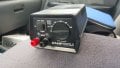
Here's a picture of it:

ps.jpg
 
Last edited:

WBahn

Joined Mar 31, 2012
32,905
Keep in mind that proposing an idea based on a hypothesis and then taking data that shows that the hypothesis was wrong, either by a little or by a lot, does not mean you have to scrap the proposal. I think it makes for a BETTER project. You say, "I expect to see A and B". You take the data and then you present the results and conclude by saying, "While A seemed to largely true, B was completely wrong and, based on the gathered evidence, it appears that C is actually the case."

And, yes, your 2A supply should be more than adequate for what you probably want to do.

Another thing that I think would make for a very strong write up would be to take the data you have now and plot it and note the kinds of things that don't make sense (just as you have been bringing them up here). Then hypothesize what might be causing the poor results, namely the assumptions about the current meter not affecting the circuit and the supply voltage remaining at a fixed, constant output voltage, and then go back and retake the data (or the key portions of it) taking those factors into account and show how much better the results align with expectations.

Science is not about being right in your hypotheses from the getgo, it is about arriving at a better understanding even though that often means making major revisions to your original hypotheses.
 

Thread Starter

opeets

Joined Mar 16, 2015
103
Keep in mind that proposing an idea based on a hypothesis and then taking data that shows that the hypothesis was wrong, either by a little or by a lot, does not mean you have to scrap the proposal. I think it makes for a BETTER project. You say, "I expect to see A and B". You take the data and then you present the results and conclude by saying, "While A seemed to largely true, B was completely wrong and, based on the gathered evidence, it appears that C is actually the case."
Good point. We'll include our experience with the LED experimentation in the write up but focus more on the new approach.

And, yes, your 2A supply should be more than adequate for what you probably want to do.
Great. Now I just need to find out where I can get a 1/8 watt 1Ω resistors in bulk online since I doubt I can find them locally. Any suggestions? Need to expedite this.
 

crutschow

Joined Mar 14, 2008
38,537
If you measure the power supply voltage, the voltage drop across the LED, and the voltage drop across the resistor, all while the LED is being lit and without disturbing the circuit otherwise, then the sum of the voltage drops across the LED and resistor should be very close the the measured supply voltage (under load).
If not then measure the voltage from the LED ground to the power supply common in case your ground connection has a significant resistance.
 

Thread Starter

opeets

Joined Mar 16, 2015
103
What if I just used 1/4 watt 10Ω resistors (which I have in supply) instead and used 9V as my power supply. Without another resistor in series the power dissipated would be 8.1 watts and the current would be 900mA. This should cause the resistor to burn up, right?

If I add a 50Ω resistor in series the current would be 150mA and the power in the 10Ω resistor would be a smidge under a 1/4 watt. It should get hot but not burn out.

If I replaced the 50Ω resistor with a 100Ω resistor, the current would be ~82 mA and the power in the 10Ω resistor would be less than 1/10 watt. Should not feel warm to the touch.

Is this logic sound?
 

Thread Starter

opeets

Joined Mar 16, 2015
103
What if I just used 1/4 watt 10Ω resistors (which I have in supply) instead and used 9V as my power supply. Without another resistor in series the power dissipated would be 8.1 watts and the current would be 900mA. This should cause the resistor to burn up, right?

If I add a 50Ω resistor in series the current would be 150mA and the power in the 10Ω resistor would be a smidge under a 1/4 watt. It should get hot but not burn out.

If I replaced the 50Ω resistor with a 100Ω resistor, the current would be ~82 mA and the power in the 10Ω resistor would be less than 1/10 watt. Should not feel warm to the touch.

Is this logic sound?
Actually I just realized that this won't work with 50Ω and 100Ω resistors as my current limiting resistors.

For the 50Ω resistor the power dissipated in it will be (.15)(.15)(50) = 1.125 watt which is far greater than the 1/4 watt it is rated for.

For the 100Ω resistor, the power dissipated would be (.082)(.082)(100) = .67 watts (which still exceeds its rating by almost a 1/2 watt).

I would need something in the vicinity of a 500Ω resistor so the current would be ~18mA and the power dissipated across the 500 Ω resistor would be (.018)(.018)(500) = .16 watts

I think what it boils down to is that for this to work the power rating of the load resistor NEEDS to be less than the power rating of the current limiting resistor by at least half.

Or does it? Any suggestions on what I should use for my load resistor and what I should use for my current limiting resistor?
 
Last edited:

Thread Starter

opeets

Joined Mar 16, 2015
103
Instead of LEDs, consider using a low wattage, low resistance resistor as your load. A 1 ohm 1/8 Watt resistor connected without a resistance in series will draw 6W, considerably more than the rated capacity of 1/8 W. A POP will result as the resistor burns up. A large resistor in series and nothing will happen. A medium to small resistor will pass enough current to cause the resistor to smoke.
Place an ammeter in the circuit and you have two visual sources demonstrating your circuit. The burning resistor and the meter.
I'm actually have a hard time wrapping my mind around what you would consider a large resistor and a medium-to-small resistor as well as their respective power ratings. No matter what numbers I plug into my Excel spreadsheet I can't figure out the values of these resistors that will make the 1/8 watt resistor react as you indicated (without causing the current limiting resistor to undergo the same behavior).
 

djsfantasi

Joined Apr 11, 2010
9,237
Here is a source from Digikey: <LINK>

I like dealing with them I find they ship quickly and reasonably.

Just make sure that the current limiting resistor is of sufficient wattage to handle the calculated current. Excel would be great tool to set up your limitations; maximum current, desired wattage over the 1 to 2 ohms, and your supply voltage. At work now... so cannot supply a more detailed solution.
 
Top