Under current Control circuit

Thread Starter

Talha77

Joined May 13, 2019
7
I have a shunt resistor of 70mV 50A and I need to operate a relay from it like; when the ampere is 40 and the mV is 60 it switches the relay. Can anyone help me please. In short i wanna make undercontrol device which turns off when the current decreases at 40Amp.

Please help me!
 

Daniel Sala

Joined May 28, 2015
65
Hi,

It would help me and others if you elaborated a little on what you mean, please, and defined undercurrent circuit supply voltage and the relay coil voltage and current, if you know them. And, if you have one, post any schematic of your current circuit. Is this kind of circuit a new concept for you and you would like to be talked through it - is that what you mean?

I understand:
>40 Amps = >60mV = relay ON.
<40 Amps = < 60mV = relay OFF.

I think the linked-to article can be adapted, but to do the opposite - a quick fix is to swap the comparator inputs, for example. Downside is that regarding housekeeping current, it's preferable to have the comparator output "high" when doing nothing and low when doing something useful, obviously not possible if it's directly driving a relay, which I doubt, so solveable with a BJT or MOSFET from comparator to relay coil.

I'd have gone with a current sensing amplifier over an op amp with gain, as shown i the article, but a decent-ish op amp with gain (and any offset input cancelled out if precision is needed) is more than enough.

There's a lot missing from your needs which leads to needing to speculate. e.g. Does this need to be super precise at exactly 40.000A? Are you asking for a ready-made circuit? You can add hysteresis to the comparator to avoid false triggering but it will no longer be "snap action" at "exactly" 40A/60mV, if we omit the hysteresis then we'll likely get false triggering around the reference voltage.

Which brings me to the op amp (or CSA) gain needed to match the reference voltage used. Personally, with my own ability and being wary of signals close to ground, I wouldn't do it without a reasonable gain/reference voltage as 60mV is very close to ...just being noise.

Say what you want exactly, please. :)

I'm sure you'll get a better answer from other members.
 

Thread Starter

Talha77

Joined May 13, 2019
7
Thank you daniel for your time.
I made a transformer Rectifier with input of 220vAC and output of 50V 50Amps variable from 0-100%.
What I wanted to do is:

I have connected another device and What I want is the circuit diagram which operates like if the the Rectifier output is lower then the 40Amps It will switch the relay. And it can only possible with shunt resistor with mV. But I don't have any Idea of how can I do so...

What's you understand is right.
>40 Amps = >60mV = relay ON.
<40 Amps = < 60mV = relay OFF.

Please help me for this.
 

Reloadron

Joined Jan 15, 2015
7,890
What's you understand is right.
>40 Amps = >60mV = relay ON.
<40 Amps = < 60mV = relay OFF.
OK, there are several options you can use. I assume you have a shunt since I see mention of milli-volts. I have a shunt laying here so I will use my numbers. The shunt is a 50 Amp 50 mV shunt.

50 Amp Shunt.png

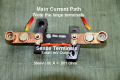
In this case 40 Amps is 40 mV. I would use a comparator with what is called hysteresis. The problem with triggering a relay or anything else with a specific set point is if the current hovers around 40 amps, slightly above or below by a small margin, the relay or whatever you choose to drive will chatter on and off. Hysteresis will eliminate this. A problem with a shunt like this is also the low DC output voltage. Frequently the low shunt voltage is amplified for example 0 to 50 mV can be amplified to 0 to 5 Volts. A Google of Current Shunt Amplifiers should get you some results. As was mentioned and is important is are you sensing current on the High Side or Low Side of the load? That is important as well as the load voltage?

A Google of comparator circuits should give you an idea of how it works but basically you would set a Vref (Reference Voltage) so when an input voltage be it from a shunt or anything goes above or below a set point (Vref) something happens. You can also use a uC (Micro Controller) and just write some code so when an analog input goes above or below a set value something happens. You can omit shunt amplification with such a low level off the shunt you really have a low signal to work with. Here is an example of a current shunt (High Side) amplifier as a module on a board, sort of simple turn key solution.

Finally this realy you mention is switching something? That something has a voltage and current which the relay contacts need to be capable of handling. Things like the relay coil voltage and current are pretty important as is the load which will be handled by the relay contacts.

Ron
 
Last edited:

Thread Starter

Talha77

Joined May 13, 2019
7
Thankyou reloadron,
Can you please share the block diagram or something so that i can understand the complete flow.
What I think is After shunt there should be a comparator and thenan opamp but after it I can't get the technical way to switch relay before 40Amps
 

BobaMosfet

Joined Jul 1, 2009
2,211
I have a shunt resistor of 70mV 50A and I need to operate a relay from it like; when the ampere is 40 and the mV is 60 it switches the relay. Can anyone help me please. In short i wanna make undercontrol device which turns off when the current decreases at 40Amp.

Please help me!
You listed a voltage and an amperage spec on your shunt resistor, but not it's resistance... which is necessary for you to determine current measurements. Current is measured by measuring the loss of voltage required to make it move through the shunt.

If we use your number 70mV and 50A in relation to Ohm's Law, we get this:

R = E/I
R = 0.070/50
R = 0.0014 Ohms

Are you saying your shunt is a 1.4-mili-Ohm resistor? Or is it another value?

Whatever it's value, you then use Ohm's law the other way to determine current through the shunt:

Let's say the voltage drop measured across the shunt is 55mV:

I = E/R
I = 0.055/0.0014
I = 39.28571

So, at 55mV, you know you're carrying 39.3A across that shunt.
 

Reloadron

Joined Jan 15, 2015
7,890
OK, there is a number of ways to sense DC current. They range from as simple as a current shunt which you mentioned, and I pictured above, to devices like a hall effect current transducer. Each method has good and bad points so we look at the good and bad points of each method and decide on a sensor based on our application, in other words what exactly we want to do. We also need to consider is this just a home project or is this going to be an industrial application. Do we want to actually make or build any circuit boards involved or do we want an off the shelf turn key solution?

The basic shunt method simply uses a very low resistance in the path of current flow which produces a small voltage drop across the resistance. That voltage drop, with a known resistance, is proportional to the current flow. One down side to using a shunt is the voltage drop across the shunt is very small and in most cases to make it useful we need to amplify it. When using a current shunt there is also a matter of sensing current on the high side (positive) or the low side (negative) of the load. You have not said which you want to do? That needs to be known even before a block diagram is drawn or any amplification is chosen. Your application needs to be known also, in detail.

Simply put you have Shunt > Amplifier > and any follow up electronics such as an Amplifier.

Then you also, as mentioned, need to consider hysteresis in the comparator circuit for the reasons I mentioned earlier.

You can also use a Current Sensor like this one. The latter is what we call a turn key solution. It's all nice and modular and everything is done on board. The decision of which way to go rest with your application. This solution can be coupled for example to a comparator circuit or a uC (micro-controller) which has an analog input line. Which way do you want to go? Using a uC you write the code.

You need to provide a detailed description of exactly what your objective is what exactly in detail you are planning to do.

Ron
 

AnalogKid

Joined Aug 1, 2013
12,130
No matter what type of relay
Ah, but it *does* matter. The load you want to switch determines the power needed by the relay coil, and that can change the driver circuit.

So far, what I see is that there is 50 V available continuously to power the current sense circuit and relay coil. Correct? yes / no

If yes, then a relay with a 48 V coil is an option, but those are usually a bit more expensive than ones with 12 V or 24 v coils because they are not as widely used.

The whole circuit can be done with parts that can withstand 50 V, or you can start with a regulator that is a small power supply to make 12 V to run the comparator circuit.

Or, you can run the circuit off of a separate power source, such as a USB wall wart.

ak
 

Thread Starter

Talha77

Joined May 13, 2019
7
Ah, but it *does* matter. The load you want to switch determines the power needed by the relay coil, and that can change the driver circuit.
Ans: It doesn't matter because where the relay is connect those are two switches point. For your reference 2Amp relay is enough

So far, what I see is that there is 50 V available continuously to power the current sense circuit and relay coil. Correct? yes / no
Ans: no we use shunt mV to switch.

The whole circuit can be done with parts that can withstand 50 V, or you can start with a regulator that is a small power supply to make 12 V to run the comparator circuit.
Ans: we can make it but how we can do so?
 

Reloadron

Joined Jan 15, 2015
7,890
I have a shunt resistor of 70mV 50A and I need to operate a relay from it like; when the ampere is 40 and the mV is 60 it switches the relay. Can anyone help me please. In short i wanna make undercontrol device which turns off when the current decreases at 40Amp.

Please help me!
I also just noticed something doesn't see correct here when you say:
I have a shunt resistor of 70mV 50A and I need to operate a relay from it like; when the ampere is 40 and the mV is 60 it switches the relay. Can anyone help me please. In short i wanna make undercontrol device which turns off when the current decreases at 40Amp.

Please help me!
If a shunt outputs 70 mV at 50 amps that tells us the shunt resistance is 0.0014 Ohm. Then you mention 40 amps with a shunt output of 60 mV which would make the shunt resistance 0.0015 Ohm. The shunt resistance should remain a constant under normal use. That is how current shunts are designed. Earlier I posted a 50 Amp 50 mV shunt. This works out to be a convenient 1.0 mV per ampere of current and the shunt resistance is a constant which would be .050 Volt / 50 Amp = 0.001 Ohm. The numbers you have are unusual for a current shunt and the resistance should be constant.

Ron
 

Thread Starter

Talha77

Joined May 13, 2019
7
Dear Ron,
I use shunt at positive side of the TR and the unit will be used on industrial application.

I can only do this with shunt source.

If you can help me in uC then we can go for it. I didn't work on uC since 4 to 5 years.
 

Reloadron

Joined Jan 15, 2015
7,890
Then for an industrial application I would use an off the shelf turn key solution. I would use an off the shelf current transducer as I linked to earlier. This is just an example. If I choose a 50 Amp range the output is scaled -50 to 50 Amps is equal to -5 to 5 volts out so for keeping it simple 0 to 50 Amps is equal to 0 to 5 volts. So we get 0.1 volt/amp. Everything is done in a single package which can be powered by a single common power supply. Matter of fact the current transducer and the supply can be mounted on a single DIN rail. OK so we have our scaled output of 0 to 50 amps equal 0 to 5 VDC out.

As to a uC (micro-controller) just about any uC with an analog input can be used. There are literally dozens to choose from. Again in keeping things simple I would use a 08M PICAXE chip or an Arduino chip since you really don't need much. The problem with the PICAXE is you need to mount it and make up a board for it or buy a prototyping board. The nice thing is it is a single DIP 8 pin chip. They also come with the chip's boot loader installed making for pretty easy programming. There are hundreds of code samples out there to acomplish what you want.

Another uC choice is using an out of the box Arduino UNO micro-controller. They, like the PICAXE are available from dozens of online retailers globally. They come already mounted on a board ready to go. Like the PICAXE they allow easy programming and both of these chips have endless online documentation and code samples online.

Both micro-controllers mentioned have an ADC input as well as digital outputs. Both use a 10 bit ADC so for example an input of 0 to 5.0 VDC would equal 0 to 1024 bits. So you can resolve 5.0 / 1024 = 4.8 mV. We already know in this scenario that each Amp is 0.1 Volt based on my suggested Current Transducer.

You write the code for the chip and ADC you have. You use a DO (Digital Out) pin on your uC to drive a transistor capable of handling the relay of your choice or use a MOSFET. You choose your relay accordingly and we have covered all of that. These forums have sections for help with uC devices. You write your code to allow for some hysteresis which we touched on previously.

That is roughly how I would go about doing what I think you want to do. I have no clue where you are so I really can't be specific as I don't know what is available to you.

Ron
 

AnalogKid

Joined Aug 1, 2013
12,130
Ans: no we use shunt mV to switch.
No, you use the 70 mV to *control* the switch. The 70 mV signal goes into an electronic circuit that compares it to a voltage that represents the trip point, the level where you want the relay to engage. The circuit drives the relay, and that circuit needs a power source to operate. It doesn't require very much current, only a few mA plus whatever the relay coil requires.

ak
 

Bernard

Joined Aug 7, 2008
5,784
Just a drawing to illustrate how it might be done including hysteresis assuming a .0014 ohm shunt. For testing , shunt is represented by R1-A &B. For 40 A R2 would be adjusted to .056 V.
 

Attachments

Top