Type of this capacitor

Thread Starter

Willen

Joined Nov 13, 2015
338
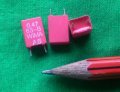
Searched around internet & found similar around eBay. They don't have more specification. Do you know what type of capacitor this is?

I don't have film capacitor between 0.1uF to 1uF for audio purpose. But have this type of capacitors almost 20 pcs. So I wish these are film capacitors. :)
 

Attachments

ebp

Joined Feb 8, 2018
2,332
It is probably stacked metalized polyester film 470 nF, 63 VDC, but the markings are not consistent with what is shown on the Wima website. I suspect those in the photo might be older, with slightly different marking convention. I should have some older Wima data, and even some capacitors like that that I can check (probably tomorrow).

http://www.wimausa.com/EN/marking.htm
(home site is in Germany)

There is a chance it is polypropylene rather than polyester, but I don't think that capacitance-voltage product in polypropylene will fit in such a small package. I don't think Wima has ever made capacitors other than film types.
 

MisterBill2

Joined Jan 23, 2018
27,528
How critical of an audio application is it? Dielectric losses do matter, but those don't look like typical bypass capacitors, and so they might sound OK.
 

Thread Starter

Willen

Joined Nov 13, 2015
338
It is probably stacked metalized polyester film 470 nF, 63 VDC, but the markings are not consistent with what is shown on the Wima website. I suspect those in the photo might be older, with slightly different marking convention. I should have some older Wima data, and even some capacitors like that that I can check (probably tomorrow).
Did you checked? Or any simple and quick idea to check capacitor which is film or not, without breaking?
The 630V(!) capacitors are much larger than 63V capacitors.
I always use 63V film capacitors like that for coupling audio signals.
You mean you have used same film capacitors as I posted picture?

Hi MisterBill2,
I want to make very low noise DIY preamp for computer recording, ever.
 

MisterBill2

Joined Jan 23, 2018
27,528
OK, now the application is understood.The resistors and the semiconductors will probably be larger contributors of noise than the capacitors. And my experience has been that microphonic components can be challenging noise sources. And even connectors can be noise sources. Fortunately there is a whole lot of published material on the subject of noise.
 

DECELL

Joined Apr 23, 2018
96
These caps are fine for coupling AF signal voltages dielectric will not have any discernable effect on your audio quality. In power filters and crossover networks you need something that can handle the current.
I find it annoying that there is so much myth about how expensive connectors and components will improve your audio.
Look inside high end broadcast and recording equipment and there are almost no exotics or gold plated this or that. Just inteligent design!
 

MisterBill2

Joined Jan 23, 2018
27,528
These caps are fine for coupling AF signal voltages dielectric will not have any discernable effect on your audio quality. In power filters and crossover networks you need something that can handle the current.
I find it annoying that there is so much myth about how expensive connectors and components will improve your audio.
Look inside high end broadcast and recording equipment and there are almost no exotics or gold plated this or that. Just inteligent design!
The specific instance of a microphonic connector was with an amplifier that had a one megohm input impedance and a designed gain of five million. The connector that was microphonic was a poor quality phono plug. The demonstration that it was indeed microphonic was holding the cable about six inches below the connector and speaking directly at the plug from about two inches away. The speech was intelligible but poor quality.
My point was to use adequate quality connectors, not that the "gold plated audiophile" ones were needed, but that poor quality ones with poor surface finishes can cause problems.
 

ebp

Joined Feb 8, 2018
2,332
I checked some data from 1997 and 2003. The marking scheme matches the photos in the datasheets (WIMA at the bottom) but there is no guide to markings. As best I can tell from the photo at #1, the size corresponds to metalized polyester film. I cannot find anything to suggest what the "B" at the end of the voltage rating line means. B as an EIA tolerance code means ±0.1%, but that is extremely unlikely for any capacitor, especially polyester.

Polyester does exhibit moderately high dielectric absorption, so it is not ideal for audio. Polypropylene is better. For audio, stay away from any ceramic dielectric except for the low dielectric constant types ("COG") which are quite good. High dielectric constant types have high dielectric absorption and many have significant voltage coefficient of capacitance which makes them non-linear, leading to distortion.
 

MisterBill2

Joined Jan 23, 2018
27,528
I checked some data from 1997 and 2003. The marking scheme matches the photos in the datasheets (WIMA at the bottom) but there is no guide to markings. As best I can tell from the photo at #1, the size corresponds to metalized polyester film. I cannot find anything to suggest what the "B" at the end of the voltage rating line means. B as an EIA tolerance code means ±0.1%, but that is extremely unlikely for any capacitor, especially polyester.

Polyester does exhibit moderately high dielectric absorption, so it is not ideal for audio. Polypropylene is better. For audio, stay away from any ceramic dielectric except for the low dielectric constant types ("COG") which are quite good. High dielectric constant types have high dielectric absorption and many have significant voltage coefficient of capacitance which makes them non-linear, leading to distortion.
In addition to the mentioned flaws of ceramic dielectric capacitors, they may tend to be microphonic, thus adding noise as well as distortion.
 
Top