Type of 120 V AC single phase motor

Thread Starter

fborot

Joined Feb 1, 2018
13
My gate uses a single phase, 120 V AC motor with a capacitor. It has 3 wires that I refer to as:
1- ground
2- forward direction
3- reverse direction

When there is power between 1&2 the motor rotates in one direction and when power is applied between 1&3 it rotates on the opposite direction.
I would like to properly identify this motor in case I need to find a replacement for it.

Is "bidirectional motor" a right term? When I search for that term I find examples on how to permanently reverse the original direction of a motor (i.e from clock wise to counter clock wise or vice versa) but can't find descriptions of such a motor or where to buy a similar one.

Also, about the capacitor: how do I know whether it is a "capacitor run" or "capacitor start" motor?

Thank you
 

MaxHeadRoom

Joined Jul 18, 2013
30,717
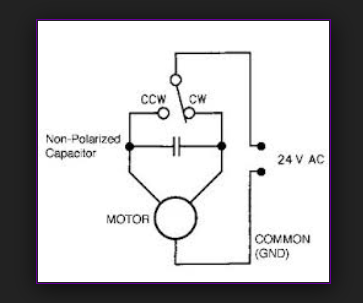
It sounds like a PSC (permanent start cap) motor, is is very simple to reverse by SPDT switch with centre off.
Google PSC motor.
Same as a garage door opener etc.
Max.


Thread Starter

fborot

Joined Feb 1, 2018
13
thank you. I can see in your diagram the 3 wires ....

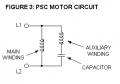
help me understand it better ... it has a winding for each direction ? , I found this simplified diagram of a PSC motor on this web site:

upload_2018-7-12_15-26-12.png
 

MaxHeadRoom

Joined Jul 18, 2013
30,717
The typical PSC motor has two identical windings for run and start so they can be used alternately.
IOW, no defined Main winding, they alternate duty.
Max.
 

MaxHeadRoom

Joined Jul 18, 2013
30,717
My gate uses a single phase, 120 V AC motor with a capacitor. It has 3 wires that I refer to as:
1- ground
2- forward direction
3- reverse direction
Incidentally, the correct term for 1- is Neutral or Common, not Ground.
In this instance Ground would be the earth conductor to the motor frame.
Max.
 

MaxHeadRoom

Joined Jul 18, 2013
30,717
If you look at the DWG I posted in #2, draw a winding from CW to Common, and a winding from CCW to common, and you have it.
Both winding serve as start and run alternatively.
Max.
 
Here http://www.hurst-motors.com/permanentmagnetacsynchronous.html is a little blurb.

The windings are not quite identical, but for all practical purposes they are. I ran into a paper explaining why when they were discussing speed control.

This https://www.designnews.com/automati...l-single-phase-induction-motor/74809400841732 also confirms the windings are not the same. Search for "different electrical" on the page.

The motors are also used in clocks and ceiling fans.

When the capacitor goes bad, the motor generally has trouble figuring out what direction to turn when unloaded. The capacitor phase shifts the phase of the other winding.

Check for continuity of the windings. The resistance will be close, but not identical and the condition of the bearings.

The capacitor used MUST be non-polarized.
 
Last edited:

Thread Starter

fborot

Joined Feb 1, 2018
13
Here http://www.hurst-motors.com/permanentmagnetacsynchronous.html is a little blurb.

The windings are not quite identical, but for all practical purposes they are. I ran into a paper explaining why when they were discussing speed control.

This https://www.designnews.com/automati...l-single-phase-induction-motor/74809400841732 also confirms the windings are not the same. Search for "different electrical" on the page.

The motors are also used in clocks and ceiling fans.

When the capacitor goes bad, the motor generally has trouble figuring out what direction to turn when unloaded. The capacitor phase shifts the phase of the other winding.

Check for continuity of the windings. The resistance will be close, but not identical and the condition of the bearings.

The capacitor used MUST be non-polarized.
Thank you sir!
 

MaxHeadRoom

Joined Jul 18, 2013
30,717
If the windings are not close then there will be a different running current in one direction over the other, this is in motors that are not intended to be reverable in use.
In my personal experience the winding's have been the same in a dedicated reversable PSC motor.
This statement indicates they are only talking of unidirectional motors.
The link quotes: Most PSC motors are designed to run in one direction. However, many applications call for bidirectional motor rotation. Historically, gear mechanisms or external relays and switches were used to achieve this.
Max.
 
Last edited:
Top