TX/RX data over 24 -30 VAC wires

Thread Starter

DJ_AA

Joined Aug 6, 2021
490
Hi All,


I am trying to create a custom version of a communication module similar to irrigation decoders, where I can send messages over a 24 VAC cable. I believe this is essentially a PLC modem, similar to Microchip’s PL460 — unless I’m mistaken.


I would like to connect a simple UART to a modem to send and receive messages. Ideally, if there is a ready-made module available, that would be great; otherwise, I can design my own PCB.


Any suggestions on the best approach?
 

ronsimpson

Joined Oct 7, 2019
4,702
"Power line Communicatons"
What I have done:
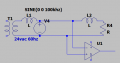
On the left side is T1 which is a 120/220 to 24V transformer. On the right side is a load, resistor, or motor or .... In the middle is a long wire.
The transformer is strong, and the load eats up power. We want to add data on top of this strong voltage.
L1 and L2 are inductors that are added to the transformer and load. At low frequencies they act like a short, but at high frequencies it opens up the wire. Now 60hz passes just as before the inductors were added. But at 100khz the wire looks almost as there is no load, or transformer.
In this schematic V4 sends 100khz signal on the wire, and U1 picks up this signal. There should be a 100khz filter in the input of the receiver. (block 60hz, pass 100khz)
1760710975577.png
I have used frequencies in the 100khz to 500khz range. 120khz is common. I used 455 khz because there are many filters at the frequency.
 

schmitt trigger

Joined Jul 12, 2010
2,090
Ditto for 455 Khz. One has to look for common availability of the selected devices. There are, or at least were, many ceramic filters for AM IF applications.
With the decline of superheterodyne AM receivers, I ignore the actual availability.
 

MisterBill2

Joined Jan 23, 2018
27,563
Certainly it is not an altogether new concept. I have seen a circuit that used mains power lines, and vacuum tubes in the circuitry. So the concept is certainly valid.
The realization of that functionality with modules not intended for that sort of connections will be the serious challenge. A powered AC pair is a much lower impedance and a much higher interference line.
 

ronsimpson

Joined Oct 7, 2019
4,702
Do you want to work with Hunter, or are you building a separate system?
I understand the "decoder".
I don't understand the transmitter very well. Do you want to work with a traditional controller?
Are you going to make the controller also?
Can you program a micro controller?
I have made similar but with micro switches to set the addresses. I see in a wet environment you need to program without opening up the box. Good idea there.

Do you want to make this just for you or are you looking to make 10,000?
Are you competing against Hunter for the large market? Or you looking to undercut Hunter and go for smaller systems. Maybe 20 zones max.
 

Thread Starter

DJ_AA

Joined Aug 6, 2021
490
No, it’s a separate system. I don’t think you can connect to their protocol.

I have a controller that activates several relays, all operating on 24 VAC. I also have a spare data port. The site I’m working at already has some wires installed in the building, and I’m looking to use them for communication with another device, as well as to operate a few relays.

Yes, we can use micro switches to program the address or assign a UID to each device.

The aim isn’t to undercut existing products, but rather to develop my own version that can integrate with the hardware I already have installed.

Have you developed this type of technology before?

I’ve looked into other Microchip solutions, but they seem a bit too bloated for my requirements, as I don’t need my circuit to be compatible with other commercial standards or hubs.
 

ronsimpson

Joined Oct 7, 2019
4,702
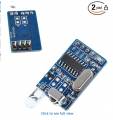
Here is a little board, with microcomputer. It transmits IR light to talk. 32khz This one transmits and receives.
This is about the size of computer you need.
In this format the computer sends 32khz tone out (in light but could be signal). I don't remember the different formats, but I think it sends out address + data, then inverts the numbers and sends it again. The receiver collects the two transmission and compares to make sure there is no errors.
This is basically a TV remote control device.
32khz is ok, If I made it, I would use 120khz or 455khz.
This is just an example of how small the computer could be, doing the same job.
It needs a power supply. 24Vac to 5Vdc. (simple)
It needs a receiver that can be simple. (or transmitter)
It needs a relay to send the power out.
1760882775731.png
 

Thread Starter

DJ_AA

Joined Aug 6, 2021
490
Here is a little board, with microcomputer. It transmits IR light to talk. 32khz This one transmits and receives.
This is about the size of computer you need.
In this format the computer sends 32khz tone out (in light but could be signal). I don't remember the different formats, but I think it sends out address + data, then inverts the numbers and sends it again. The receiver collects the two transmission and compares to make sure there is no errors.
This is basically a TV remote control device.
32khz is ok, If I made it, I would use 120khz or 455khz.
This is just an example of how small the computer could be, doing the same job.
It needs a power supply. 24Vac to 5Vdc. (simple)
It needs a receiver that can be simple. (or transmitter)
It needs a relay to send the power out.
View attachment 357333
So how do i use this with 2 wire 24VAC?
 

ronsimpson

Joined Oct 7, 2019
4,702
So how do i use this with 2 wire 24VAC?
I probably would not use it. I do think removing the IR transmitter LED and removing the IR receiver, the boards will talk to each other just fine over wires.

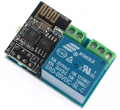
At this point I want to show you some similar boards as examples. This board has a relay to switch power. A smaller part will work. On the left side is a computer that includes a WiFi radio. These boards talk over air waves not wires. These boards I use to control valves using the WiFi network in the buildings. The computer could talk over wires. Just an example.
1760895675595.png
While you are thinking about how this is to work. I have a problem with some of the boards don't talk back. Jest because I sent a "turn on " command does not tell me if the board received the message. Sometime the power drops and relay opens up. If the remote device can talk back, I could every 10- minutes ask, "are you on or off". This would solve some of my problems.

Next problem I see is, what happens if the communication fails. In my case I want the remote device to reset back to off if there is not communication for a long time. I like to set a time for 10 minutes.

I use 24Vac valves but some people use DC valves. The valves are latching so they only need a very short pulse of power.

There are many things to think about.
 

panic mode

Joined Oct 10, 2011
5,000
i would start by presenting some numbers to help narrow down recommendations:

what is the total number of nodes/devices?
what is the total length of the 2-wire cable end to end?
does it matter if the 24V is AC or DC?
 

0ri0n

Joined Jan 7, 2025
173
The THVD8000 or THVD8010 are transceivers for RS485 links over DC or AC lines. TI has an app note (SLLA590) specifically for a COM link over an 120V AC outlet.
Another choice would be the TDA5051A, a powerline modem IC for home automation. All you need is an UART interface. The datasheet has a complete schematic for 230V AC power lines. It doesn't take much to mod it for 24V AC.
 

ronsimpson

Joined Oct 7, 2019
4,702
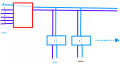
Make some pictures like this. Label the blocks. Describe the functions of each piece.
1761000742018.png
There could be up 50 device.
Because 64 is a binary number and good for computers. Say the number of devices to needs to be 50 to 64. It might to be good to have some addresses reserved for special functions. Example address 0 and 51 to 64 are not used at this time.

Each remote device listens for its address. (1 through 51) Then follows some instructions. (0=off, 1=on, 2=?, 3=?)
What happens when the power first comes on? (turn off) or (remember what state you were at)
What happens when no communications happens for a long time?

I think it would be good if the remote devices did not care if the two wires get reversed.

What drives the main device? A normal sprinkler controller? Are you going to build a controller?

State how waterproof it must be.

Put this picture in your document.
1761001836981.png
It is very important to understand what you are wanting to build.
It is important to know who will do each piece of the project.
Who will use it? What is their ability?
 
Top