Two switches - One actuator

LesJones

Joined Jan 8, 2017
4,511
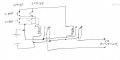
The fact that you are prepared to hold the buttons pressed makes it very easy. This is the basic schematic.
190818_01.jpg
You will also require a fuse of about 30 amps from the battery. It would also be a good idea to fit a smaller fuse (Rated for the relay current.) to feed the +12 volts to the push buttons to protect that wiring as it can be much thinner than the wire for the actuator current. Diodes across the relay coils will also reduce sparking at the push button contacts due to the inductance of the relay coils.

Les.
 

LesJones

Joined Jan 8, 2017
4,511
I have just had a look at Farnell's website and found this relay which should suit your application.
I have chosen a current rating higher than 20 amps as the starting current of the actuator will be higher than 20 amps. Farnell also have branches in the US so they will probably have this item. This relay has a built in resistor (560 ohms) in parallel with the coil so you will not need diodes across the relay coils. A one amp fuse for the wiring to the push buttons and relay coils should be about right. The relay coils will take about 150 mA each so even if an up button and a down button are pressed at the same time the current will only be about 0.3 amps.

Les.
 

ronsoy2

Joined Sep 25, 2013
71
The two standard toggle switches will work fine. (they must NOT be center off!) Note that it will require two extra wires to run the battery (or motor) to the remote switch, which is the one located outside. Other than that the circuit is dead simple.
Since the door opener already has limit switches, the door will cycle to the opposite limit whenever one switch or the other is activated. If it is open, it will close; if it is closed, it will open.
The switch will NOT be labelled "open" or "closed" since the open or closed position will depend on the position of the other switch. This is not of importance since it is assumed that the operator will know if the door is open or closed when he is activating the switch.
switchs.jpg
 

Thread Starter

GTHill

Joined Aug 18, 2018
14
The two standard toggle switches will work fine. (they must NOT be center off!) Note that it will require two extra wires to run the battery (or motor) to the remote switch, which is the one located outside. Other than that the circuit is dead simple.
Since the door opener already has limit switches, the door will cycle to the opposite limit whenever one switch or the other is activated. If it is open, it will close; if it is closed, it will open.
The switch will NOT be labelled "open" or "closed" since the open or closed position will depend on the position of the other switch. This is not of importance since it is assumed that the operator will know if the door is open or closed when he is activating the switch.
View attachment 158875
Ron,

Thank you for this. What kind of switch would I use then? My guess is DPDT with no center off? My current switches have center off but I can go get another set. Thanks!

GT
 

Thread Starter

GTHill

Joined Aug 18, 2018
14
The two standard toggle switches will work fine. (they must NOT be center off!) Note that it will require two extra wires to run the battery (or motor) to the remote switch, which is the one located outside. Other than that the circuit is dead simple.
Since the door opener already has limit switches, the door will cycle to the opposite limit whenever one switch or the other is activated. If it is open, it will close; if it is closed, it will open.
The switch will NOT be labelled "open" or "closed" since the open or closed position will depend on the position of the other switch. This is not of importance since it is assumed that the operator will know if the door is open or closed when he is activating the switch.
View attachment 158875
Ron - Does the flip the polarity to the motor to go the other direction?
 

ronsoy2

Joined Sep 25, 2013
71
Ron,

Thank you for this. What kind of switch would I use then? My guess is DPDT with no center off? My current switches have center off but I can go get another set. Thanks!

GT
Yes, you would need the no-center switches. They are not expensive, even for fairly high current ones. Note that you could save one center off switch for the INSIDE switch so you could LOCK the door when you are inside if so desired. With the inside switch in the center, the outside switch would not activate the door. When you leave, the inside switch would be left in one or the other positions so the outside switch would work to open and close the door.
 

Thread Starter

GTHill

Joined Aug 18, 2018
14
Yes, you would need the no-center switches. They are not expensive, even for fairly high current ones. Note that you could save one center off switch for the INSIDE switch so you could LOCK the door when you are inside if so desired. With the inside switch in the center, the outside switch would not activate the door. When you leave, the inside switch would be left in one or the other positions so the outside switch would work to open and close the door.
Ok... so it works! Took me a few times to figure out how to wire it even though you gave me the wiring diagram.

The only downside is that it doesn't work with the light b/c its under constant power and the limit switches are what keeps it off. I know the other solutions presented would solve for that I think. But this way was really easy.

I guess I could wire the warning light and the bell separately if I wanted to.

Thank you for the help!

GT
 
So, out a relay coil across the actuator. Relay won't care which direction the power is going (Polarity).

Now use the Normally open contacts to power the likely polarity sensitive rotating light fro a 12 V source. Still no power consumption when fully open or closed.

If you want two different lights, one for "opening" and on for "closing" use two relays and "steer" the voltage to one or the other coil with a diode.

Now, you have two contacts - one that wll close when the door is opening and another when the door is closing.
 

LesJones

Joined Jan 8, 2017
4,511
Hi KISS,
I don't think that would work as the TS does not have access to the motor side of the limit switches. ronsoy2's method would mean that there was allways power to the actuator so the light / bell would be on all the time. A few turns of the power cable around a reed switch (As I suggested in post #12) could be used to to control the light and bell as there would only be current flowing while the door was moving. (Or if the actuator was stalled due to a mechanical fault or a limit switch failing short circuit.)

Les.
 
Top