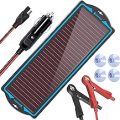
Trickle charge car battery with solar panel

Thread Starter

injtsvetkov

Joined Dec 12, 2015
12
Hello everyone!

I plan to buy a small solar panel and put it in the trunk of my car (there is a car lighter socket in there) to trickle charge the battery.
The idea is to permanently place the solar panel near a "small" side window which means that it won’t get enough sunlight to reach its full voltage. Since I’m not sure if a 12V solar panel would be enough, I plan to get an 18V (10W max) solar panel and make some tests. However I don’t know much about solar panels so my concerns are:
Is it safe to permanently connect the solar panel to the battery (e.g. for 2-3 weeks until the battery is fully charged)? I mean could this somehow discharge or harm the battery or damage the solar panel if there are some cold rainy days in the winter?
Also is there a problem when the car is running (the alternator generates 14V) and at the same time there is direct sunlight to the panel and it generates 17-18V?
Or are there any other risks which I haven’t considered?

Thank you!
 

dl324

Joined Mar 30, 2015
18,261
There is very little chance that the solar panel will be able to charge the battery hard enough to cause problems, even if it was trying to generate 18V.

Check the panel to see if it has a diode to prevent the battery from discharging. If it doesn't, you can add your own. Also check the cigarette lighter socket to make sure it doesn't have a diode. I tried charging my car using the lighter socket for the rear seats, only to find out that there was a diode preventing it from working.
 

sparky 1

Joined Nov 3, 2018
1,218
I have read reviews of different product approaches to the idea.
The photovoltaic panels having larger surface area were liked and the small ones (tiny trickle) had most complaints.
Minimum might be around 2 square feet. along with that, a good charge controller and a way to keep it from being stolen.
One of the best ideas incorporates an automobile rooftop cargo carrier with panels securely locked.
 
Last edited:

boostbuck

Joined Oct 5, 2017
1,037
You could choose a panel sized so its max voltage and current stay within safe parameters for the battery and then it can just be connected across the battery, but the panel will charge the battery very slowly. The maximum voltage for a battery at full charge is about 14V. When your battery is full and your panel is attempting to deliver 18V, the result will be gassing and drying the battery.

If you are going to leave it for weeks at a time then your really should get a charge controller. Then you can use a larger panel with a higher voltage and current and the charge controller will protect your battery and allow quicker charge and better maintenance of float condition.

Its normal to use a diode to isolate the solar panel and charge controller from the car electrics. The panel will not generate 18V if it is connected to a car battery - the battery will hold the panel voltage low.
 

Thread Starter

injtsvetkov

Joined Dec 12, 2015
12
Thank you all for the prompt replies and for the helpful info! It seems a bit trickier than I thought. Basically I don't want to use any controllers because it gets more complicated and expensive and I'm not sure how much benefit I could get by trickle charging. I'm willing to play around and make some measurements to determine how long it takes to fully charge the battery (and then see how fast it discharges) and then make a simple schedule, e.g. leave it charging for the weekend and switch it off for 5 days or the other way around in order to maintain a bit higher voltage in the battery, there is no need to fully charge it.
 

boostbuck

Joined Oct 5, 2017
1,037
Actually if you use a charge controller, it is simpler and less expensive because you wont have to fluff around monitoring it all the time, and checking how full the battery is, and topping the battery up when you forget to disconnect it, and charging the battery manually because you forgot to reconnect it, and replacing the battery too soon, and... and .. and...

A 5A charge controller will cost a few dollars and save you a truckload of bother and look after the battery properly.
 

Hymie

Joined Mar 30, 2018
1,347
One of the main problems with a trickle charge solar panel plugged into a cigar lighter socket is that with the ignition off, the socket is isolated from the vehicle battery.

Plug in some device which clearly indicates it to be powered from the battery, and switch off the ignition to see if this will be a problem for you.
 

MrAl

Joined Jun 17, 2014
13,680
Hello everyone!

I plan to buy a small solar panel and put it in the trunk of my car (there is a car lighter socket in there) to trickle charge the battery.
The idea is to permanently place the solar panel near a "small" side window which means that it won’t get enough sunlight to reach its full voltage. Since I’m not sure if a 12V solar panel would be enough, I plan to get an 18V (10W max) solar panel and make some tests. However I don’t know much about solar panels so my concerns are:
Is it safe to permanently connect the solar panel to the battery (e.g. for 2-3 weeks until the battery is fully charged)? I mean could this somehow discharge or harm the battery or damage the solar panel if there are some cold rainy days in the winter?
Also is there a problem when the car is running (the alternator generates 14V) and at the same time there is direct sunlight to the panel and it generates 17-18V?
Or are there any other risks which I haven’t considered?

Thank you!

Hello there,

With a 10 watt solar panel you will be lucky if it works well enough over some weeks or months. That would probably be the minimum power required. That's because the insolation level is never guaranteed. When you get several cloudy days the battery runs down anyway, then you have to depend on several sunny days to get it back to normal. Of course it depends where you live too. If you get a sunny day most of the days of the month you would probably get away with a 10 watt panel as long as it received that sunlight with the angle adjustment just right.

The two angle adjustments are azimuth and altitude. You can adjust the azimuth to the center of the curve of the apparent movement of the sun. The altitude you can adjust so that when the apparent position of the sun is in the center of that travel, the solar panel surface is normal to the suns position (pointing right at the sun). This adjustment would be good enough for charging a battery. Of course a test is always in order and you have to watch it as the seasons change because the angle of the sun changes. When I used a 20 watt panel to charge a car battery I had a problem with I never had to adjust the angles though, only when it was first installed.

Putting the solar panel inside the car can also reduce the power significantly. That's because the windows are often tinted, and even if not tinted the window glass can still reduce the power significantly. Even a 20 watt panel might not work in that case. Also, it may be hard to get the angles adjusted right if the panel is inside the car. You'd have to have a window that pointed to the apparent position of the center travel of the sun as above. You may even need a 100 watt panel to get that to work.

Then there is the drive cycle factor. The normal charging of the battery due to the alternator may charge the battery up enough some days and not other days, depending on the length of the drive. If you only drive once a week or less though, this probably is not a concern.

My experience has been with a huge panel worth a literally million dollars, but I got more experience with car battery charging when I did my own car. I had a Volvo that had a charge voltage that was too low so I wanted to add some extra charge time when the car was just sitting so the battery would not go dead especially in the winter. I tried the 20 watt panel inside the back window which happened to point due south which was just right for my location, but that luck wasn't good enough. The window reduced the power so much I had to mount the panel on the roof. Once I did that, I was able to get nearly 1 amp charge current all the time while the sun was near the center of travel and not bad outside that range either. In other words, it worked and solved the problem.

I started with a diode in series, a Schottky 10 amp diode. That was good enough for a while. I monitored the progress over days and months, taking readings at least once per minute then just once every two minutes, and logging the results so I could review them when I had a chance. This gave me the insight needed to figure out what I had to do to get it to work right.
At first the diode worked pretty good. Then I noticed that if we got several sunny days, the battery would start to charge higher than I wanted it to, so I added the controller. The controller actually came with the solar panel I had purchased so I did not have to buy one. This is not to say that it would have worked forever without the charge controller, but I felt more comfortable using the controller after I made sure it was not eating too much of the solar panel power. Note this was not a max power tracker, just a controller that limited the top end voltage. I used it that way for a long time and never had a problem with the battery after that.

The wireless monitor was created with both a Microchip microcontroller in the car as the transmitter, and an Arduino connected via RS232 to the computer inside the home. The controller inside the car is designed to use minimal power, and transmitting just once every two minutes cut the power consumption down to a minimum. When the car is off the transmitting circuit has to use the car battery power so keeping that to a minimum is a good idea.
The RS232 connection allowed the use of regular files on the computer to be used for the logging of data such as voltage and time, and if any readings were missed due to wireless interference. Overall most of the time the readings came in fine there were only small periods of time when it might have missed a couple readings. The position of the receiving antenna had to be placed a few times to get the best reception inside the house.

In conclusion, it works very well to use a solar panel to keep the car battery up enough even when you do not drive the car much. In fact, sometimes I would go a whole month without driving yet no problems came up.
Charging through the car window did not work very well at all and significantly reduced the charge current. It would never have worked out that way unless maybe I got a larger panel. I'd say a panel of 100 watts might do it, possibly 50 watts, but not as low as 20 watts as even with full direct sunlight it would not charge enough.
Mounting on the roof requires some thought though, and you probably should not drive with it that way unless you bolt it down and keep the speed of the vehicle low. You can calculate the approximate force on the panel at a given speed and get away with maybe even strapping it to the roof, but the local laws may not allow that either. I used strapping, and only one time tested it driving about 30 miles per hour on back streets for a distance of about 1.2 miles and there was no movement of the panel at all. The straps were rated for 500 pounds or something like that, and the panel only weighs maybe 2 pounds, and the added force calculated for driving at 60mph was not enough to budge the panel.
Oh one more thing, you have to get a mounting bracket to mount the panel properly, and that probably applies to a panel mounted inside the car also although there are some tricks you can use for that. The brackets are lightweight aluminum angle stock.

BTW even though a panel max voltage may be spec'd at 21 volts, that's with very low current so you'd never see that in real life charging a car battery.

If you can think of any questions about this I might be able to answer them if I had experience with those issues.
 

Thread Starter

injtsvetkov

Joined Dec 12, 2015
12
OK so maybe the panel should be a bit bigger. However I don't want to go anywhere near 1 amp. I have charged the battery a few times and it takes 6-7 hours at 0.5 amp to reach 12.6 volts. I did that during the night and if I apply 1 amp the battery gets a bit warmer so I can only imagine what would happen if the car is parked at direct sunlight in the summer... I guess I'll be using it mostly in the winter but anyway I need to chose a panel which (placed inside the car) would provide between 0.1 and 0.5 amps for a few hours in a relatively sunny day. Of course it won't provide anything in cloudy days but that's OK. I prefer safety over efficiency!
I understand that using a controller generally makes things easier but in my case the idea is to spend some time and play around at a minimum cost (like a hobby project). I'm not trying to make a solar charger at any cost. Even if I don't achieve the desired effect, at least I could gain some precious experience and end up using the panel for something else. I just need to chose the right panel that could give me a chance to make some experiments and not just buy it to see it can't do anything. However I have a strange feeling that the right panel would be either too large or too expensive. If I have to give more money than the cost of a new car battery then there is no point, I'd rather buy a new battery and forget about the solar charger.
I have this car for 1 year and I don't know when the battery was replaced or if the alternator charges it enough. Basically the problem is that sometimes, for 2-3 weeks or so, the car is driven at short distances only, which is bad even for a new battery. I had some problems in March, the battery was down to 12 volts, but after I charged it several times and since then I'm driving at longer distances so now it holds 12.3 volts and there is no problem at all. However I suspect that next winter, when I drive mostly at short distances, I would need to charge it more often but since I live in an apartment charging with AC charger is a bit complicated. That's why I thought that buying some relatively cheap solar panel could reduce the number of charges and give me a bit longer battery life but as I see it won't be so easy.

Anyway, thank you all for the advices!

Could someone give me a link with more detailed specifications for the solar panels regarding the wattage, voltage and amperage depending on the insolation.

Thanks!
 

ronsimpson

Joined Oct 7, 2019
4,660
I plan to get an 18V (10W max) solar panel and make some tests.
The most you can hope for is 500mA. I have a small panel, and they put a 1A diode in line to keep the car from feeding power back into the panel when the engine is on. Most of the panels do not make the rated power. At that power level I and only working for hours in the day, I don't there will be any damage by overcharging.
 

MrAl

Joined Jun 17, 2014
13,680
OK so maybe the panel should be a bit bigger. However I don't want to go anywhere near 1 amp. I have charged the battery a few times and it takes 6-7 hours at 0.5 amp to reach 12.6 volts. I did that during the night and if I apply 1 amp the battery gets a bit warmer so I can only imagine what would happen if the car is parked at direct sunlight in the summer... I guess I'll be using it mostly in the winter but anyway I need to chose a panel which (placed inside the car) would provide between 0.1 and 0.5 amps for a few hours in a relatively sunny day. Of course it won't provide anything in cloudy days but that's OK. I prefer safety over efficiency!
I understand that using a controller generally makes things easier but in my case the idea is to spend some time and play around at a minimum cost (like a hobby project). I'm not trying to make a solar charger at any cost. Even if I don't achieve the desired effect, at least I could gain some precious experience and end up using the panel for something else. I just need to chose the right panel that could give me a chance to make some experiments and not just buy it to see it can't do anything. However I have a strange feeling that the right panel would be either too large or too expensive. If I have to give more money than the cost of a new car battery then there is no point, I'd rather buy a new battery and forget about the solar charger.
I have this car for 1 year and I don't know when the battery was replaced or if the alternator charges it enough. Basically the problem is that sometimes, for 2-3 weeks or so, the car is driven at short distances only, which is bad even for a new battery. I had some problems in March, the battery was down to 12 volts, but after I charged it several times and since then I'm driving at longer distances so now it holds 12.3 volts and there is no problem at all. However I suspect that next winter, when I drive mostly at short distances, I would need to charge it more often but since I live in an apartment charging with AC charger is a bit complicated. That's why I thought that buying some relatively cheap solar panel could reduce the number of charges and give me a bit longer battery life but as I see it won't be so easy.

Anyway, thank you all for the advices!

Could someone give me a link with more detailed specifications for the solar panels regarding the wattage, voltage and amperage depending on the insolation.

Thanks!
Well at this point I also have to ask what is the charging voltage when you first start the car after a night with the engine turned off. That's importance too.

I tried 100ma but it did not work well enough. I found I had to go to 1 amp and that is partly because the insolation level is such that the current decreases from that point on. That means that 1 amp is the maximum in direct sunlight. Later in the day it's going to go down a lot, so you never get 1 amp continuous. That's an important fact. That's why 100ma did not do anything much, because that was in bright, direct sunlight.

If your alternator charging voltage is too low then when you run the car it won't charge much or take a very long time to reach any real charge level close to a full charge. I had two cars that had a charge voltage of 14 volts, and that is because they must have been designed like that. When I got a new alternator, it did not help. This is why some people now modify their alternators to increase the charge voltage by about 0.5 volts or so by adding a series diode in the right place in the alternator. This fools the voltage regulator into thinking that the battery voltage is 1/2 volt lower, and so it charges it at a higher voltage which means a higher current which means it charges better.
In my experience with three cars, the ones that were charging at 14v or lower were always a problem. The min should probably be 14.5v and I've measured this on other cars too that work more or less normally.

Keep in mind that if you get a more powerful solar panel than you need you can always reduce the power by simply tilting the panel at a different angle. If you get one that is underpowered there is not anything you can do but buy another panel.
The word of the day though is "experimentation" as that will show you the best way to do this in your situation. It only takes a week or two making some measurements day by day to figure out what works right. If you can monitor remotely like I did you can get results over an entire day and night (night operation is interesting too in some cases).
 

Thread Starter

injtsvetkov

Joined Dec 12, 2015
12
Oh I can't remember exactly but I think when the battery was down to 12V or maybe less (that was in March) the car couldn't start so I jumpstarted it with another car and started measuring. At first I think the charging voltage was arround 14-14.1V and after driving for 1 hour it went up to 14.3-14.4V. I think that means the alternator charges the battery at more than 1 amp which seems enough to me.

As I see it (but I'm not sure), 100ma can only maintain the voltage of the battery but it won't increase. I think this is good because when the alternator charges the battery, the voltage will increase slightly and these 100ma won't let it drop when the car is not running. That means the next time you drive the car it will charge the battery a bit more. That way you don't have a problem when you don't use the car for a few weeks or run it at short distance only.
Ideally my purpose is not to charge the battery by the solar panel, but only help the alternator which will do the main charging itself.
That's why I don't want (and I don't need) to get 1 amp from the panel. I don't want the headache every time I need to park the car at direct sunlight for 1-2 hours. I think there is a risk (probably low but still a risk) of overheating/boiling the battery especially if it's an old one. I prefer slow and safe than fast and risky.

The most you can hope for is 500mA. I have a small panel, and they put a 1A diode in line to keep the car from feeding power back into the panel when the engine is on. Most of the panels do not make the rated power. At that power level I and only working for hours in the day, I don't there will be any damage by overcharging.
Do you mean that you bought a small panel which was designed and manufactured particularly for that purpose?
Does it have some kind of controller or any other protections besides the 1A diode preventing battery discharge?
What are the panel dimensions and specifications? What was it's price?

Thanks?
 

schmitt trigger

Joined Jul 12, 2010
2,053
Many years ago when I lived in the DFW metroplex my job required to fly out for 2 or 3 weeks at the time. Sometimes I would return and find my car’s battery depleted.
I purchased a unit similar to what Ron has shown, and that was enough to prevent a repeat situation.
What others have mentioned about the lighter outlet is correct, it is disconnected when the engine is shut off. Thus I wired it directly into the electrical junction box, the solar panel had a built in schottky, I only added a small value fuse.
 

MrAl

Joined Jun 17, 2014
13,680
Oh I can't remember exactly but I think when the battery was down to 12V or maybe less (that was in March) the car couldn't start so I jumpstarted it with another car and started measuring. At first I think the charging voltage was arround 14-14.1V and after driving for 1 hour it went up to 14.3-14.4V. I think that means the alternator charges the battery at more than 1 amp which seems enough to me.

As I see it (but I'm not sure), 100ma can only maintain the voltage of the battery but it won't increase. I think this is good because when the alternator charges the battery, the voltage will increase slightly and these 100ma won't let it drop when the car is not running. That means the next time you drive the car it will charge the battery a bit more. That way you don't have a problem when you don't use the car for a few weeks or run it at short distance only.
Ideally my purpose is not to charge the battery by the solar panel, but only help the alternator which will do the main charging itself.
That's why I don't want (and I don't need) to get 1 amp from the panel. I don't want the headache every time I need to park the car at direct sunlight for 1-2 hours. I think there is a risk (probably low but still a risk) of overheating/boiling the battery especially if it's an old one. I prefer slow and safe than fast and risky.


Do you mean that you bought a small panel which was designed and manufactured particularly for that purpose?
Does it have some kind of controller or any other protections besides the 1A diode preventing battery discharge?
What are the panel dimensions and specifications? What was it's price?

Thanks?
If you are charging through one of the windows you can probably expect to see a very large reduction in power.

Yes the panel I purchased was made for charging car batteries and was $50 USD on Amazon and the panel was another $50 USD:

SOLPERK Solar Panel Kit 20W 12V, Solar Battery Trickle Charger Maintainer + Upgrade Controller + Adjustable Mount Bracket for Boat Car RV Motorcycle Marine Automotive


SOLPERK Solar Panel Mount, 13.8in Solar Panel Stand, Angle Adjustable (0-60 Degree), Solar Panel Mounting Brackets for 1 Pcs Solar Panel.


The panel mount (second item above) did not adjust from 0 to 60 degrees as advertised though it only went from 0 to 45 degrees, but that worked ok anyway. The "adjustable bracket" that came with the first item above (the panel itself) was too cheap and flimsy and did not offer a good way to mount the panel on the roof of the car that's why I ended up buying a better mount about week later.
 
Last edited:

Thread Starter

injtsvetkov

Joined Dec 12, 2015
12
OK, so if a panel rated at 12V should charge a 12.6V battery that means it should provide at least 14V, maybe even more. Does that mean that 18V panel will provide 20V or more? They don't give any info about MIN/MAX voltage in the websites. I presume that the generated voltage will depend on the insolation level but how? Or does the level of insolation affects mainly the amperage?
 

dl324

Joined Mar 30, 2015
18,261
They don't give any info about MIN/MAX voltage in the websites. I presume that the generated voltage will depend on the insolation level but how? Or does the level of insolation affects mainly the amperage?
Voltage will depend on the amount of light hitting the solar cells and the design voltage. Amperage will be limited by the cells.

You don't need to worry about any of those small panels boiling your battery. They don't have enough current to overcharge a car battery. The battery will limit the voltage from the panel. You just need something that can output more than 12.6V.
 

MrAl

Joined Jun 17, 2014
13,680
OK, so if a panel rated at 12V should charge a 12.6V battery that means it should provide at least 14V, maybe even more. Does that mean that 18V panel will provide 20V or more? They don't give any info about MIN/MAX voltage in the websites. I presume that the generated voltage will depend on the insolation level but how? Or does the level of insolation affects mainly the amperage?
Hi,

Well actually you have to pay close attention to the voltage ratings like '12v' or '21v'. That's because the raw, bare panel will have a rating like 21v but the overall system may suggest that the 'battery' voltage is 12v. The panel itself though, with no regulation, would have to be around 20v or so. 18v might cut it but probably 20v or so is better. The reason for the higher raw unregulated voltage is because the power only comes after the voltage naturally falls with load. In other words, that 21v is the "open circuit" voltage. When there is no load, it should be 20v or 21v, but after the load is applied it would fall lower and then you might see the rated power output. At 20v it may only put out 1ma, which is only 20mw. If it does put out 10ma, then still only 200mw, which is nowhere near the 10 or 20 watts of the panel. At 15 volts it may put out 1 amp, which is a lot more and close to the full power of a 20 watt panel.

So you do have to check the rating and make sure they are quoting the open circuit voltage of the panel, and it is around 20v or better. That would be typical for charging a 12v car battery.

The panel I quoted says it is "12v" but that's the battery voltage it is made to charge, not the open circuit voltage. The open circuit voltage is around 21v. Since they say it's for charging a car battery, they can say 12v.
I am not sure that they mention the open circuit voltage, but they do say 12v for car batteries:
"Designed to charge and maintain 12V rechargeable batteries like LiFePO₄, Lithium Ion, AGM, SLA, GEL, EFB, MF, etc. Keep batteries charged for trailer, tractor, truck, boat, motorcycle, RV, car, lawn mower, water pump, gate opener, electric fence, etc."
 
Last edited:
Top