"Tricking" a Capacitor?

Thread Starter

johnyradio

Joined Oct 26, 2012
615
Suppose a capacitor is calculated to handle 3A AC at 400 kHz. If you wanted to pass lower frequencies at 3A, you'd need a bigger cap.

So you pass a 3A square wave AC at 400 kHz. So far, so good.

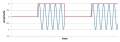
Next, you turn that square wave on and off, over and over. This is On–off keying (OOK), the "simplest form of amplitude-shift keying (ASK) modulation that represents digital data as the presence or absence of a carrier wave." (Wikipedia)
1727559763591.png

Let's say you modulate at 2 kHz. Now you're passing 2 kHz at 3A. Aren't you exceeding the capacitance? Will the cap burn up? Or have you tricked the cap into passing 3A at 2 kHz?

I think the answer is, you're not really putting 2 kHz thru the cap, because you're still discharging the cap at 400 kHz.

To me, this is a very intriguing trick, which someone might find useful, for what i'm not sure.
 
Last edited:

Thread Starter

johnyradio

Joined Oct 26, 2012
615
Ok, but if you scan the output with a spectrum analyzer, would you see energy at 2 kHz and 400 kHz?

Now put a low-pass RC filter on the output, so the 400 kHz gets filtered out completely, but everything under 5 kHz passes without attenuation. Could a load draw 3A from the 2 kHz energy?
 

MisterBill2

Joined Jan 23, 2018
27,186
If the AC is still 400 KHZ, and the filter will block all of it, assuming a "perfect filter". So now, at the 2 KHZ rate, you are switching between zero and nothing. Simple math leaves it difficult to tell the difference.
Consider that a filter does not rectify, it blocks, at least in this case.
 

nsaspook

Joined Aug 27, 2009
16,251
Ok, but if you scan the output with a spectrum analyzer, would you see energy at 2 kHz and 400 kHz?

Now put a low-pass RC filter on the output, so the 400 kHz gets filtered out completely, but everything under 5 kHz passes without attenuation. Could a load draw 3A from the 2 kHz energy?
The 2 kHz modulation energy is converted to RF sidebands of the 400kHz carrier.
1727572609130.png
No Tricks.
 
Last edited:

Ramussons

Joined May 3, 2013
1,567
Suppose

Let's say you modulate at 2 kHz. Now you're passing 2 kHz at 3A. Aren't you exceeding the capacitance? Will the cap burn up? Or have you tricked the cap into passing 3A at 2 kHz?
No, you are not. You are still passing 3A at 400 KHz, but itermittently at 2 KHz rate. The average current passed will depend on the 2 KHz duty cycle.
 

MisterBill2

Joined Jan 23, 2018
27,186
If in the example, you add a perfect filter that removes all of the 400KHZ signal that is being switched on and off at a two kilohertz rate, it is like a SSB transmitter signal when nobody is talking. ALL of the non-existent energy is concentrated in the empty sideband, and so there is nothing.
And once again, it is difficult to tell the difference between zero and nothing.
 

Thread Starter

johnyradio

Joined Oct 26, 2012
615
It seems like an envelope detection linear demodulator to me. Or a buck converter. In a buck, you've got kHz of AC power. You filter out all the AC. Now you have DC power. Not nothing. A better analogy may be a Class D audio amplifier, where the output is the audio but it's gained the power of the Mhz carrier. Or an A.M. demodulator.
"The resistance is chosen such that the discharge is slow enough to smooth out the carrier frequency and fast enough to not smooth out the envelope frequency. Here is an example of a leaky peak detector for AM demodulation:"

1727663555268.png
https://www.allaboutcircuits.com/te...emodulation/how-to-demodulate-an-am-waveform/
 
Last edited:

MisterBill2

Joined Jan 23, 2018
27,186
When the modulating input is ZERO, the product of the modulation, generally taken to equal the math product of signal amplitude times carrier amplitude, would seem to also be zero. What portion of that math is so complicated??
 
Top