Triac for AC motor speed controller

Thread Starter

q12x

Joined Sep 25, 2015
2,227
(Original diode is RL207)
A rough indication of the condition of the motor is to run it off of a 12v automotive battery, if it is a series (Universal) motor as suspected, it should wind up pretty good, being a series wound-field motor.
Try in each direction.
Max.
To Mister Max :
Thank you mister Max!
I dont have a car batery but i have a computer power supply with 12V on it.
I did the test and is working fine both ways as you suggest. OAU ! I didnt expect that.
Excellent idea you had with the 12V ! Lesson for the future to test other weirdos motors.
My best Guess is that white smoke was the insulation over the copper wire that boiled when i keep that AC200V for 3-4seconds.
I can't open the motor because its made with metal ears bend over the plastic and too much bending will turn off those ears. And the geniuses who made it, point welded the 2 capacitors to the metal case. I can cut them and solder later if I think about it. Geniuses,right?
And from the tests so far it looks ok! I am of course worried about that white smoke and what damages are there.
Another theory I have about this aspect with the motor, is if some wire is shorted internally because of the melting of the isolation, then the power of the motor is down at some degree now while is still working. Now is at 90% randament/efficacy/yield like it was new from factory. Eh, i can live with it, while is still running.
I actually tested each winding inside as you suggested earlier, without opening the motor case, by setting my beeping diode mode on my measuring tool, I connect to the pins of the motor and on the other side, i rotated the rotor of the motor. Slow at first to listen to each gap and step, then fast to obtain a continuous beeping. Smart, eh?
 

Thread Starter

q12x

Joined Sep 25, 2015
2,227
...There also appears to be a MOV in the circuit, check the visible condition of this, it is blue and labeled ZR11x.
Max.
This is the Varistor: [K275 ru] I have no idea how to measure it !!! It looks fine, nothing exploded on him.
 

MaxHeadRoom

Joined Jul 18, 2013
30,686
This is the Varistor: [K275 ru] I have no idea how to measure it !!! It looks fine, nothing exploded on him.
Usually they disintegrate when their rating is exceeded or they take out a high energy pulse, if it appears to be complete as shown then most likely it's OK.
Max.
 

Thread Starter

q12x

Joined Sep 25, 2015
2,227
This is a typical Triac/bridge controller.

Max.
aaa... i gathered 15 schematics with triac in the beginning of the project. They are very similar (but not the same). Your scheme fits with the others i already have indeed.
-Your schematic is for show?
-Or you suggest to remake it exactly like that from scratch? (with the components i already have)

Now I am learning about this Varistor from you. I never consider it important - i hear of it but never took him seriously. Until now with you. I will look after him in tutorials and YT. From what i peek so far about him, it looks like it's smoothing the spike and the shock of the large voltage. My motor is literally shocked when the power is started. Maybe this varistor will smooth the start. Again, thank you for all the help!
 
Last edited:

MaxHeadRoom

Joined Jul 18, 2013
30,686
There are a few different methods of 'Snubbers' the R/C, the MOV and often a ferrite choke is included.
If the speed control is working and started at zero, there should be no inrush to the motor, if your Triac is shorted or conducting all the time for some reason, then yes, the motor will jump quite violently at switch on.
Max.
 

Thread Starter

q12x

Joined Sep 25, 2015
2,227
There are a few different methods of 'Snubbers' the R/C, the MOV and often a ferrite choke is included.
Max.
This is the first time when I encounter the word 'snubber'. A new keyword for me to retain. From the movies I just watched they are called suppressors too.
So, if i understood correctly, they conduct only at higher voltages while on low voltages(under a threshold) are non-conductive. And they have 2 functions : [regulator] if a spike appear and is in some parameters, and [protector] if the spike is super high, they blow up. VERY interesting ! I also seen varistors in parallel, one after another. Like a battery of varistors 4-6-8 in a row. I wonder why... one possible explanation is being lazy not to change them every time they blow up. But is a fascinating method of usage. Like resistors in parallel.
- I mounted my K275 ru Varistor in my scheme. I can't see anything noticeable. It is still starting with a big shock, and not smooth.
I can see in the original scheme from the factory, the one that i take components from, there are 2 very little coils , they resemble like resistances, on the sides of the varistor . I notice one coil is blown up good. Exploded. I remember that one exploded later in some tests i did while working with AC. But not from the start.
 

Thread Starter

q12x

Joined Sep 25, 2015
2,227
This is a typical Triac/bridge controller.
Max.

Should I remake the schematics you provided?
OR
We work on what i build so far?
It's not that hard for me to rebuild it. But i feel i learn more with the current one that i am doing right now.
What do you say?
~q12~
 

Thread Starter

q12x

Joined Sep 25, 2015
2,227
A little literature on the subject.
for: Snubbers.pdf File size: 1.5 MB
Max.
I read " Snubbers.pdf File size: 1.5 MB" and i realized its 1 component. I search it on google and it was true. This is a completely new component for me. I didnt know about it's existence until today.
I literally thought that i can build from scratch this snubber,using a resistor and a capacitor , but You probably thinking all the time about this 1 single component. They make everything today i suppose. This is illuminating.
I dont have this component.
I will build it in the old fashion way.


I build this RC snuber, and put it in parallel with my varistor.
Again, Noting noticeable in the test.
The motor still kick hard on Power on. But does not tremble(hard) while running like with AC before. And it looks stabilized in the long functioning.
-----
- I need to lower down the voltage over the motor!!! From the Potentiometer !!!!!!!!!!!!!!
How to do that?
----
 

Alec_t

Joined Sep 17, 2013
15,119
If gate current has at any time been excessive then the triac may well be fried. An internal short could account for the absence of proper speed control.
 

Thread Starter

q12x

Joined Sep 25, 2015
2,227
Yes, you are right again.
I manage to fry every pin of the triac. How and when, i didnt check every time, so i have no idea.
I manage to fry my pot also. I put a rezistor after him - between the pot and the zener. That suprasolicited the pot.
Most probably the triac burned that time also.

Can you explain to me the gate of the triac? How to make it work?
I found another triac BT136 but i was lucky to find it and its the last one i have. I test it and mounted and test it again.
I put a normal resistor of 100ko and the V on A1 was 90V(from 220V on A2) But when I put higher resistor 300ko or a lower one 1ko I get 100V. The lower resistor 1ko started to make smoke and i interrupted in time the power. Something very fishy is going on here.
The conclusion is that if i put 220V (or when the pot is close to 0ohm) on the gate of triac (passing through diac) the triac will fry completly. It's my conclusion that i get from experimentation.
From what i read, the diac is having a treshhold of 30V. If the V is across this value, will pass and diac will open. If the V is under this value, diac will stop the V to cross. I also see that the gate of the triac is activated with 5V from a microcontroller. What this skematic that i build from internet do is very wird. Basically is letting 220 drop over diac and diac will let it pass, and then over gate of triac, and triac will burn. This is my conclusion. Please correct me because I am certainly miss something essential here. I couldnt learn everything. I am also upset that my components are destroyed. And the local electronic store does not have them - i went today and ask. And from internet the transport (inside my country) is extremely high.
In conclusion, thank you all for the time you put for my help. I really appreciate you all.
 

#12

Joined Nov 30, 2010
18,224
Can you explain to me the gate of the triac? How to make it work?
A triac gate is like a pair of diode junctions in series. They are connected between the gate leg and the MT1 leg. It requires about 1.1 to 1.5 volts to send current through those junctions but, like any other diode, these junctions have no ability to limit the current through them. What makes this worse is the connection to the MT1 leg. If you do not provide some resistance in series with the gate terminal, your gate driver will be connected to the MT1 leg and allow too much current.

When you send some current through the gate to MT1 junction, that allows the MT2 leg to be connected to the MT1 leg. Triacs typically need about 5ma to 50ma to activate the connection from MT2 to MT1. After the gate current is sufficient, current flows from MT2 to MT1 for as long as the current flows in the same direction...EXCEPT when the MT2 to MT1 current diminishes below the, "holding" current, the triac shuts off. After the AC wave crosses zero volts, you have to supply the gate trigger current again to get the triac to allow the second half of the AC wave to pass current through the triac.

If this explanation is not sufficient, ask again.
 

Thread Starter

q12x

Joined Sep 25, 2015
2,227
Can you explain on the scheme that i build ?
You explained from the point of view of the current (or Amp). And somehow i understand. I will understand better if you refer to Voltage. I know some stuff but i am not even close to being an expert or a professional. So, explain again if you can / or want. I am still in the dark with what happened so far and even with your explanation.
 

#12

Joined Nov 30, 2010
18,224
I will understand better if you refer to Voltage.
That is a problem because some circuits are voltage driven and some are current driven. A triac gate is current driven. It doesn't matter to say the gate uses up 1.1 volts to 1.5 volts because that is the symptom, not the cause. The cause is current and the voltage only show up because the current has to go through 2 diode junctions to do its job...turning on the triac.

Have you done LEDs yet? That is another case of, The current must be right but the voltage doesn't matter very much.
Maybe a look at my beginner's guide?
https://forum.allaboutcircuits.com/threads/ohms-law-for-noobies-or-the-amp-hour-fallacy.69757/
 

Bordodynov

Joined May 20, 2015
3,426
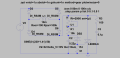
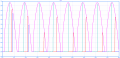
I did a simulation and found interesting things. At the maximum value of the variable resistor, an initial current surge is observed. At the beginning of the adjustment, current asymmetry is observed. Also, for the inductance of the motor given by me, I had to put a shunt (on control) 51 ohm resistor. Without a resistor, the triac did not turn off. I think that this is due to the high sensitivity of the triac and, using a less sensitive triac, this resistor is not needed.Draft618_cir.png
Draft618_plot.png
 

Thread Starter

q12x

Joined Sep 25, 2015
2,227
of, I did changed the triac with a new one BT136 (and a last one i have).Now a new problem I have:
When I plug in the power, the motor starts to work for a very short period of time then is stopping. It is like it gets a spike of current/voltage in him. All the time it is powered, it just stays off.
Another damaged triac, this time also? I measured it and is looking ok.
My potentiometer is fried on half of it. I open it since is big enough, and I could look inside. I use the side that is not damaged.
My question:
-Can I apply direct voltage on the diac? Bypassing the potentiometer. Like the pot is on 0 ohm. I will use a wire.
I am hesitating on trying it, since this is my last triac, and i want to be more careful. Basically 220V will fall through diac onto the Gate of the triac, directly.
If this will work, I will make a rudimentar varable rezistor myself. (i hope)
Thank you so much for the patience and help.
-q12-
 
Top