Transistor with emitter as direct output

Thread Starter

rfpd

Joined Jul 6, 2016
101
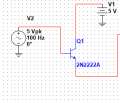
upload_2017-9-19_19-49-40.png

I saw this in a video about audio sampling in arduino, and he put this after the DAC, imagine the AC source as the output of the R-2R ladder. The output is the emitter. He was talking about loudness, saying this would amplify the signal, which didn't make much sense to me. Then I thought it would be to 'follow the voltage' without screwing it up, but it's an open circuit between the base and the emitter. Is there current flowing between the collector and the emitter? Can someone explain to me what this is doing, thanks.

Just a 'side question', in an amplifier montage what is the voltage drop between the collector and the emitter? Since the voltage at the collector is base's amplified and inverted, and at the collector it's base's -0.7.
 

crutschow

Joined Mar 14, 2008
38,503
Then I thought it would be to 'follow the voltage' without screwing it up, but it's an open circuit between the base and the emitter. Is there current flowing between the collector and the emitter?
Yes, it's called a emitter-follower.
It amplifies current to drive a low impedance load but does not amplify the voltage.

There is indeed current flowing between the collector and emitter, as necessary to supply the current to the emitter load and keep the emitter voltage about 0.7V below the base voltage (the normal Vbe drop).
in an amplifier montage what is the voltage drop between the collector and the emitter? Since the voltage at the collector is base's amplified and inverted, and at the collector it's base's -0.7.
The collector voltage does not (and cannot) change, as it is connected directly to the supply voltage.
There is only voltage amplification at the collector if there is a collector resistor, but this circuit has none.
 

Thread Starter

rfpd

Joined Jul 6, 2016
101
Yes, it's called a emitter-follower.
It amplifies current to drive a low impedance load but does not amplify the voltage.

There is indeed current flowing between the collector and emitter, as necessary to supply the current to the emitter load and keep the emitter voltage about 0.7V below the base voltage (the normal Vbe drop).
The collector voltage does not (and cannot) change, as it is connected directly to the supply voltage.
There is only voltage amplification at the collector if there is a collector resistor, but this circuit has none.
It doesn't have a resistor in the emitter either, in multisim the voltage below 0.7 V is being outputed unchanged.

What do you mean here 'It amplifies current to drive a low impedance load'?

Does it have anything to do with ohm's law, being the voltage high, and the current low (due to the multiple resistors of the R-2R ladder)?

EDIT: I just googled a good article, and I think I got it. I mean, if we would connect a 5 ohm speaker to a voltage divider, the first resistor would drop almost all of the voltage.
 
Last edited:

crutschow

Joined Mar 14, 2008
38,503
It doesn't have a resistor in the emitter either, in multisim the voltage below 0.7 V is being outputed unchanged.
In real life it would have some load, even if it's just the resistance of the measurement probe.
If there's no output load, then the transistor has no purpose.
What do you mean here 'It amplifies current to drive a low impedance load'?
The emitter current can be much higher than the base current, as amplified by the transistor current gain (Beta or hFE).
 
Top