Common Emitter Transistor

Thread Starter

fady.moawad

Joined Dec 24, 2024
28
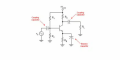
Hello all, i was trying to learn the transistor bjt properly, i was this circuit online that is called Common Emitter Transistor , and its used to amplify a signal, but i had a question: the RC in this circuit is used to define only the VC right? cus the IC depends on the ib not from the rc ( but the ic goes on the rc so here i make confusion, it shouldnt lower the current if like RC is higher) or why ic doesnt depend from rc? thanks for explaining me and for the help.
capacitor-coupling-and-decoupling-750x375.png
 

MrChips

Joined Oct 2, 2009
34,689
In general, the voltage gain is approximately Rc / RE.
For example, for a voltage gain of 10, Rc is ten times greater than RE.
Rc is the load and Ic does depend on Rc. Rc will set the maximum current when the transistor is fully conducting.

Ic does depend on IB but don’t look at it from that perspective. Do it the other way around.
For a given Ic, how much IB do you need? In other words, what is the minimum IB required in order to put the transistor in full saturation mode?
 

Thread Starter

fady.moawad

Joined Dec 24, 2024
28
In general, the voltage gain is approximately Rc / RE.
For example, for a voltage gain of 10, Rc is ten times greater than RE.
Rc is the load and Ic does depend on Rc. Rc will set the maximum current when the transistor is fully conducting.

Ic does depend on IB but don’t look at it from that perspective. Do it the other way around.
For a given Ic, how much IB do you need? In other words, what is the minimum IB required in order to put the transistor in full saturation mode?
but i dont want the transistor to work in saturation mode (where it acts like a switch) , i want it to work in amplification mode. So the perspective i see is always i got the ic ( which may be given for a certain application, like i need 200mA to drive a motor) and from that i calculate ib, right?
 

Thread Starter

fady.moawad

Joined Dec 24, 2024
28
but in that way i never set RC in fact , i know that Ic depends on it , but once i give a value to it , i need to do calculations for ib and rb part basically right?
 

LvW

Joined Jun 13, 2013
2,012
Hello all, i was trying to learn the transistor bjt properly, i was this circuit online that is called Common Emitter Transistor , and its used to amplify a signal, but i had a question: the RC in this circuit is used to define only the VC right? cus the IC depends on the ib not from the rc ( but the ic goes on the rc so here i make confusion, it shouldnt lower the current if like RC is higher) or why ic doesnt depend from rc? thanks for explaining me and for the help.
View attachment 341058
In the following, I like to explain in short the transistor function in common-emitter configuration.

* The bipolar transistor (BJT) works as a voltage-controlled current source Ic=f(Vbe), which means that the collector current Ic is determined by the base-emitter voltage Vbe via an exponential function (Shockley equation). That means: The value of Rc has no influence on the current Ic.

* For quasi-linear operation there must be a DC operational point on this exponential transfer curve.
That means: At the beginning of the desgn process we freely select a suitable current Ic (in the mA range).
This quiescent current Ic is determined only by the voltage divider at the base.
The resistors Rc and Re determine the corresponding DC voltages - with the aim to make app. Vce=Vcc/2.
It is the task of Re to stabilize this operational point aganst tolerances and temperature influences (principle of negative feedback).

* Voltage-amplification: A small signal voltage Vs causes the collector current to fluctuate around the operational point thereby causing a corresponding voltage fluctuation across the resistor Rc||RL. This defines the signal ouput voltage Vout.

* Voltage gain: Vout/Vs=-gm*(Rc||RL)
(Re has no signal effect due to the cap in parallel)
The transconductance gm=Ic/Vt is identical to the the slope d(Ic)/d(Vbe) of the exponenetial transfer characteristic Ic=f(Vbe).
For "normal" environmental conditions the "temperature voltage" Vt is app. 26mV.
 
Last edited:

MrChips

Joined Oct 2, 2009
34,689
I understand that you want to design a linear amplifier. But you still need to design IB in order for the amplifier to swing to its maximum values.

Here are the steps in designing a common emitter amplifier.

1) Select supply voltage Vcc.
2) Select output impedance and hence Rc.
3) Select voltage gain Av.
4) Calculate RE = Rc / Av.
5) Calculate saturation current Ic = Vcc / (Rc + RE).
6) Calculate IB using beta = 100, i.e. IB = Ic / 100
7) Calculate VB using VBE = 0.65 V, i.e. VB = VBE + VE
8) Calculate R1 using (Vcc - VB) / VB
9) Calculate R2 using VB = Vcc x (R2 / (R1 + R2)
10) Simulate and tweak R1 and R2
 

Thread Starter

fady.moawad

Joined Dec 24, 2024
28
In the following, I like to explain in short the transistor function in common-emitter configuration.

* The bipolar transistor (BJT) works as a voltage-controlled current source Ic=f(Vbe), which means that the collector current is determined by the base-emitter voltage Vbe via an exponenetial function (Shockley equation).

* For quasi-linear operation there must be a DC-dermined operational point on this exponenetial transfer curve. This operational point is determined by the voltage divider at the base as well as the resistors Rc and Re. It is the task of Re to stabilize this operational point aganst tolerances and temperature influences (principle of negative feedback).

* Voltage-amplification: A small signal voltage Vs causes the collector current to fluctuate around the operational point thereby causing a corresponding voltage fluctuation - this defines the signal ouput voltage Vout.

* Voltage gain: Vout/Vs=-gm*Rc
(Re has no signal effect due to the cap in parallel)
The transconductance gm=Ic/Vt is identical to the the slope d(Ic)/d(Vbe) of the exponenetial transfer characteristic Ic=f(Vbe)
hmm yes this is the explaination i found on google too but i dont get how i should size rc and re for example? and ic is given or i need to find it? ( for the RE part , it depends on the frequency, at higher frequency re basically doesnt exist.
 

Thread Starter

fady.moawad

Joined Dec 24, 2024
28
I understand that you want to design a linear amplifier. But you still need to design IB in order for the amplifier to swing to its maximum values.

Here are the steps in designing a common emitter amplifier.

1) Select supply voltage Vcc.
2) Select output impedance and hence Rc.
3) Select voltage gain Av.
4) Calculate RE = Rc / Av.
5) Calculate saturation current Ic = Vcc / (Rc + RE).
6) Calculate IB using beta = 100, i.e. IB = Ic / 100
7) Calculate VB using VBE = 0.65 V, i.e. VB = VBE + VE
8) Calculate R1 using (Vcc - VB) / VB
9) Calculate R2 using VB = Vcc x (R2 / (R1 + R2)
10) Simulate and tweak R1 and R2
okay alright , i will try to make this circuit in simulation and lets see.
 

Thread Starter

fady.moawad

Joined Dec 24, 2024
28
I understand that you want to design a linear amplifier. But you still need to design IB in order for the amplifier to swing to its maximum values.

Here are the steps in designing a common emitter amplifier.

1) Select supply voltage Vcc.
2) Select output impedance and hence Rc.
3) Select voltage gain Av.
4) Calculate RE = Rc / Av.
5) Calculate saturation current Ic = Vcc / (Rc + RE).
6) Calculate IB using beta = 100, i.e. IB = Ic / 100
7) Calculate VB using VBE = 0.65 V, i.e. VB = VBE + VE
8) Calculate R1 using (Vcc - VB) / VB
9) Calculate R2 using VB = Vcc x (R2 / (R1 + R2)
10) Simulate and tweak R1 and R2
I will use an 2N2222 Transistor , which has a hfe of 30
 

LvW

Joined Jun 13, 2013
2,012
As I have mentioned: Select Ic at first.

Example: Vcc=12V and Ic=5mA
Select: Vce=6V and Rc*Ic=5V and Re*Ic=1V which makes Rc=1k and Re=0.2k
(Rule of thumb: Re=(0.05...0.2)Rc for sufficient stabilization.)

Please, keep in mind that Re does not determine the voltage gain Av in case you have a by-pass capacitor.
(Using the rough approximation Av=-Rc/Re would give you wrong results)
 

LvW

Joined Jun 13, 2013
2,012
I understand that you want to design a linear amplifier. But you still need to design IB in order for the amplifier to swing to its maximum values.
..................
5) Calculate saturation current Ic = Vcc / (Rc + RE).
..................
Please, can you explain why you recommend to use the saturation current for the design of a linear amplifier?
 

MrChips

Joined Oct 2, 2009
34,689
You need to design for the base bias voltage,
VB = Vcc x R2 (R1 + R2)

Select a starting point for R1. You can make the bias stiff (low resistance) or more pliant (high resistance).
 

LvW

Joined Jun 13, 2013
2,012
You need to design for the base bias voltage,
VB = Vcc x R2 (R1 + R2)

Select a starting point for R1. You can make the bias stiff (low resistance) or more pliant (high resistance).
With all respect - I am not able to follow you.
Where is the relation between saturation current and the simple given voltage divider expression VB=....
 

MrChips

Joined Oct 2, 2009
34,689
With all respect - I am not able to follow you.
Where is the relation between saturation current and the simple given voltage divider expression VB=....
It is included in the value of beta chosen.
For saturation mode switching application, use beta = 10.
For a linear amplifier, use beta = 100. This will alter the value of R1 in the design.

In brief, we need an estimate for IB for which we choose IB = Ic / beta.
What is important is not IB but VB, because VB will determine symmetry, distortion and clipping on signal peaks.
 

LvW

Joined Jun 13, 2013
2,012
It is included in the value of beta chosen.
For saturation mode switching application, use beta = 10.
For a linear amplifier, use beta = 100. This will alter the value of R1 in the design.
In brief, we need an estimate for IB for which we choose IB = Ic / beta.
I must admit that I still don`t follow you.
I am involved in transistor electronics since more than 30 years - and my approach to start the design of such a simple BJT-stage is as follows:
* Select Rc, Re and Ic with respect to Vcc, Vce and gain requirements (knowing about the relation between gain and Ic resp. gm).
* Design the base voltage divider (for Vbe=0.7V) with resistors as low as possible (with respect to power requirements and input resstance).

May I kindly ask you WHY you would recommend to use the saturation current Ic=Vcc/(Rc+Re) instead of a quiescent current Ic which allows a suitable value for Vce (since you start with Vce=0) ?
 
Last edited:

MrChips

Joined Oct 2, 2009
34,689
I must admit that I still don`t follow you.
I am involved in transistor electronics since more than 30 years - and my approach to start the design of such a simple BJT-stage is as follows:
* Select Rc, Re and Ic with respect to Vcc, Vce and gain requirements (knowing about the relation between gain and Ic resp. gm).
* Design the base voltage divider (for Vbe=0.7V) with resistors as low as possible (with respect to power requirements and input resstance).

May I kindly ask you WHY you would recommend to use the saturation current Ic=Vcc/(Rc+Re) instead of a quiescent current Ic which allows a suitable value for Vce (since you start with Vce=0) ?
How much would Ic differ using Ic = (Vcc-Vce)/(Rc+Re) instead of Ic = Vcc/(Rc+Re) ?
 

LvW

Joined Jun 13, 2013
2,012
How much would Ic differ using Ic = (Vcc-Vce)/(Rc+Re) instead of Ic = Vcc/(Rc+Re) ?
The questioner explicitly asked about the function and dimensioning of a common-emitter stage for signal amplification.
And my question to you (my post #13, #15 and #17) was only why you recommended in you answer (post #6) a DC operating point with the voltage Vce=0, which does not allow any amplification (unfortunately, no answer from you so far).

To your last question: I don't have to prove my knowledge of Ohm's law here.
The value of the collector current Ic alone is completely uncritical as long as this current - together with the resistors Rc and Re - enables a reasonable operating point (which is not possible with Vce=0).
 
Last edited:
Top