Transistor Replacement on Wurlitzer Amp.

MrChips

Joined Oct 2, 2009
34,828
Hi Mr Chips
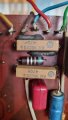
What is the effect of increasing the value of these to 100 ohm

Would there bring an advantage of fitting variable resistors in place?
Not really. I would buy a quantity of 1Ω resistors and experiment until you determine the value that works best. Then you can install a single resistor if you so desire.
 

Thread Starter

Control Dave

Joined Sep 2, 2023
34
Not really. I would buy a quantity of 1Ω resistors and experiment until you determine the value that works best. Then you can install a single resistor if you so desire.
Hi Mr Chips
Good idea. Some one has carried out other mods on the board for some reason. So once I got it back to the schematic and tested ill get back to you with the results.
Dave
 

MrChips

Joined Oct 2, 2009
34,828
The nice thing about the transformer coupled final stage is that the DC bias of the output power transistors is totally determined by just two resistors and not by a complex feedback loop which you find in modern solid state power amplifiers.
 

Alec_t

Joined Sep 17, 2013
15,121
I've corrected my sim (I'd misread the schematic previously). 2.2Ω is definitely the right value if germanium transistors are used, but would need to be increased if silicon transistors were used, otherwise crossover distortion would increase significantly.
 

Thread Starter

Control Dave

Joined Sep 2, 2023
34
The nice thing about the transformer coupled final stage is that the DC bias of the output power transistors is totally determined by just two resistors and not by a complex feedback loop which you find in modern solid state power amplifiers.
Amplifier circuits are new to me, I do Pinball repairs for a hobby, and its all relay logic that I can understand, so really want to learn about these analogue circuits.
 

Thread Starter

Control Dave

Joined Sep 2, 2023
34
I've corrected my sim (I'd misread the schematic previously). 2.2Ω is definitely the right value if germanium transistors are used, but would need to be increased if silicon transistors were used, otherwise crossover distortion would increase significantly.
Hi Alec,
Thanks for the info. Slowly learning about these type of circuits.
Dave
 

abrsvc

Joined Jun 16, 2018
163
I am a little late to this party,but...

I have 3 NOS packages of ECG121MP (Matched Pairs) if you are interested in them for somewhat exact replacements for the SP1271 transistors.

Dan
 

Thread Starter

Control Dave

Joined Sep 2, 2023
34
I am a little late to this party,but...

I have 3 NOS packages of ECG121MP (Matched Pairs) if you are interested in them for somewhat exact replacements for the SP1271 transistors.

Dan
Hi Dan,
Thanks for the response, I'm in two minds to replace the transistors with something easily available, or replacements. How much would a matched pair cost?

Dave
 

abrsvc

Joined Jun 16, 2018
163
Best I have seen online for these is around $60 plus shipping. I have 3 sets. Contact me directly for details, but $50 per pair seems fair shipped.

Dan
 

BobTPH

Joined Jun 5, 2013
11,524
If this is just an audio amp, you can replace the entire board with a modern class D amp for less than the price of a replacement transistor.

Edited to add: And get better sound out.
 

MrChips

Joined Oct 2, 2009
34,828
I think it is fair game at this point to try the MJ2955 substitution.
Hold on and I will give you a quick introduction to transistors.
 

MrChips

Joined Oct 2, 2009
34,828
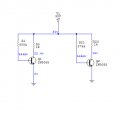
I will begin with how the base-emitter junction needs to be biased for the transistor to start conducting across the collector-emitter. I will use an NPN 2N3055 high power transistor with a +30V power supply for this simulation because this fits your current situation.

For an NPN transistor, the base-emitter junction needs a positive voltage bias. The point of conduction is very critical and conduction reaches a tipping point of around 0.55V.

2N3055 simulation.jpg

As you can see in the simulation, Q1 is only just starting to conduct, VCE = 22.4V, Ic = 7.6mA, when VBE = 0.544V
On the right transistor, Q2, VCE = 15V, Ic = 15mA when VBE = 0.564V, an increase of just 20mV or about 4%.

Hence the DC bias point is very sensitive to base-emitter voltage.
We will reduce this sensitivity by using a voltage divider at the base.

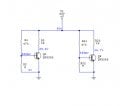
2N3055 simulation Part B.jpg
Now we have added a very "stiff" voltage divider to control the base voltage.
Rising the pull-down resistor slightly from 8Ω to 9Ω cause the transistor to go from cut-off to conduction.
But don't let the 1Ω increase fool you. This represents a 13% increase.

For a PNP transistor such as MJ2955, the circuit schematic and analysis is the same except that the supply voltage is changed. from +30V to -30V.
 

Thread Starter

Control Dave

Joined Sep 2, 2023
34
I will begin with how the base-emitter junction needs to be biased for the transistor to start conducting across the collector-emitter. I will use an NPN 2N3055 high power transistor with a +30V power supply for this simulation because this fits your current situation.

For an NPN transistor, the base-emitter junction needs a positive voltage bias. The point of conduction is very critical and conduction reaches a tipping point of around 0.55V.

View attachment 305104

As you can see in the simulation, Q1 is only just starting to conduct, VCE = 22.4V, Ic = 7.6mA, when VBE = 0.544V
On the right transistor, Q2, VCE = 15V, Ic = 15mA when VBE = 0.564V, an increase of just 20mV or about 4%.

Hence the DC bias point is very sensitive to base-emitter voltage.
We will reduce this sensitivity by using a voltage divider at the base.

View attachment 305108
Now we have added a very "stiff" voltage divider to control the base voltage.
Rising the pull-down resistor slightly from 8Ω to 9Ω cause the transistor to go from cut-off to conduction.
But don't let the 1Ω increase fool you. This represents a 13% increase.

For a PNP transistor such as MJ2955, the circuit schematic and analysis is the same except that the supply voltage is changed. from +30V to -30V.
Hi Mr Chips. Many thanks for taking the time to do that. Starting to make a bit more sense.
Regards
Dave
 
Top