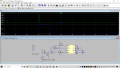
So then what's the problem you are trying to solve?
Why do you want it to trigger with a negative pulse?
Then you need a negative going pulse, not a negative polarity pulse.I want the On button to turn power on as well as provide a low pulse on the trigger pin of a 555 timer.
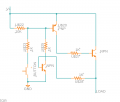
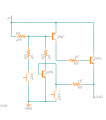
Thanks...that was the plan and why I wanted my latch to operate on a low pulse. Basically it turns on and triggers the 555 all from one button. A second button turns everything back off and there shouldn't be any current consumed in the off state besides whatever leaks across the transistor junctions. I just couldn't find an example online of a transistor latch circuit operating on a low pulse....only a high pulse.Then you need a negative going pulse, not a negative polarity pulse.
If both circuits are operating from the same supply voltage, just connect the 555 trigger pin to the top of the ON pushbutton.
I don't understand.I just couldn't find an example online of a transistor latch circuit operating on a low pulse....only a high pulse.
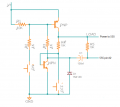
Yes that’s my circuit that I was proposing. It worked.I don't understand.
The circuit you show operates on a low pulse (push-button to ground).
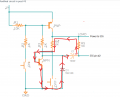
Oh this looks cool. I’ll try this out! Thanks! What does D1 do?Modified circuit in post #3
View attachment 311883
ah gotcha....I didn't think about it discharging through the 555 to gnd.No. C1 charges up through the npn, R5 and the pnp to V+. Discharges through D1, the internal resistance of the 555 and R5 when powered OFF.
| Thread starter | Similar threads | Forum | Replies | Date |
|---|---|---|---|---|
|
|
Ib current for transistor saturation | Analog & Mixed-Signal Design | 26 | |
| R | Transistor sanity check for simple buzzer | General Electronics Chat | 68 | |
| I | Transistor Latch (Flip/Flop) High Efficiency | Digital Design | 0 | |
| J | Transistor Latch Circuit | Analog & Mixed-Signal Design | 17 | |
|
|
Small Transistor SR Latch Kit | Marketplace | 0 |