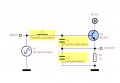
transistor internal parasitic elements

Thread Starter

electronicsenjoyer089

Joined Feb 24, 2025
182
Hello, i had a question, as we know in a npn and pnp transistor there is an internal LC parasitic elements, which basically formes a LC resonant circuit ( in that way the circuit has a better frequency response to certain bandwith, i read that to change this frequency response, and u can obtain a wider frequency response by lowering the quality factor, and u can do that by introducing a resistor in parallel , which is basically adding a resistor to the transistor base.

Lower the resistor, lower is the quality factor, so better is the response to more frequencies.

But now, my question is: if u lower the resistor base u get a higher base current, and u may break the transistor?, then how u balance both things? having a low quality factor ( lets suppose in ur application u want to do that ) and having a lower current going into base?

Thanks all.
 

Attachments

MrAl

Joined Jun 17, 2014
13,667
Hello, i had a question, as we know in a npn and pnp transistor there is an internal LC parasitic elements, which basically formes a LC resonant circuit ( in that way the circuit has a better frequency response to certain bandwith, i read that to change this frequency response, and u can obtain a wider frequency response by lowering the quality factor, and u can do that by introducing a resistor in parallel , which is basically adding a resistor to the transistor base.

Lower the resistor, lower is the quality factor, so better is the response to more frequencies.

But now, my question is: if u lower the resistor base u get a higher base current, and u may break the transistor?, then how u balance both things? having a low quality factor ( lets suppose in ur application u want to do that ) and having a lower current going into base?

Thanks all.
Hi,

You only get a higher base current if you allow that to happen, it is not dependent on the base resistor unless you do not have control over the input voltage. If however you need a certain voltage, then yes the current will increase.

You said parallel but maybe you meant series, because a resistor parallel to the base emitter junction will not cause the transistor to get more current into the base, but there will be more drive current required.

To get a transistor to switch fast it is very common to see a negative signal applied to the base (NPN that is). This would be negative with respect to the emitter. It is also common to see the use of a Baker Clamp or similar to see that the transistor does not get 'stuck' in saturation. This depends highly on your application.
 

Thread Starter

electronicsenjoyer089

Joined Feb 24, 2025
182
Hi,

You only get a higher base current if you allow that to happen, it is not dependent on the base resistor unless you do not have control over the input voltage. If however you need a certain voltage, then yes the current will increase.

You said parallel but maybe you meant series, because a resistor parallel to the base emitter junction will not cause the transistor to get more current into the base, but there will be more drive current required.

To get a transistor to switch fast it is very common to see a negative signal applied to the base (NPN that is). This would be negative with respect to the emitter. It is also common to see the use of a Baker Clamp or similar to see that the transistor does not get 'stuck' in saturation. This depends highly on your application.
adding resistor to base isnt like adding a resistor in parallel to LC?
 

MrAl

Joined Jun 17, 2014
13,667
adding resistor to base isnt like adding a resistor in parallel to LC?
It depends if wire it up in series or in parallel.

In series, the resistor goes in series with the input and the base.
In parallel, the resistor goes from the base to the emitter.
The two are very different and have different effects.
 
Top