Transistor Base voltage and Current

Thread Starter

pinkyponky

Joined Nov 28, 2019
373
Since the maximum voltage required for the segments is 4.7V, how do you expect to reliably light them with only a 4V supply?
The minimum supply should be at least 6V for the LEDs.
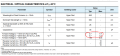
No, as per the datasheet the typical voltage is 3.7V and maximum voltage is 4.7V. So, I'm chosen the voltage value between those values as 4V. See the voltage rantings marked below in red. I think the LED will light-up effectively with 4V. Am I correct?.

1693211343300.png
 
Last edited:

Audioguru again

Joined Oct 21, 2019
6,826
The specs for LEDs are at an ambient of 25 degrees C. and some with a current of only 10mA. The forward voltage changes when the ambient temperature changes and when the current changes.
Many of the LEDs will be 3.7V, a few will be 4.0V and a few will be 4.7V. If you want the LEDs to work if they are 4.0V at 10mA and when the ambient temperature is higher or lower than 25 degrees C then buy hundreds of them, test them all and pick the few that work. Edited for a typical voltage of 3.7V.

The LED driver circuit needs additional voltage to work so power it with a minimum of 6.0V or 7.0V.
 
Last edited:

AnalogKid

Joined Aug 1, 2013
12,142
No, as per the datasheet the typical voltage is 3.7V and maximum voltage is 4.7V. So, I'm chosen the voltage value between those values as 4V. See the voltage rantings marked below in red. I think the LED will light-up effectively with 4V. Am I correct?.
No.

You don't get to choose the forward voltage of an LED. It is a physical property that you have to deal with. The datasheet is saying that if you want to push 10 or 20 mA through a short or long segment, you *must* put a voltage across the segment of at least anywhere from 3.7 to 4.7 V, depending on the efficacy of your particular unit. If you put 4 V across a unit that demands 4.7 V to wake up, there will be no light.

The numbers in the datasheet are the minimum and maximum *required* voltage for operation. The fact that there is such a large range is one of the reasons the preferred way to drive an LED is with a constant current source rather than a constant voltage source. More complicated, more expensive, but more consistent.

ak
 
Last edited:

crutschow

Joined Mar 14, 2008
38,525
No, as per the datasheet the typical voltage is 3.7V and maximum voltage is 4.7V. So, I'm chosen the voltage value between those values as 4V. See the voltage rantings marked below in red. I think the LED will light-up effectively with 4V. Am I correct?.
Again no, as the others have explained.
You need to seriously work on your understanding of data sheet MIN and MAX values and ABSOLUTE MAXIMUM, RATINGS, as you are constantly interpreting them incorrectly.
 

Janis59

Joined Aug 21, 2017
1,894
WBahn and other: Why so artifically high science for simple homework? The proletariat leader stalin (or lenin or whoever) said, be more simple and nation will approach You! So, the first prerequisite: the U(BE) ALWAYS will be 0.7 V except the superbeta (Darlington) transistor where double and Germanium (where 0.3), probably GaAs and other superspecs where higher. Anyway, if there is 0.7 then i(R1)=0.7/R1=0.7/10K=0.07 mA. Therefore i(R2)=(U(in)-0.7)/R2=9.3/10K=0.93 mA. From what in the BE will flow 0.93-0.07=0.923 mA. What will be amplified beta minus one fold. If transistor have beta=100, then i(C)=99*0.923 mA=about 100 mA. Voila! Calculated! Homework may be given to Your teacher if so was the question.
However, knowing the sour practice, any transistor needs at least 2....3 fold larger oversaturation, thus the base current must be willfully enlarged accordingly.
 

AnalogKid

Joined Aug 1, 2013
12,142
the first prerequisite: the U(BE) ALWAYS will be 0.7 V
Ummm ... no.

For a typical small signal transistor, collector current conduction begins when Vbe is approx. 0.5 V. Vbe increases to 0.6 V or 0.8 V as the base current increases. For the plain old 2N2222, some manufacturers specify the base-emitter voltage up to 1.5 V under specific conditions.

For a typical power transistor, conduction begins when Vbe is around 0.6 V, and a typical value for normal operation is around 0.8 V to 1.0 V. For the plain old 2N3055, Motorola specifies Vbe up to 1.5 V.

ak
 

Johnfoxwell

Joined May 23, 2021
18
Hello All!

1) How much base voltage and current needs to be applied to draw maximum collector current of 500mA using 'PDTD114EU'?.

2) The half of the voltage will be present after R1 resistor. Right?. If I applied 5V before R1, then after R1 resistor the voltage will be 2.5V, which will applied to the base of the transistor, Right?.

View attachment 301100

The datasheet is attached below.
https://assets.nexperia.com/documents/data-sheet/PDTD1XXXU_SER.pdf
The way to solve this problem is to convert the two resistors and the input voltage to an equivalent Thevenin circuit.
The circuit is a voltage
Vth = Vin x R2 / (R1 +R2)
Equivalent series resistor =
Rth = R1 x R2 / (R1 + R2)

The base current is simply=
(Vth -Vbe) / Rth
 

Thread Starter

pinkyponky

Joined Nov 28, 2019
373
No.

You don't get to choose the forward voltage of an LED. It is a physical property that you have to deal with. The datasheet is saying that if you want to push 10 or 20 mA through a short or long segment, you *must* put a voltage across the segment of at least anywhere from 3.7 to 4.7 V, depending on the efficacy of your particular unit. If you put 4 V across a unit that demands 4.7 V to wake up, there will be no light.

The numbers in the datasheet are the minimum and maximum *required* voltage for operation. The fact that there is such a large range is one of the reasons the preferred way to drive an LED is with a constant current source rather than a constant voltage source. More complicated, more expensive, but more consistent.

ak
Ok!

Could you tell me what is the maximum voltage can I applied and the device can with stand, if there is no light at 4V. Then, If I go with 4.7V then I can feel that the value of 4.7V is maximum voltage rated and it may damage the device when you operate the device at maximum ratings. What did you say?.
 

Audioguru again

Joined Oct 21, 2019
6,826
You must never feed a voltage to an LED. If you feed 4.7V to a 3.7V LED then it quickly burns out.
Some of those LEDs are 3.7V at 25 degrees C and at the rated current, some of the LEDs are 4.0V and some of the LEDs are 4.7V.
The LED voltage changes with temperature and with current.

Instead you feed a limited current to it. Then the LED operates at its forward voltage at that current.

6V supply, 3.7V LED and 20mA. Then the current limiting resistor has 6V - 3.7V= 2.3V across it and is 2.3V/20mA= 115 ohms.
If the LED is 4.0V and the resistor is 115 ohms then the current becomes 2V/115 ohms= 17.4mA.
If the LED is 4.7V and the resistor is 115 ohms then the current becomes 1.3V/115 ohms= 11.3mA.

Use a 12V supply then for a current of 17.4mA in a 4.0V LED, the resistor has 12V - 4V= 8V across it and is 8V/17.4mA= 460 ohms.

If the supply is 12V and you want a current of 20mA in a 3.7V LED then the resistor has 12V - 3.7V= 8.3V across it and is 8.3V/20mA= 415 ohms.
 

ericgibbs

Joined Jan 29, 2010
21,445
Hi @pinkyponky

It is obvious that you are deliberately pretending not to understand the guidance being given to you by your fellow members.
As you are registered as an Electrical Engineer and not as a Student, you must at least been taught Ohms Law.

Moderation
 

Thread Starter

pinkyponky

Joined Nov 28, 2019
373
You must never feed a voltage to an LED. If you feed 4.7V to a 3.7V LED then it quickly burns out.
Some of those LEDs are 3.7V at 25 degrees C and at the rated current, some of the LEDs are 4.0V and some of the LEDs are 4.7V.
The LED voltage changes with temperature and with current.

Instead you feed a limited current to it. Then the LED operates at its forward voltage at that current.

6V supply, 3.7V LED and 20mA. Then the current limiting resistor has 6V - 3.7V= 2.3V across it and is 2.3V/20mA= 115 ohms.
If the LED is 4.0V and the resistor is 115 ohms then the current becomes 2V/115 ohms= 17.4mA.
If the LED is 4.7V and the resistor is 115 ohms then the current becomes 1.3V/115 ohms= 11.3mA.

Use a 12V supply then for a current of 17.4mA in a 4.0V LED, the resistor has 12V - 4V= 8V across it and is 8V/17.4mA= 460 ohms.

If the supply is 12V and you want a current of 20mA in a 3.7V LED then the resistor has 12V - 3.7V= 8.3V across it and is 8.3V/20mA= 415 ohms.
Hi Again!

Those forward voltages are between 3.7V and 4.7V are the voltage drop across the LED segments, like diode forward voltage as 0.6V/0.7V. These Vf are 3.7V to 4.7V voltages are required to turn ON the LED segments. Right?.

That's why you're substituting the => Supply Voltage - Forward Voltage = Actual Voltage across the LED segments (This voltage is required to turn ON LED segments). Right?.

Please correct me If I'm still wrong. I hope what I understand is correct.

Thank you for your support and reply.
 
Last edited:

BobTPH

Joined Jun 5, 2013
11,523
@pinkyponky: I
Hi @pinkyponky

It is obvious that you are deliberately pretending not to understand the guidance being given to you by your fellow members.
As you are registered as an Electrical Engineer and not as a Student, you must at least been taught Ohms Law.

Moderation
We have been through this before with @pinkyponky. I honestly don’t know if he is trolling us or if he really just cannot grasp the simplest concepts of electronics.
 

Thread Starter

pinkyponky

Joined Nov 28, 2019
373
@pinkyponky: I

We have been through this before with @pinkyponky. I honestly don’t know if he is trolling us or if he really just cannot grasp the simplest concepts of electronics.
Hello Bob!

I'm not a person who waste other people time. Please do not misunderstand me. But, I would like to share one thing here that, most of the times I have asked simple and straight question. But, I have not get the straight answer from you guys. Please do not think that I'm blaming you guys. This is one of the reason why too many post on my questions.

While reading the datasheet for supply voltage, I was misunderstand between the forward voltage and supply voltage. I know what is meaning of them.

After reading the Audioguru again reply at post 49, I realized that, I was misunderstand between the forward voltage and supply voltage.

Please do not misunderstand me. I never waste your time and troll you guys. Please trust me and support me.

Thank you!
 

Janis59

Joined Aug 21, 2017
1,894
The way to solve this problem is to convert the two resistors and the input voltage to an equivalent Thevenin circuit.
Yeppp, I always had wonder WHY in schools the boys are taught the sequential changes method, the Kirchoff laws method, but with a no even the word are said about Thevenin and Norton. For them one must wait to engineering classes at University. Strange and illogical thing is that educational pedagogy.
 

Thread Starter

pinkyponky

Joined Nov 28, 2019
373
Hi Again!

Those forward voltages are between 3.7V and 4.7V are the voltage drop across the LED segments, like diode forward voltage as 0.6V/0.7V. These Vf are 3.7V to 4.7V voltages are required to turn ON the LED segments. Right?.

That's why you're substituting the => Supply Voltage - Forward Voltage = Actual Voltage across the LED segments (This voltage is required to turn ON LED segments). Right?.

Please correct me If I'm still wrong. I hope what I understand is correct.

Thank you for your support and reply.
Hi Audioguru again!

Could you please respond to this post?.

Thank you!
 
Top